“Many people – though not all – have been able to secure freedom from torture, unjustified imprisonment, summary execution, enforced disappearance, persecution and unjust discrimination, as well as fair access to education, economic opportunities, and adequate resources and health-care. They have obtained justice for wrongs, and national and international protection for their rights, through the strong architecture of the international human rights legal system.” – Introduction to the Universal Declaration of Human Rights, p.vi
See also: The Universal Declaration of Human Rights turns 70 | Human Rights Commission (posts) | National Human Rights Commission: www.nhrc.nic.in (Government of India) >>
“Where, after all, do universal human rights begin? In small places, close to home — so close and so small that they cannot be seen on any maps of the world. […] Unless these rights have meaning there, they have little meaning anywhere. Without concerted citizen action to uphold them close to home, we shall look in vain for progress in the larger world.” — Eleanor Roosevelt
Learn more | UN Human-rights Day >>
“Human beings are as good a creator as a destroyer. According to scientific studies, this planet has entered the phase of sixth extinction where man-made destruction, if not stopped, will be the undoing of not only the human race but also the other lives on the earth. In this context, I would urge you not to treat the issue of human rights in isolation and pay equal attention to nursing Mother Nature which is deeply wounded by the indiscretions of human beings. In India, we believe that every particle of the universe is a manifestation of divinity. Let us rekindle our love for nature to conserve and enrich it before it is too late.” – Droupadi Murmu | Speeches by the 15th President of India (20 September 2023) >>
Source: ADDRESS BY THE HON’BLE PRESIDENT OF INDIA, SMT DROUPADI MURMU ON THE OCCASION OF INAUGURATION OF 28TH ANNUAL GENERAL MEETING AND BIENNIAL CONFERENCE OF ASIA PACIFIC FORUM OF NATIONAL HUMAN RIGHTS INSTITUTIONS
URL: https://www.presidentofindia.gov.in/speeches/address-honble-president-india-smt-droupadi-murmu-occasion-inauguration-28th-annual
Date Visited:24 September 2023
“The issue is not whether the world’s economy is governable toward ambitious goals like promoting social justice, equality between countries and greater democratic control for the bulk of the world’s people, but whether it is governable at all.” – Mogobe B. Ramose quoting Globalization in question by Hirst, P. and Thompson, G in “Globalization and ubuntu” (The African Philosophy Reader), pp. 732 | Globalization >>
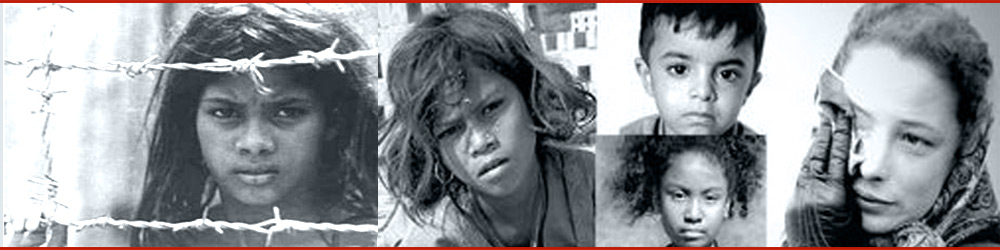
Human trafficking | Violence against women
Slavery | Zamindari
Human trafficking is a crime. To report in India, contact
Shakti Vahini https://shaktivahini.org/contact-us >> shaktivahini@gmail.com
+91-9899710847 +91-9582909025
and/or Childline 1098 (national helpline)
National Programme for Child Labour Free India | PDF-Repository (70 KB)
“Child marriage is not just an age-old social evil, but also a heinous crime that robs children of their childhood. Child marriage is a “crime against children” that violates basic human rights, minor girls are forced to marry and live a life of mental trauma, physical and biological stress, domestic violence including limited access to education and increased vulnerability to domestic violence. […] early pregnancies leading to complications and higher rate of maternal mortality and death of infants, malnutrition.” – Shakti Vahini’s campaign for a Child Marriage Free India >>
“As per a study on human trafficking, the state of Jharkhand has emerged as India’s trafficking hub with thousands of tribal women and girls being trafficked out of the state each year to Delhi, Punjab, Haryana and beyond [while] human traffickers are also involved in many cases of missing children.” – The Wire | Shakti Vahini | Tourism locations | Adivasi tribal bondage slavery trafficking (Safe search) >>
“Childline 1098 is a 24×7 emergency, free phone outreach for children in distress. It is one of the world’s biggest emergency helpline services dedicated to children, and is considered to be among the country’s largest emergency response systems” – The Hindu, 17 April 2022 >>
Universal Declaration of Human Rights & Human Rights Day >>
The National Human Right Commission (NHRC) describes “crimes like rape, molestation, torture, fake encounter in police custody as manifestations of a systemic failure to protect human rights”;
It reports that “rights of the people were violated or negligence was shown by a public servant in the prevention of such violations”; NHRC concludes:
“Atrocities against vulnerable sections of society – women, children, disabled and the elderly – are often compounded when they belong to the Scheduled Castes and Scheduled Tribes”; and therefore demands:
India must ratify the International Convention against Torture.
Download | Backup (PDF, 500 KB) >>
“A call to action, resilience, and collective defence of democracy, truth, and academic freedom”
The Anti-Autocracy Handbook is a call to action, resilience, and collective defence of democracy, truth, and academic freedom in the face of mounting authoritarianism. […]
Because open inquiry and dissent are central to science and academia—qualities antithetical to authoritarian control—academia is often among the first targets of autocrats. To help scholars resist authoritarian developments, the handbook highlights both historic and contemporary measures aimed at attacking scholars, their institutional environments, and their scholarship.
The handbook also sets out a framework for action based on personal risk level—low, medium, high, or extreme. This is designed to help scholars think about their own risk and purposefully choose actions in line with it. The handbook considers tools for enhancing digital safety and highlights the importance of ongoing documentation, preserving imperilled data, and creating distributed archives as a defence against erasure. It also calls on scholars to tell their stories—publicly or anonymously—to inspire others, maintain accountability and preserve a historical record.
Accompanying the handbook is a living wiki that will continue to incorporate new developments and provide updates on global efforts by scholars to push back against authoritarianism and safeguard the democratic foundations that enable free inquiry.
Source: “The Anti-Autocracy Handbook: A Scholars’ Guide to Navigating Democratic Backsliding” by
URL: https://zenodo.org/records/15696097
Date Visited: 20 April 2026
Albert Camus on service of truth and the service of liberty – Nobelprize.org
Excerpt from Albert Camus’ speech at the Nobel Banquet at the City Hall in Stockholm, December 10, 1957 | Read the full speech: https://www.nobelprize.org/prizes/literature/1957/camus/speech/ >>
By the same token, the writer’s role is not free from difficult duties. By definition he cannot put himself today in the service of those who make history; he is at the service of those who suffer it. Otherwise, he will be alone and deprived of his art. Not all the armies of tyranny with their millions of men will free him from his isolation, even and particularly if he falls into step with them. But the silence of an unknown prisoner, abandoned to humiliations at the other end of the world, is enough to draw the writer out of his exile, at least whenever, in the midst of the privileges of freedom, he manages not to forget that silence, and to transmit it in order to make it resound by means of his art.
None of us is great enough for such a task. But in all circumstances of life, in obscurity or temporary fame, cast in the irons of tyranny or for a time free to express himself, the writer can win the heart of a living community that will justify him, on the one condition that he will accept to the limit of his abilities the two tasks that constitute the greatness of his craft: the service of truth and the service of liberty. Because his task is to unite the greatest possible number of people, his art must not compromise with lies and servitude which, wherever they rule, breed solitude. Whatever our personal weaknesses may be, the nobility of our craft will always be rooted in two commitments, difficult to maintain: the refusal to lie about what one knows and the resistance to oppression.
Basics
Tribal Cultural Heritage in India in the 21st century (printfriendly PDF)
Forest dwellers in early India – myths and ecology in historical perspective
Education
Background guide for education (free eBook)
Childhood | Child marriage | Children’s right to Education
! Contact: National helpline Childline & report trafficking
Customs | Marriage customs | Social conventions
Free comic books (Unicef)
Survival Int. on tribal education
Video | “Nations don’t make us human – languages make us human”: Ganesh Devy
Health, environment & nature
Biological Diversity: What is the Biodiversity Act?
Forest dwellers in early India – myths and ecology
Issues
Assimilationist & isolationist positions
“Casteism” and its effect on tribal communities
Denotified Tribe vs. “criminal tribe“
Fighting exploitation and women’s stigmatization
Particularly Vulnerable Tribal Groups & Endangered languages (interactive map)
President of India
National development and the development of tribal communities are linked
Government of India, national & international organizations
Endangered languages: Peoples’ Linguistic Survey of India
Govt. of India, NGOs, Indian universities and international organisations
Govt. What are the Rights of Scheduled Tribes (ST)
Human Rights Commission (posts) | www.nhrc.nic.in (Government of India)
India’s Constitutional obligation to respect their cultural traditions
India’s 28 States and 8 Union Territories
National Commission for Scheduled Tribes | Related posts
Particularly Vulnerable Tribal Groups (PVTG)
People’s Linguistic Survey of India | Volumes (PLSI) | PeoplesLinguisticSurvey.org
Universal Declaration of Human Rights & International Convention against Torture
Women | Safe search | President Droupadi Murmu on women’s empowerment
Legal provisions
Child rights & Right to education handbook
Constitution and Supreme Court
Denotified, nomadic and semi-nomadic (“hidden”) tribes: Classifications in different states
Forest Rights Act (FRA) | Legal rights | What is the Forest Rights Act about?
India’s Constitutional obligation to respect their cultural traditions
Right to Information Act (RTI)
Scheduled Tribes (ST) | Who are Scheduled Tribes?
Who is a forest dweller under this law, and who gets rights?
Resources
Adivasis’ struggle for India’s freedom and Independence
Anthropology & Anthropological Survey of India
The Anti-Autocracy Handbook: A Scholars’ Guide to Navigating Democratic Backsliding | Backup (PDF, 500 KB)
Books on tribal culture and related resources
Fact checking | Factchecker.in | Safe search examples with keywords:
“factchecker.in rural india“| “factchecker.in adivasi tribe“
Figures, census and other statistics | Primitive Tribes in Andaman and Nicobar Islands (Census 2011)
Indian magazines and web portals – news coverage and analysis
Indigenous knowledge: biodiversity, ecology, health, nutrition, nature, wildlife
Languages and linguistic heritage
Nehru’s 5 Principles: Panchsheel
News update in Indian periodicals: Tribal Affairs
People’s Linguistic Survey of India | Volumes (PLSI) | PeoplesLinguisticSurvey.org