By Jan Breman
Emeritus professor Faculty of Social and Behavioural Sciences (University of Amsterdam)The moral standard of state and society can be deduced from the way people are treated who are not productive anymore and have no assets of their own. Missing the means for self-providence includes all those among the labouring poor who are disabled either because of old age, defective health or other handicaps that prevent them for working for their livelihood. With the introduction of the Informal Workers’ Security Act the Government of India seemed to acknowledge that people without means of livelihood were entitled to state provisions if they had lost their labour power to gain an income. However, the act passed by the end of 2008 was not the beginning of a right-based approach to solve the problem of improvidence. It merely enabled states to incorporate various schemes and programmes which were already in place in different parts of the country for vulnerable categories in a nation-wide framework and back them up with central funding.
What were the arrangements made in the past for providing sustenance to the labouring poor when they lost the capability to work? My presentation will focus on West India where I have carried out fieldwork in both rural and urban localities during the past half century. From the pre-colonial era onwards members of the tribal Halpati caste in south Gujarat used to be attached as farm servants to the main landowners of higher castes. Engaged in a condition of bondage they had a right to livelihood and received social benefits in exchange for serving their patrons dutifully and loyally in a relationship of life time duration which was passed on from generation to generation. In addition to their daily wages paid in kind, the labouring poor were entitled to their basic needs in the slack season or when they were not fit to work due to illness or old age. The terms of engagement extended to provisions which enabled the halis to take care of life cycle events and other social obligations. Thus, patronage and exploitation were the opposite ends of an arrangement which allowed for the cost of social reproduction at the bottom of the agrarian economy and facilitated a culture of domination imposed by the high-caste landowners in the peasant society that was India. Labour bondage, of course, also implied that people without access to land had to relinquish their freedom and to accept subordination in order to be secured of their livelihood. Once agricultural production became more capitalist in nature, and not labour but land became a scarce commodity, a process of depatronization started which left the former clients in a condition of isolation. The landowners did not feel obliged any longer to guarantee the livelihood of their subordinates. The government turned out to be reluctant to take over the functions of patronage, especially the provision of protection and security. The landless class was excluded from the land reform operation that was carried out shortly after independence and had no other option but to continue working for wages that were barely enough to survive. Thus, at the start of my village-based fieldwork in the early 1960s, I found the rural proletariat of south Gujarat in a state of pauperization.
In the long transition to a monetized and more diversified economy structured along capitalist lines of production the small contingent of the workforce which found access to the slowly emerging formal sector of employment in the urban economy qualified for benefits meant to improve the plight of the working class. Mahatma Gandhi, as the founding father of the Textile Labour Association in Ahmedabad which emerged as the leading trade union in colonial India, insisted that the worker’s pay should be enough for the basic needs of his family. Gandhi’s demand for a fair wage included social care provisions such as retirement benefits, health insurance as well as a dearness allowance to compensate for the rising cost of living. The benefits gained in the first decades after Independence were the outcome of legislation introduced to strengthen the bargaining power of labour, in particular of the small segment which got organized. […]
The garib kaliyan mela have the character of poor out-relief which is haphazardly distributed or denied. What have been announced as statutory rights are downgraded as favours and doles in practice. My conclusion is that the social welfare package as handled by the government of Gujarat is no substitute for the shortfall in income and work and hardly makes a dent in the misery of the most vulnerable. How to improve the fate of a massive army of reserve labour which is structurally redundant in a thoroughly liberalized market economy and beyond the protection of a government which condones rather than resists a social hierarchy based on an ingrained ideology of inequality? Fair enough, what is going on in Gujarat cannot be generalized for India as a whole. For the reasons stated, dynamics which are more hopeful can be detected elsewhere. While conceding that the poverty of the down and out seems to be addressed with more success in some other parts of the vast South Asian subcontinent, mainly in the southernmost states, I also have to point out that Gujarat is not a unique case of growing prosperity at the top and ongoing misery at the bottom. To suggest that she social question in India is held in a state of abeyance is an understatement. In my perception the economic and political trend is still marked more by a morale of exclusion than of inclusion.
Source: “Caring for destitution or not?”: T.G. Narayanan Memorial Lecture on Social Deprivation by Jan Breman, The Hindu, January 19, 2013
Address : https://www.thehindu.com/news/resources/caring-for-destitution-or-not/article4323348.ece
Date Visited: 13 December 2021
Backup file: Read the entire lecture by Jan Breman here (PDF, 100 KB)
Publication by Jan Bremen
Labour Bondage in West India: From Past to Present
280 pages; ISBN13: 978-0-19-568521-3ISBN10: 0-19-568521-0Search Worldcat.org for publications by reputed authors (select “Open Content/Open Access” for freely downloadable content)
Search tips
Combine the name of any particular state, language or region with that of any tribal (Adivasi) community.
Ask a question that includes “tribal” or “Adivasi”, for instance: “Adivasi way of life better?” (or “tribal way of life worse?”)
Add keywords of special interest (music, poetry, dance just as health, sacred grove and biodiversity); learn about the rights of Scheduled Tribes such as the “Forest Rights Act” (FRA); and the United Nations “Declaration on the Rights of Indigenous Peoples”, “Universal Declaration of Human Rights”, “women’s rights”, or “children’s right to education”.
Specify any particular issue or news item (biodiversity, bonded labour and human trafficking, climate change, ecology, economic development, ethnobotany, ethnomedicine, global warming, hunter-gatherers in a particular region or state, prevention of rural poverty, water access).
About the Author
Utilizing his fieldwork done in south Gujarat between 2004 and 2006, Jan Breman critically analyses the historical roots of the ongoing subordination of the rural poor in what has come to be recognized as a booming economy.
Jan Breman, Professor of Comparative Sociology, Amsterdam School of Social Science Research, University of Amsterdam (Emeritus)
Source: Oxford University Press: Labour Bondage in West India: Jan Breman
Address : http://www.oup.com/us/catalog/general/subject/Sociology/Economic/?view=usa&ci=9780195685213
Date Visited: 29 January 2013
[…] Jan Breman, having studied cultural anthropology and non western sociology was highly critical about mainstream development economics and about policy planning, development programming and shaping society in general. […]
Jan Breman never resorts to a superficial critique of global capitalism, but presents a well documented analysis of its devastating effects. The high quality of his studies, his persistent analyses, and the example that he has given as a consistent and dedicated field researcher, determined to render the voice of those who, in the view of others, hardly count on the social and economic scale, have made Jan Breman a unique scholar.
Source: Laudatio delivered on the occasion of the award to Dr. Jan Breman of the degree Doctor Honoris Causa on the 57th Anniversary of the International Institute of Social Studies, The Hague, 29 October 2009. Promotor: Dr. Jan Pronk
Address : http://www.janpronk.nl/speeches/english/laudatio-dr-jan-breman.html
Date Visited: 13 December 2021
[Bold typeface added above for emphasis]
For how long will I have to
Bear the pain of development
Or is it that I will be done to death
Before attaining development?
Ram Dayal Munda in “The Pain of Development” (Vikas Ka Dard) courtesy Dr. Ivy Hansdak >>
Context | Health care for communities identified as “poorest of poor” (PVTGs)
India is designated as the melting pot of so many ethnic groups dwelling at the same time under the common umbrella of a unified nation. Among these varied ethnic groups, some of them have been categorized under article 342 (1) of the constitution and have been labelled as Scheduled Tribe. In the post independent scenario, several schemes for upliftment of STs were run by the government but it was found that all these groups did not come up to the same level of development. Some of them were at much lower strata than others. Thus, in order to ensure the development of these communities, they were, for the first time in 1975-76 (during 5th Five-year plan) and thereafter-in 1993, identified as poorest of poor among the STs and were designated as Primitive Tribal Groups and thereafter constitution of India renamed and declared as Particularly Vulnerable Tribal Groups (PVTGs). Out of the 75 particularly vulnerable tribal groups, 13 are residing in Odisha; they are becoming increasing vulnerable due to loss of their customary habitat. The health troubles of rural areas especially in the tribal areas need a unique concentration, because the tribal people have typical health problem.
Source: 2019 PhD thesis (Abstract) by Jayanta Kumar Nayak titled “Health Seeking Behaviour and Health Care Services among the Hill Kharia Mayurbhanj District Odisha”, Department of Anthropology, Central University of Orissa
URL: http://hdl.handle.net/10603/257651
Date Visited: 21 May 2025
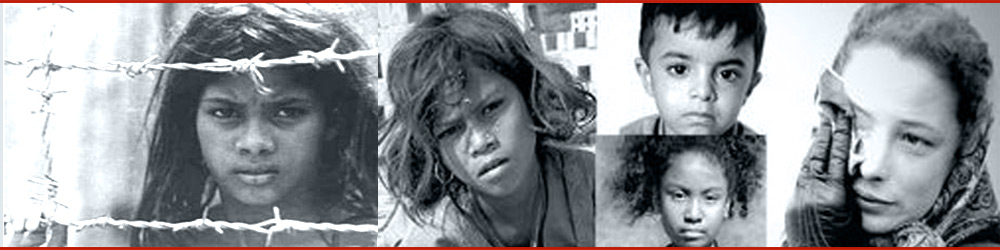
Human trafficking | Violence against women
Slavery | Zamindari
Human trafficking is a crime. To report in India, contact
Shakti Vahini https://shaktivahini.org/contact-us >> shaktivahini@gmail.com
+91-9899710847 +91-9582909025
and/or Childline 1098 (national helpline)
National Programme for Child Labour Free India | PDF-Repository (70 KB)
“Child marriage is not just an age-old social evil, but also a heinous crime that robs children of their childhood. Child marriage is a “crime against children” that violates basic human rights, minor girls are forced to marry and live a life of mental trauma, physical and biological stress, domestic violence including limited access to education and increased vulnerability to domestic violence. […] early pregnancies leading to complications and higher rate of maternal mortality and death of infants, malnutrition.” – Shakti Vahini’s campaign for a Child Marriage Free India >>
“As per a study on human trafficking, the state of Jharkhand has emerged as India’s trafficking hub with thousands of tribal women and girls being trafficked out of the state each year to Delhi, Punjab, Haryana and beyond [while] human traffickers are also involved in many cases of missing children.” – The Wire | Shakti Vahini | Tourism locations | Adivasi tribal bondage slavery trafficking (Safe search) >>
“It was assumed that tribal people have same health problems, similar needs and hence the uniform national pattern of rural health care would be applicable to them as well, albeit with some alteration in population: provider ratio. The different terrain and environment in which they live, different social systems, different culture and hence different health care needs were not addressed.” – Abhay Bang in Report of the Expert Committee on Tribal Health >>
Basics
Tribal Cultural Heritage in India in the 21st century (printfriendly PDF)
Forest dwellers in early India – myths and ecology in historical perspective
Education
Background guide for education (free eBook)
Childhood | Child marriage | Children’s right to Education
! Contact: National helpline Childline & report trafficking
Customs | Marriage customs | Social conventions
Free comic books (Unicef)
Survival Int. on tribal education
Video | “Nations don’t make us human – languages make us human”: Ganesh Devy
Health, environment & nature
Biological Diversity: What is the Biodiversity Act?
Forest dwellers in early India – myths and ecology
Issues
Assimilationist & isolationist positions
“Casteism” and its effect on tribal communities
Denotified Tribe vs. “criminal tribe“
Fighting exploitation and women’s stigmatization
Particularly Vulnerable Tribal Groups & Endangered languages (interactive map)
President of India
National development and the development of tribal communities are linked
Government of India, national & international organizations
Endangered languages: Peoples’ Linguistic Survey of India
Govt. of India, NGOs, Indian universities and international organisations
Govt. What are the Rights of Scheduled Tribes (ST)
Human Rights Commission (posts) | www.nhrc.nic.in (Government of India)
India’s Constitutional obligation to respect their cultural traditions
India’s 28 States and 8 Union Territories
National Commission for Scheduled Tribes | Related posts
Particularly Vulnerable Tribal Groups (PVTG)
People’s Linguistic Survey of India | Volumes (PLSI) | PeoplesLinguisticSurvey.org
Universal Declaration of Human Rights & International Convention against Torture
Women | Safe search | President Droupadi Murmu on women’s empowerment
Legal provisions
Child rights & Right to education handbook
Constitution and Supreme Court
Denotified, nomadic and semi-nomadic (“hidden”) tribes: Classifications in different states
Forest Rights Act (FRA) | Legal rights | What is the Forest Rights Act about?
India’s Constitutional obligation to respect their cultural traditions
Right to Information Act (RTI)
Scheduled Tribes (ST) | Who are Scheduled Tribes?
Who is a forest dweller under this law, and who gets rights?
Resources
Adivasis’ struggle for India’s freedom and Independence
Anthropology & Anthropological Survey of India
The Anti-Autocracy Handbook: A Scholars’ Guide to Navigating Democratic Backsliding | Backup (PDF, 500 KB)
Books on tribal culture and related resources
Fact checking | Factchecker.in | Safe search examples with keywords:
“factchecker.in rural india“| “factchecker.in adivasi tribe“
Figures, census and other statistics | Primitive Tribes in Andaman and Nicobar Islands (Census 2011)
Indian magazines and web portals – news coverage and analysis
Indigenous knowledge: biodiversity, ecology, health, nutrition, nature, wildlife
Languages and linguistic heritage
Nehru’s 5 Principles: Panchsheel
News update in Indian periodicals: Tribal Affairs
People’s Linguistic Survey of India | Volumes (PLSI) | PeoplesLinguisticSurvey.org