[…] A unique idea that has taken root over the last two years among the tribespeople here—the Rathwas, Dungras, Chaudharis, Bhils and Nayaks, across 1,200 villages in the Narmada, Baroda, Surat and the Panchmahals districts—is that of creating what they call green economic zones (GEZs) as bulwarks against special economic zones (SEZs). Rather than lose land to corporate giants, they want to reclaim it by focusing on reviving tribal culture and language, fighting migration, creating economic self-reliance.
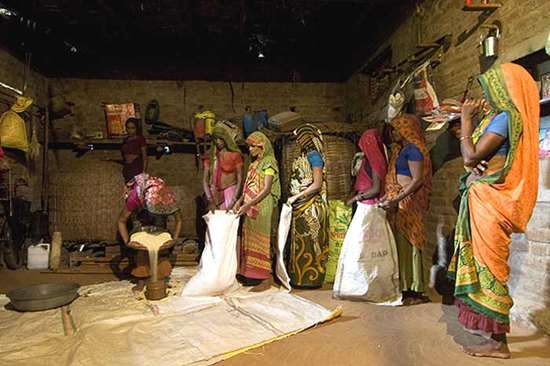
With happy faces greeting you at every village, it’s clear tribal communities are aware of the importance of being at the vortex of such positive transformation. Watda village of Baroda district has found financial autonomy through eight microcredit groups and a grain bank, both run by women. The grain bank is no more than a dimly-lit house where some 500 kg of maize, the staple of tribal populations in these parts, is stored in three ceiling-high baskets. The stock is of “deposits” of 5 kg per year made by 60 families, on which they earn interest. “For every 20 kg of grain a family borrows, it has to return 23 kg—an annual interest rate of 15 per cent. It’s a blessing: not only does it make us self-reliant, families that contribute to it earn interest,” says Raily Seema, president of the grain bank. Loans of grain help out when market prices shoot up during shortages, not unusual in the summer months.
Fuelling such change and overseeing it at the micro level is a network of Gram Vikas Kendras set up across the region by the Baroda-based Bhasha Trust, a voluntary group. […]
Much of the confidence the tribals have found to deal with practical problems is the result of what the Adivasi Academy in Tejgadh, also overseen by Devy’s group, has done by way of training. The academy is a picturesque red-brick building set on a 10-acre campus at the base of a misty hill some two hours from Baroda (see box). The open-air classrooms, the non-formal learning environment and the rustic look lend it a Shantiniketan feel but there is a difference: it’s an academy for tribals that is run by tribals themselves. Children are encouraged to study their own culture and language, and graduate to serve their own community, rather than migrating to the city. Informal courses at the academy have made graduates learn and think about agriculture, literacy, finance, health and women’s empowerment in locally useful ways. […]
In other villages, like Kanalwha, non-formal classes are a hit. Chatra Singh, a teacher who takes lessons in his living room, focuses on practical learning—tree walks, lessons in mythology and religion by the river. He speaks to his 30-odd students in Rathwi. “These children have never been to school before,” he says. “So it’s important to draw their attention, which I do by teaching in their tribal language rather than in Gujarati.” There are close to 3,000 students enrolled in such non-formal schools.
At its core, the movement is not just about numbers but an increasingly conscious community—albeit one that has always taken pride in its tribal identity—inspired to protect its land. “We are well aware of the dangers of land acquisition. Everyone knows it’s happening all around us,” says Viresh Rathwa, who oversees a number of initiatives around Tejgadh. “But what’s amazing is how much everyone here wants to be part of this concept, even if they don’t immediately connect with a term like GEZ. They understand it as a green movement. After all, the fields are where we belong, and nobody wants to lose his home.”
Source: “Ways Of Owning, Ways Of Belonging” by Neha Bhatt, Outlookindia.com Magazine, Aug 22, 2011
Address: http://www.outlookindia.com/article/ways-of-owning-ways-of-belonging/277984
Date Visited: 9 June 2015
“The landless class was excluded from the land reform operation that was carried out shortly after independence and had no other option but to continue working for wages that were barely enough to survive.” – Jan Breman (Emeritus professor Faculty of Social and Behavioural Sciences, University of Amsterdam) in his T.G. Narayanan Memorial Lecture on Social Deprivation titled The moral standard of state and society >>
Up-to-date reports by Indian experts and journalists
Search tips
Combine the name of any particular state, language or region with that of any tribal (Adivasi) community.
Add keywords of special interest (music, poetry, dance just as health, sacred grove and biodiversity); learn about the rights of Scheduled Tribes such as the “Forest Rights Act” (FRA); and the United Nations “Declaration on the Rights of Indigenous Peoples”, “Universal Declaration of Human Rights”, “women’s rights”, or “children’s right to education”.
Ask a question that includes “tribal” or “Adivasi”, for instance: “Adivasi way of life better?” (or “tribal way of life worse?”)
Specify any particular issue or news item (biodiversity, bonded labour and human trafficking, climate change, ecology, economic development, ethnobotany, ethnomedicine, global warming, hunter-gatherers in a particular region or state, prevention of rural poverty, water access).
For official figures include “scheduled tribe ST” along with a union state or region: e.g. “Chhattisgarh ST community”, “Himalayan tribe”, “Scheduled tribe Tamil Nadu census”, “ST Kerala census”, “Particularly Vulnerable Tribal Group Jharkhand”, “PVTG Rajasthan”, “Adivasi ST Kerala”, “Adibasi ST West Bengal” etc.
SafeSearch browser tips
If your (mobile) browser fails to display “embedded” media contents, Google maps and SafeSearch windows
Try another browser like Firefox, Chrome or Safari available on your device
Ensure your favourite browser is up to date
Close your present browser
Check your browser and mobile (gsm) settings:
e.g. permission for video or JavaScript
(seen under Preferences >Security >Enable JavaSript)
Restart your computer (smartphone, tablet)
Reconnect to your wifi network or connect to a different one
On some iPhone models the following helps:
>Settings >Safari >scroll down to:
SETTING FOR WEBSITES
Enable “Request Desktop Website” (All Websites) temporarily
Return to the map-post in Safari and “Reload”
Return to >Settings and disable “Request Desktop Website” again
Return to the post in Safari and “Reload”which should now display “embedded” contents as intended (with the convenience of browsing the mobile version on a small screen)
Note: similar solutions may also work with other mobile operating systems.
List of websites covered by this Google custom search engine
Academia.edu (platform for academics to share research papers) – www.academia.edu
Archive.org – https://archive.org
Centre for Science and Environment – https://www.cseindia.org
Current Conservation – https://www.currentconservation.org
Development and Cooperation (D+C) https://www.dandc.eu
Down To Earth (India) – www.downtoearth.org.in
India Environment Portal – www.indiaenvironmentportal.org.in
Harnessing Nature Magazine – https://harnessingnature.online
Mongabay-India – https://india.mongabay.com
M S Swaminathan Research Foundation – www.mssrf.org
Navdanya (protecting India’s biodiversity based food heritage) – https://navdanya.org
People’s Archive of Rural India – https://ruralindiaonline.org/
Third World Network (Penang, Malaysia) – https://twn.my
The Shola Trust (nature conservation in the Nilgiri region) – www.thesholatrust.org
Indian online periodicals and platforms | Images view >>
~ ~ ~
Personalize your CustomSearch by combining other search words >>
(e.g. name of a tribal community and region, a craft, or dance and puppetry)
Research: explore PhD theses from all over India
Shodhganga (Open Access)