Memories of life in a remote Bhil hamlet on the Narmada river >>
“Those displaced, who are the Scheduled Tribes, belong to the Bhil, Bhilala, Pavra, Tadvi, and Vassawa ethnic groups [of] Gujarat, Madhya Pradesh, and Maharashtra.”
Source: Development and Dispossession in the Narmada Valley >>
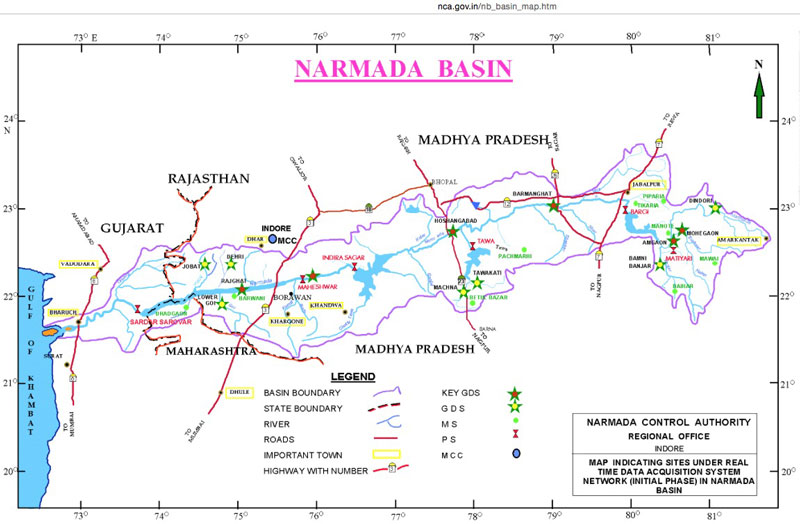
Ever since the Narmada Control Authority in its Action Taken Report permitted the raising of the Sardar Sarovar dam to 110.64 metres, the entire tribal belt in the Narmada valley came under the submergence zone. The scale of devastation during this monsoon will depend on the extent of rainfall here. | Read the full article (PDF) >>
Source: “Flood of fears” in Frontline Magazine (India’s National Magazine from the publishers of The Hindu), Volume 21 – Issue 16, Jul. 31 – Aug. 13, 2004
Address : https://www.hinduonnet.com/fline/fl2116/stories/20040813002609400.htm
Date Visited: 22 October 2020
The social characteristics of those displaced by the Sardar Sarovar Dam are not unique, either to India or to the rest of the world. Of the 200,000 to 250,000 who have been displaced by the Sardar Sarovar Dam, 60–70 per cent, are the Scheduled Tribe populations, i.e., those defined by the Indian Constitution to live primarily by pastoralism, subsistence-oriented slash and burn agriculture, and/or hunting and gathering. […]
Those displaced, who are the Scheduled Tribes, belong to the Bhil, Bhilala, Pavra, Tadvi, and Vassawa ethnic groups and are located at the boundaries between the three states of Gujarat, Madhya Pradesh, and Maharashtra. Their rates of education and literacy are low by the all-India standards. Although Scheduled Tribes make up 8 per cent of India’s population, they constitute between 40–50 per cent of those whose lands have faced submergence in the post-Independence period. Reliable estimates of the numbers displaced in India are between 20–38 million people of whom, nearly half belong to the Scheduled Tribes.
Source: Judy Whitehead (University of Lethbridge) in “Development and Dispossession in the Narmada Valley” (Pearson, New Delhi 2010), pp. 6-7
URL: https://www.academia.edu/442943/
Date visited: 4 December 2020
Thirty-three villages in Maharashtra were submerged, 4,300 families displaced. According to data from the Narmada Bachao Andolan, 4,135 families were resettled over the last 25 years. District collector Mallinath Kalshetty says efforts are under way to rehabilitate remaining families.
Source: Tabassum Barnagarwala, The Indian Express, 12 March 2018
URL: https://indianexpress.com/article/india/after-25-years-narmada-dam-sufferer-shown-land-for-resettlement-5094548/
Date Visited: 22 October 2020
Saving the forests of Garhwal by sticking to trees. Fighting a big dam by living in submerged waters. These movements redefined the greening of India.
6. HIGH TIDE
Narmada Bachao Andolan, 1985Narmada Bachao Andolan announced the arrival of the India Greens, protesting against destructive development.“One of the largest and most successful environmental campaigns, Narmada Bachao Andolan began with a wide developmental agenda, questioning the very rationale of large dam projects in India” (India Today, December 2007).
Source: “10 most powerful movements” by Purvi Malhotra (India Today, 19 December 2008)
URL: https://www.indiatoday.in/magazine/environment/story/20081229-10-most-powerful-movements-738539-2008-12-19
Date Visited: 31 May 2021
[Bold typeface added above for emphasis]
Learn more about tribal communities in the Narmada region >>
Reports in the Indian press | List of periodicals included in this search >>
Search tips
Combine the name of any particular state, language or region with that of any tribal (Adivasi) community.
Add keywords of special interest (music, poetry, dance just as health, sacred grove and biodiversity); learn about the rights of Scheduled Tribes such as the “Forest Rights Act” (FRA); and the United Nations “Declaration on the Rights of Indigenous Peoples”, “Universal Declaration of Human Rights”, “women’s rights”, or “children’s right to education”.
Ask a question that includes “tribal” or “Adivasi”, for instance: “Adivasi way of life better?” (or “tribal way of life worse?”)
Specify any particular issue or news item (biodiversity, bonded labour and human trafficking, climate change, ecology, economic development, ethnobotany, ethnomedicine, global warming, hunter-gatherers in a particular region or state, prevention of rural poverty, water access).
For official figures include “scheduled tribe ST” along with a union state or region: e.g. “Chhattisgarh ST community”, “Himalayan tribe”, “Scheduled tribe Tamil Nadu census”, “ST Kerala census”, “Particularly Vulnerable Tribal Group Jharkhand”, “PVTG Rajasthan”, “Adivasi ST Kerala”, “Adibasi ST West Bengal” etc.
SafeSearch browser tips
If your (mobile) browser fails to display “embedded” media contents, Google maps and SafeSearch windows
Try another browser like Firefox, Chrome or Safari available on your device
Ensure your favourite browser is up to date
Close your present browser
Check your browser and mobile (gsm) settings:
e.g. permission for video or JavaScript
(seen under Preferences >Security >Enable JavaSript)
Restart your computer (smartphone, tablet)
Reconnect to your wifi network or connect to a different one
On some iPhone models the following helps:
>Settings >Safari >scroll down to:
SETTING FOR WEBSITES
Enable “Request Desktop Website” (All Websites) temporarily
Return to the map-post in Safari and “Reload”
Return to >Settings and disable “Request Desktop Website” again
Return to the post in Safari and “Reload”which should now display “embedded” contents as intended (with the convenience of browsing the mobile version on a small screen)
Note: similar solutions may also work with other mobile operating systems.
Research: explore PhD theses from all over India
Shodhganga (Open Access)
Basics
Tribal Cultural Heritage in India in the 21st century (printfriendly PDF)
Forest dwellers in early India – myths and ecology in historical perspective
Education
Background guide for education (free eBook)
Childhood | Child marriage | Children’s right to Education
! Contact: National helpline Childline & report trafficking
Customs | Marriage customs | Social conventions
Free comic books (Unicef)
Survival Int. on tribal education
Video | “Nations don’t make us human – languages make us human”: Ganesh Devy
Health, environment & nature
Biological Diversity: What is the Biodiversity Act?
Forest dwellers in early India – myths and ecology
Issues
Assimilationist & isolationist positions
“Casteism” and its effect on tribal communities
Denotified Tribe vs. “criminal tribe“
Fighting exploitation and women’s stigmatization
Particularly Vulnerable Tribal Groups & Endangered languages (interactive map)
President of India
National development and the development of tribal communities are linked
Government of India, national & international organizations
Endangered languages: Peoples’ Linguistic Survey of India
Govt. of India, NGOs, Indian universities and international organisations
Govt. What are the Rights of Scheduled Tribes (ST)
Human Rights Commission (posts) | www.nhrc.nic.in (Government of India)
India’s Constitutional obligation to respect their cultural traditions
India’s 28 States and 8 Union Territories
National Commission for Scheduled Tribes | Related posts
Particularly Vulnerable Tribal Groups (PVTG)
People’s Linguistic Survey of India | Volumes (PLSI) | PeoplesLinguisticSurvey.org
Universal Declaration of Human Rights & International Convention against Torture
Women | Safe search | President Droupadi Murmu on women’s empowerment
Legal provisions
Child rights & Right to education handbook
Constitution and Supreme Court
Denotified, nomadic and semi-nomadic (“hidden”) tribes: Classifications in different states
Forest Rights Act (FRA) | Legal rights | What is the Forest Rights Act about?
India’s Constitutional obligation to respect their cultural traditions
Right to Information Act (RTI)
Scheduled Tribes (ST) | Who are Scheduled Tribes?
Who is a forest dweller under this law, and who gets rights?
Resources
Adivasis’ struggle for India’s freedom and Independence
Anthropology & Anthropological Survey of India
The Anti-Autocracy Handbook: A Scholars’ Guide to Navigating Democratic Backsliding | Backup (PDF, 500 KB)
Books on tribal culture and related resources
Fact checking | Factchecker.in | Safe search examples with keywords:
“factchecker.in rural india“| “factchecker.in adivasi tribe“
Figures, census and other statistics | Primitive Tribes in Andaman and Nicobar Islands (Census 2011)
Indian magazines and web portals – news coverage and analysis
Indigenous knowledge: biodiversity, ecology, health, nutrition, nature, wildlife
Languages and linguistic heritage
Nehru’s 5 Principles: Panchsheel
News update in Indian periodicals: Tribal Affairs
People’s Linguistic Survey of India | Volumes (PLSI) | PeoplesLinguisticSurvey.org