“The natural wealth with which much of tribal India is endowed is also its bane. […] The Adivasi is wedged between the state programme for development, meaning mines, dams, steel plants and roads, and a private agenda for quick money, which is currently termed ‘real estate’.” – Madhu Ramnath, Preface for Woodsmoke and Leafcups >>
The Union Cabinet on Friday approved the landmark Mines and Mineral Development and Regulation (MMDR) Bill, 2011 that provides for mining companies to keep aside 26 per cent of their net profits for a Mineral Development Fund to be used for the development and rehabilitation of project-affected people in tribal areas. For the non-coal companies, the amount will be equivalent to the royalty they pay. […]
The MMDR Bill will replace a 54-year-old legislation governing the sector. The Bill seeks a complete and holistic reform in the mining sector with provisions to address issues relating to sustainable mining and local area development, especially families impacted by mining operations.
Source: “Share in profits for tribal areas in new mining bill” by Sujay Mehdudia, The Hindu, September 30, 2011
Address : https://www.thehindu.com/news/national/article2500154.ece?homepage=true
Date Visited: 19 December 2020
Shares of mining companies today ended on a mixed note, with Coal India (CIL) plunging over 5 per cent after the government approved the new Mining Bill that calls for them to share profits and an amount equivalent to royalty with the project-affected people. […]
The Bill is likely to be tabled in Parliament in the Winter Session.
Mines and Mineral Development and Regulation (MMDR) Bill, 2011, has provisions for 26 per cent profit-sharing by coal miners and an amount equivalent to royalty to be paid by other mineral mining firms with project-affected people.
Source: The Hindu : Business / Markets : Mining companies end on mixed note as govt. approves new Bill
Address : https://www.thehindu.com/business/markets/article2500746.ece
Date Visited: 19 December 2020
“The issue is not whether the world’s economy is governable toward ambitious goals like promoting social justice, equality between countries and greater democratic control for the bulk of the world’s people, but whether it is governable at all.” – Mogobe B. Ramose quoting Globalization in question by Hirst, P. and Thompson, G in “Globalization and ubuntu” (The African Philosophy Reader), pp. 732 | Globalization >>
~ ~ ~
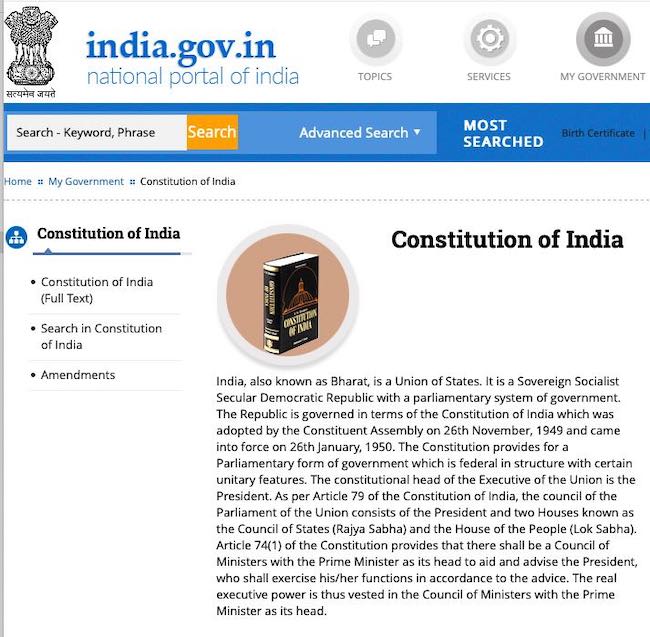
To an administrator, the term ‘tribe’ means a group of citizens who are the special responsibility of the President of India | Constitution of India | Fundamental Rights according to the Constitution of India: PDF-repository (2 MB), p. 6 >>
Basics
Tribal Cultural Heritage in India in the 21st century (printfriendly PDF)
Forest dwellers in early India – myths and ecology in historical perspective
Education
Background guide for education (free eBook)
Childhood | Child marriage | Children’s right to Education
! Contact: National helpline Childline & report trafficking
Customs | Marriage customs | Social conventions
Free comic books (Unicef)
Survival Int. on tribal education
Video | “Nations don’t make us human – languages make us human”: Ganesh Devy
Health, environment & nature
Biological Diversity: What is the Biodiversity Act?
Forest dwellers in early India – myths and ecology
Issues
Assimilationist & isolationist positions
“Casteism” and its effect on tribal communities
Denotified Tribe vs. “criminal tribe“
Fighting exploitation and women’s stigmatization
Particularly Vulnerable Tribal Groups & Endangered languages (interactive map)
President of India
National development and the development of tribal communities are linked
Government of India, national & international organizations
Endangered languages: Peoples’ Linguistic Survey of India
Govt. of India, NGOs, Indian universities and international organisations
Govt. What are the Rights of Scheduled Tribes (ST)
Human Rights Commission (posts) | www.nhrc.nic.in (Government of India)
India’s Constitutional obligation to respect their cultural traditions
India’s 28 States and 8 Union Territories
National Commission for Scheduled Tribes | Related posts
Particularly Vulnerable Tribal Groups (PVTG)
People’s Linguistic Survey of India | Volumes (PLSI) | PeoplesLinguisticSurvey.org
Universal Declaration of Human Rights & International Convention against Torture
Women | Safe search | President Droupadi Murmu on women’s empowerment
Legal provisions
Child rights & Right to education handbook
Constitution and Supreme Court
Denotified, nomadic and semi-nomadic (“hidden”) tribes: Classifications in different states
Forest Rights Act (FRA) | Legal rights | What is the Forest Rights Act about?
India’s Constitutional obligation to respect their cultural traditions
Right to Information Act (RTI)
Scheduled Tribes (ST) | Who are Scheduled Tribes?
Who is a forest dweller under this law, and who gets rights?
Resources
Adivasis’ struggle for India’s freedom and Independence
Anthropology & Anthropological Survey of India
The Anti-Autocracy Handbook: A Scholars’ Guide to Navigating Democratic Backsliding | Backup (PDF, 500 KB)
Books on tribal culture and related resources
Fact checking | Factchecker.in | Safe search examples with keywords:
“factchecker.in rural india“| “factchecker.in adivasi tribe“
Figures, census and other statistics | Primitive Tribes in Andaman and Nicobar Islands (Census 2011)
Indian magazines and web portals – news coverage and analysis
Indigenous knowledge: biodiversity, ecology, health, nutrition, nature, wildlife
Languages and linguistic heritage
Nehru’s 5 Principles: Panchsheel
News update in Indian periodicals: Tribal Affairs
People’s Linguistic Survey of India | Volumes (PLSI) | PeoplesLinguisticSurvey.org