India Perspectives (24 No. 2/2010) Backup (PDF, 4 MB) >>
Rabindranath Tagore: a universal voice – Unesco >>
The meaning of “freedom” for Indian citizens: Accountability, Childrens right to education, Democracy & Rights of Indigenous Peoples >>
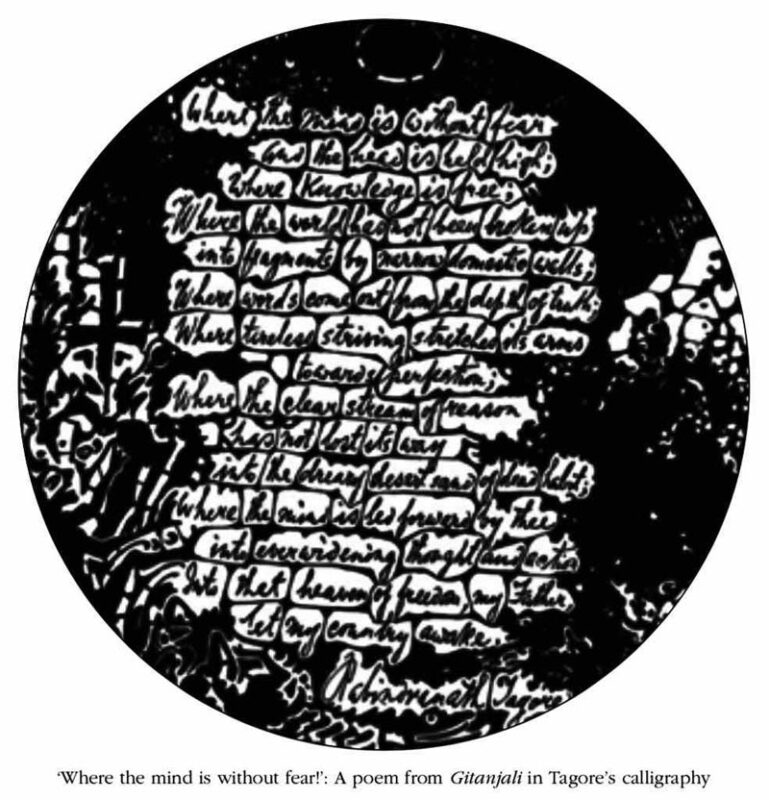
Where the mind is without fear (Bengali: চিত্ত যেথা ভয়শূন্য, romanized: Chitto Jetha Bhoyshunno, is a poem written by 1913 Nobel laureate Rabindranath Tagore before India’s independence. It represents Tagore’s vision of a new and awakened India. The original poem was published in 1910 and was included in the 1910 collection Gitanjali and, in Tagore’s own translation, in its 1912 English edition. Where the mind is without fear is the 35th poem of Gitanjali, and one of Tagore’s most anthologised poems. […]
Source: https://en.m.wikipedia.org/wiki/Rabindranath_Tagore
Date visited: 29 September 2020
Our fight is a spiritual fight, it is for Man. We are to emancipate Man from the meshes that he himself has woven round him –these organisations of National Egoism […]
If we can defy the strong, the armed, the wealthy, revealing to the world the power of the immortal spirit, the whole castle of the Giant Flesh will vanish in void. And then Man will find his ‘swaraj’. We, the famished, ragged ragamuffins of the East, are to win freedom for all Humanity. We have no word for Nation in our language. When we borrow this word from other people, it never fits us.
Source: Letter 12, ‘Tagore’s reflections on non-cooperation and cooperation’, addressed to C.F. Andrews, London, 1928, compiled in The Mahatma and the Poet: Letters and Debates between Gandhi and Tagore 1915-1941, edited by Sabyasachi Bhattacharya
URL: https://worldcat.org/en/title/943578846
Date Visited: 8 March 2023
The philosopher-poet wanted a multi-cultural country rooted in egalitarianism, secularism and the right to dissent | Read the full article in Scroll.in >>
“Patriotism can’t be our final spiritual shelter. I will not buy glass for the price of diamonds and I will never allow patriotism to triumph over humanity as long as I live.” – Rabindranath Tagore
India has always had contending visions of nationalism and patriotism. […]
The campaign for the tricolour to be displayed in every Indian home to celebrate the 75th year of Independence reflects a view of nationalism as mere sets of symbols to be unthinkingly worshiped under the rubric of patriotism. […]
In his novel Ghare-Baire (Home and the World), later turned into a film by Satyajit Ray, the protagonist Nikhil says that when love for one’s country gives way to worship, or becomes a “sacred obligation”, then disaster is the inevitable outcome.
“I am willing to serve my country; but my worship I reserve for Right which is far greater than country,” he says, “To worship my country as a god is to bring curse upon it.”
So whenever the question of national, anti national, patriotism, flag or nationalism is talked about, we reach out for our Tagore. For him, idea of a nation and a national community was
“Where the mind is without fear and the head is held high
Where knowledge is free
Where the world has not been broken up into fragments
By narrow domestic walls
Where words come out from the depth of truth
Where tireless striving stretches its arms towards perfection
Where the clear stream of reason has not lost its way
Into the dreary desert sand of dead habit
Where the mind is led forward by thee
Into ever-widening thought and action
Into that heaven of freedom, my Father, let my country awake.”Not just Har Ghar Tiranga, a flag in every home, And anyway even when we hoist our tricolour, the flag does not symbolise narrow ideas of a nation state but certain sets of universal humanist values rooted in rights of freedom, dissent, egalitarianism, secularism and multi-cultural India. Those are the values we need to hoist in every home.
Angela Rangad is a women’s and democratic rights activist in Meghalaya.
Source: “Beyond Har Ghar Tiranga: Why Indians must plant Tagore’s vision of nationalism in every home” by Meghalaya-based women’s and democratic rights activist Angela Rangad, Scroll.in, 9 August 2022
URL: https://scroll.in/article/1029979/beyond-har-ghar-tiranga-why-indians-must-plant-tagores-vision-of-nationalism-in-every-home
Date Visited: 17 August 2022
“In his play Muktadhara (The Waterfall), Tagore robustly employs this element of freedom. The play relates the story of an exploited people and their eventual release from it. [Today, when] tribal populations across India are being uprooted with impudence Tagore’s message of freedom, in all its shades, is of utmost relevance.” – Bhaswati Ghosh in Freedom in Tagore’s Plays | Learn more >>
Amnesty International says it has been forced to halt its India operations due to “reprisals” from the government. […]
Amnesty’s announcement comes amid growing concern over the state of free speech in India. The development, activists say, could dent India’s long-standing reputation of being a thriving democracy. “India does not stand in good company with these moves it is making. We operate in over 70 countries, and the only other country previously that we had been forced to shut operations in was Russia in 2016,” says Mr Khosla. “I hope people around the world sit up and take notice. We are doing this with a very heavy heart, and a deep sense of anguish and grief.”
Source: “Amnesty International to halt India operations” by Yogita Limaye
(BBC News Mumbai, 30 September 2020)
URL: https://www.bbc.com/news/world-asia-india-54277329
Date visited: 30 September 2020
Society as such has no ulterior purpose. It is an end in itself. It is a spontaneous self-expression of man as a social being. It is natural regulation of human relationships, so that men can develop ideals of life in cooperation with one another.
Rabindranath Tagore quoted in Santiniketan: Birth of Another Cultural Space by Pulak Dutta (Santiniketan, 2015) p. 42 [from The English Writings of Rabindranath Tagore, Vol. II, Sahitya Akademi, New Delhi, 2004, p. 421] | Free download of Santiniketan: Birth of Another Cultural Space >>
[Bold typeface added above for emphasis]
He who has not surrendered his free will and abdicated his intelligence and independent thinking, who does not blindly act on the teachings of others, who does not blindly accept anything without critically analysing and examining its veracity and usefulness, who is always prepared to protect his rights, who is not afraid of ridicule and unjust public criticism, who has a sound conscience and self-respect so as not become a tool in the hands of others, I call him a free man.
Bhimrao Ramji Ambedkar (who was more than the “drafter of the Constitution”), quoted by Goldy M George in Journal of People’s Studies (Volume 1, Issue 4 June 2016, Page v)
Note: in a modern educational context, we may think of any “free person” – including “free girls and boys” – as being meant by Ambedkar.
Tip: discover publications released by Indian publishers and institutions by typing “tribal children stories” in combination with the name of a tribal community (e.g. “Gond”, “Santal”, “Warli”), an Indian State or Union Territory (e.g. “Andaman”, “Tripura”, “Telangana”), a region (e.g. “Bastar”, “Northeast India”, “Nilgiri”), name of artist, author or publisher, and preferred language (“Tamil”, “Hindi”, “bilingual”).
List of sites covered by this Google SafeSearch engine
https://books.katha.org (Katha Books)
https://publicationsdivision.nic.in
Search tips
Combine the name of any particular state, language or region with that of any tribal (Adivasi) community.
Add keywords of special interest (music, poetry, dance just as health, sacred grove and biodiversity); learn about the rights of Scheduled Tribes such as the “Forest Rights Act” (FRA); and the United Nations “Declaration on the Rights of Indigenous Peoples”, “Universal Declaration of Human Rights”, “women’s rights”, or “children’s right to education”.
Ask a question that includes “tribal” or “Adivasi”, for instance: “Adivasi way of life better?” (or “tribal way of life worse?”)
Specify any particular issue or news item (biodiversity, bonded labour and human trafficking, climate change, ecology, economic development, ethnobotany, ethnomedicine, global warming, hunter-gatherers in a particular region or state, prevention of rural poverty, water access).
For official figures include “scheduled tribe ST” along with a union state or region: e.g. “Chhattisgarh ST community”, “Himalayan tribe”, “Scheduled tribe Tamil Nadu census”, “ST Kerala census”, “Particularly Vulnerable Tribal Group Jharkhand”, “PVTG Rajasthan”, “Adivasi ST Kerala”, “Adibasi ST West Bengal” etc.
SafeSearch browser tips
If your (mobile) browser fails to display “embedded” media contents, Google maps and SafeSearch windows
Try another browser like Firefox, Chrome or Safari available on your device
Ensure your favourite browser is up to date
Close your present browser
Check your browser and mobile (gsm) settings:
e.g. permission for video or JavaScript
(seen under Preferences >Security >Enable JavaSript)
Restart your computer (smartphone, tablet)
Reconnect to your wifi network or connect to a different one
On some iPhone models the following helps:
>Settings >Safari >scroll down to:
SETTING FOR WEBSITES
Enable “Request Desktop Website” (All Websites) temporarily
Return to the map-post in Safari and “Reload”
Return to >Settings and disable “Request Desktop Website” again
Return to the post in Safari and “Reload”which should now display “embedded” contents as intended (with the convenience of browsing the mobile version on a small screen)
Note: similar solutions may also work with other mobile operating systems.
More SafeSearch on this website
Basics
Tribal Cultural Heritage in India in the 21st century (printfriendly PDF)
Forest dwellers in early India – myths and ecology in historical perspective
Education
Background guide for education (free eBook)
Childhood | Child marriage | Children’s right to Education
! Contact: National helpline Childline & report trafficking
Customs | Marriage customs | Social conventions
Free comic books (Unicef)
Survival Int. on tribal education
Video | “Nations don’t make us human – languages make us human”: Ganesh Devy
Health, environment & nature
Biological Diversity: What is the Biodiversity Act?
Forest dwellers in early India – myths and ecology
Issues
Assimilationist & isolationist positions
“Casteism” and its effect on tribal communities
Denotified Tribe vs. “criminal tribe“
Fighting exploitation and women’s stigmatization
Particularly Vulnerable Tribal Groups & Endangered languages (interactive map)
President of India
National development and the development of tribal communities are linked
Government of India, national & international organizations
Endangered languages: Peoples’ Linguistic Survey of India
Govt. of India, NGOs, Indian universities and international organisations
Govt. What are the Rights of Scheduled Tribes (ST)
Human Rights Commission (posts) | www.nhrc.nic.in (Government of India)
India’s Constitutional obligation to respect their cultural traditions
India’s 28 States and 8 Union Territories
National Commission for Scheduled Tribes | Related posts
Particularly Vulnerable Tribal Groups (PVTG)
People’s Linguistic Survey of India | Volumes (PLSI) | PeoplesLinguisticSurvey.org
Universal Declaration of Human Rights & International Convention against Torture
Women | Safe search | President Droupadi Murmu on women’s empowerment
Legal provisions
Child rights & Right to education handbook
Constitution and Supreme Court
Denotified, nomadic and semi-nomadic (“hidden”) tribes: Classifications in different states
Forest Rights Act (FRA) | Legal rights | What is the Forest Rights Act about?
India’s Constitutional obligation to respect their cultural traditions
Right to Information Act (RTI)
Scheduled Tribes (ST) | Who are Scheduled Tribes?
Who is a forest dweller under this law, and who gets rights?
Resources
Adivasis’ struggle for India’s freedom and Independence
Anthropology & Anthropological Survey of India
The Anti-Autocracy Handbook: A Scholars’ Guide to Navigating Democratic Backsliding | Backup (PDF, 500 KB)
Books on tribal culture and related resources
Fact checking | Factchecker.in | Safe search examples with keywords:
“factchecker.in rural india“| “factchecker.in adivasi tribe“
Figures, census and other statistics | Primitive Tribes in Andaman and Nicobar Islands (Census 2011)
Indian magazines and web portals – news coverage and analysis
Indigenous knowledge: biodiversity, ecology, health, nutrition, nature, wildlife
Languages and linguistic heritage
Nehru’s 5 Principles: Panchsheel
News update in Indian periodicals: Tribal Affairs
People’s Linguistic Survey of India | Volumes (PLSI) | PeoplesLinguisticSurvey.org