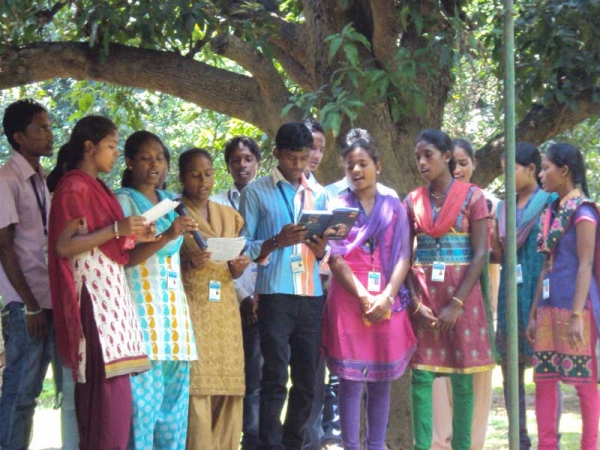
Neoliberal Development, Displacement and Resistance movement: The Case of Kalinga Nagar Industrial complex, Odisha, India | To read the full paper by Dinabandhu Sahoo and Niharranjan Mishra (NIT Rourkela), click here >>
The tribals of Kalinga Nagar have been migrated from different districts of Chotanagpur in the last part of 19th century and early 20th century. Lack of irrigation facilities and frequent drought in tribal areas of Chotanagpur region left no option for the tribals but to migrate to other places like tea gardens of Assam and Coal fields in the nearby area (Miri, 1993). The shortage of labour in the tea gardens of Assam during colonial times particularly in the 2nd half of the 19th century caused a large scale migration of the Santhals, Munda, Oraons and Hos from the villages of Chotanagpur and Santhal Pargana to Assam. Similarly, the establishment of industries in these areas led to a large scale displacement of tribals resulting into their alienation from land (Prasad, 1988:78). Land alienation due to different purposes like hydro-electric project, administration, industrial and mining projects, reservation and conservation of forests, business and other institutions like schools, colleges and technical training institutions etc. in Chotanagpur in colonial and postcolonial period pushed the adivasis of the region to migrate to other areas (Prasad, 1988:77-99). The mining industries near Chotanagpur also attracted the Hos as well as other tribes as labour force. In a similar vein in 1877 due to severe drought in Saraikala region (Present day Jharkhand), people migrated to Sukinda valley (Near the present day Kalinga Nagar Industrial Complex) (Sahu, 2007).
Similarly an adivasis of Kalinga Nagar Mansingh Purty (age about 74) vehemently stated the other cause of Adivasi migration to Kalinga Nagar area:
“We are strong and industrious people. Our forefathers came here from Ranchi areas as contractual labour by the colonial British ruler to construct the Rail road in Eastern Odisha in the last half of 19th century. Since then we are living in this region. The then Sukinda king (Zamindar) permitted us to live here and make land by cutting forests and cultivate it. He gave some people patta and we were giving Khajana (Tax) in the form of Gotti (bonded labour) to the king”. (Interview 15.12.2014)In fact it can be concluded that environmental degradation and climate change not only induced tribal migration but also economic opportunity acted as a pull factor for tribal migration to Sukinda/Kalinga Nagar area.
The topography of the area was also suitable for tribal settlement. The topography of the area consists of undulating landmass with small hills and forests. Small streams, low waste lands and Patas (wetlands) were the main source of water supply to the area. Streams and Patas provide a large quantity of varieties of fishes and crab to the local people. In Khapuria-Kumbhiragadia area there was a large grazing land which supports hundreds of milkman families for cattle rearing. The main livelihood of the local adivasis consists of agriculture, especially rain-fed agriculture i.e. paddy cultivation. After harvesting rice, some people grow pulses like black and green gram, Khesari, maize, kulthi and vegetables. The nearby forests and hills play an important role of supplying firewood and minor forest products like ground nuts, kendu fruits, mango, tamarind, jack fruits, various kinds of leafy vegetables and besides meats of various wild animals and birds. These provided health and wellbeing of the tribal populations in the area. Some rare species of medicinal herbs were found in the nearby hills. Besides these economic values, forests and hills also had religious and aesthetic values for the local tribals. Some people in the area also worked as agricultural or other wage labourers in the nearby mines and quarries. […]
The paper looks at the problems of development-induced displacement and resistance movement in Kalinga Nagar Industrial Complex in Odisha, India. While analysing the problems the paper considers some of the important variables such as livelihood risks, past resettlement policy and implementation, increase in consciousness about displacement and consciousness of opportunities and differentiation both among local people and outsider to argue how these factors initiated conflict and mobilized resistance movement against displacement in Kalinga Nagar Industrial Complex. It also argues how differentiation, fragmentation and consciousness of opportunities helped for split and decline of the movement. Based on the theoretical premises of political economy and new social movement and following ethnographic fieldwork the paper broadly explicates the political economy of development and dispossession, causes and emergence of collective mobilization and demands and strategies of resistance movement.
Source: “Neoliberal Development, Displacement and Resistance movement: The Case of Kalinga Nagar Industrial complex, Odisha, India” by Dinabandhu Sahoo [PhD Scholar] and Niharranjan Mishra [Assistant Professor], Department of Humanities and Social Sciences, NIT Rourkela, Odisha, pp. 250-1
URL: https://www.academia.edu/34043372
Date visited: 14 June 2020
[Bold typeface added above for emphasis]
“The practice of religious rituals, ceremonies and sanctions by specific cultural groups allow such sacred landscapes to be maintained, emphasizing that humans are intrinsically part of the ecosystem. Taboos, codes and customs specific to activities and community members restrict access to most sacred groves. […] The inclusion of local people’s needs and interests in conservation planning is increasingly accepted as essential, both to promote the well-being of human populations, and to ensure that biodiversity and conservation needs are met in the long-term.” – Nazir A. Pala, Ajeet K. Neg and N.P. Todaria in “The Religious, Social and Cultural Significance of Forest Landscapes in Uttarakhand Himalaya, India” (International Journal of Conservation Science, Vol. 5, Issue 2, April-June 2014) | Sacred groves | Biodiversity and development – Himalaya >>
Facts and figures: India’s biological, cultural and geographic diversity
Spread over 3,287,240 km2 and despite a total human population of over 1,210,000,000, India represents a wide spectrum of biological, cultural and geographic diversity. It has been identified as one of the top 12 global biodiversity hotspots and has 91 eco-cultural zones inhabited by 4,635 ethnic communities. India also has amongst the largest indigenous/tribal population, constituting 8.08% of the country’s population, representing 461 tribes. The term ‘Indigenous Peoples’ is not officially recognized in the country, instead the Constitution of India uses the term ‘Scheduled Tribes’. The total forest cover is estimated to be approximately 20% of the total area of the country. About 1,70,379 villages with a population of 10,674,334 inhabit areas in close proximity of forests.
Source: RECOGNITION AND SUPPORT OF ICCAs IN INDIA by Neema Pathak Broome and Tushar Dash, p. 4 | PDF-Repository
URL: https://kalpavriksh.org/wp-content/uploads/2021/01/IndiaICCARecognition_Final_SEPT2012-as-published.pdf
Date Visited: 10 March 2025
Human trafficking | Violence against women
Slavery | Zamindari
Human trafficking is a crime. To report in India, contact
Shakti Vahini https://shaktivahini.org/contact-us >> shaktivahini@gmail.com
+91-9899710847 +91-9582909025
and/or Childline 1098 (national helpline)
National Programme for Child Labour Free India | PDF-Repository (70 KB)
“Child marriage is not just an age-old social evil, but also a heinous crime that robs children of their childhood. Child marriage is a “crime against children” that violates basic human rights, minor girls are forced to marry and live a life of mental trauma, physical and biological stress, domestic violence including limited access to education and increased vulnerability to domestic violence. […] early pregnancies leading to complications and higher rate of maternal mortality and death of infants, malnutrition.” – Shakti Vahini’s campaign for a Child Marriage Free India >>
“As per a study on human trafficking, the state of Jharkhand has emerged as India’s trafficking hub with thousands of tribal women and girls being trafficked out of the state each year to Delhi, Punjab, Haryana and beyond [while] human traffickers are also involved in many cases of missing children.” – The Wire | Shakti Vahini | Tourism locations | Adivasi tribal bondage slavery trafficking (Safe search) >>
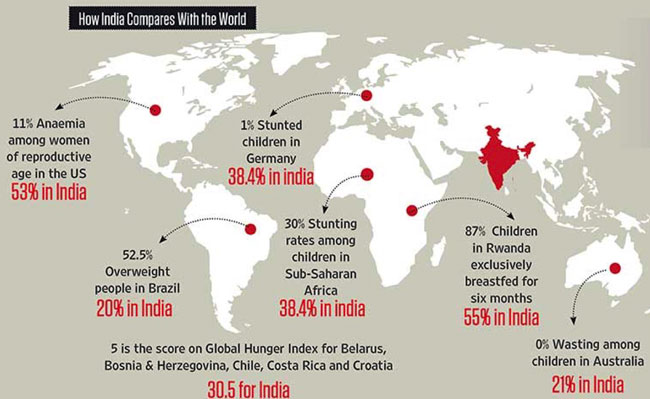
Graphic © Outlook India 26 August 2019 >>
The tribal food basket has always been diverse and nutritious >>
Childrens rights: UNICEF India | Childrens right to education >>
Health spending by the Indian government
“Health spending by the Indian government as percentage of GDP has long been one of the lowest for any major country, and the public health system is chronically dismal.” – Pranab Bardhan in “The two largest democracies in the world are the sickest now” | Learn more: Scroll.in, 24 August 2020 >>
Context | Health care for communities identified as “poorest of poor” (PVTGs)
India is designated as the melting pot of so many ethnic groups dwelling at the same time under the common umbrella of a unified nation. Among these varied ethnic groups, some of them have been categorized under article 342 (1) of the constitution and have been labelled as Scheduled Tribe. In the post independent scenario, several schemes for upliftment of STs were run by the government but it was found that all these groups did not come up to the same level of development. Some of them were at much lower strata than others. Thus, in order to ensure the development of these communities, they were, for the first time in 1975-76 (during 5th Five-year plan) and thereafter-in 1993, identified as poorest of poor among the STs and were designated as Primitive Tribal Groups and thereafter constitution of India renamed and declared as Particularly Vulnerable Tribal Groups (PVTGs). Out of the 75 particularly vulnerable tribal groups, 13 are residing in Odisha; they are becoming increasing vulnerable due to loss of their customary habitat. The health troubles of rural areas especially in the tribal areas need a unique concentration, because the tribal people have typical health problem.
Source: 2019 PhD thesis (Abstract) by Jayanta Kumar Nayak titled “Health Seeking Behaviour and Health Care Services among the Hill Kharia Mayurbhanj District Odisha”, Department of Anthropology, Central University of Orissa
URL: http://hdl.handle.net/10603/257651
Date Visited: 21 May 2025
Factchecker.in | Safe search examples with keywords:
“tribal rights unesco“ | “rural india unesco“ | “tribal education india unesco“
Find up-to-date information provided by, for and about Indian authors, researchers, officials, and educators
List of sites covered by this Google SafeSearch engine
Ashoka Trust for Research in Ecology and the Environment (ATREE) – www.atree.org
Freedom United – www.freedomunited.org
Government of India (all websites ending on “.gov.in”)
Kalpavriksh Environmental Action Group – https://kalpavriksh.org
Shodhganga (a reservoir of Indian theses) – https://shodhganga.inflibnet.ac.in
Survival International – www.survivalinternational.org
UCLA Digital Library – https://digital.library.ucla.edu
Unesco – https://en.unesco.org
Unesco digital library – https://unesdoc.unesco.org
Unicef – www.unicef.org
United Nations – www.un.org/en
Video Volunteers – www.videovolunteers.org
WorldCat (“the world’s largest library catalog, helping you find library materials online”) – https://worldcat.org
Search tips
Combine the name of any particular state, language or region with that of any tribal (Adivasi) community.
Add keywords of special interest (music, poetry, dance just as health, sacred grove and biodiversity); learn about the rights of Scheduled Tribes such as the “Forest Rights Act” (FRA); and the United Nations “Declaration on the Rights of Indigenous Peoples”, “Universal Declaration of Human Rights”, “women’s rights”, or “children’s right to education”.
Ask a question that includes “tribal” or “Adivasi”, for instance: “Adivasi way of life better?” (or “tribal way of life worse?”)
Specify any particular issue or news item (biodiversity, bonded labour and human trafficking, climate change, ecology, economic development, ethnobotany, ethnomedicine, global warming, hunter-gatherers in a particular region or state, prevention of rural poverty, water access).
For official figures include “scheduled tribe ST” along with a union state or region: e.g. “Chhattisgarh ST community”, “Himalayan tribe”, “Scheduled tribe Tamil Nadu census”, “ST Kerala census”, “Particularly Vulnerable Tribal Group Jharkhand”, “PVTG Rajasthan”, “Adivasi ST Kerala”, “Adibasi ST West Bengal” etc.
SafeSearch browser tips
If your (mobile) browser fails to display “embedded” media contents, Google maps and SafeSearch windows
Try another browser like Firefox, Chrome or Safari available on your device
Ensure your favourite browser is up to date
Close your present browser
Check your browser and mobile (gsm) settings:
e.g. permission for video or JavaScript
(seen under Preferences >Security >Enable JavaSript)
Restart your computer (smartphone, tablet)
Reconnect to your wifi network or connect to a different one
On some iPhone models the following helps:
>Settings >Safari >scroll down to:
SETTING FOR WEBSITES
Enable “Request Desktop Website” (All Websites) temporarily
Return to the map-post in Safari and “Reload”
Return to >Settings and disable “Request Desktop Website” again
Return to the post in Safari and “Reload”which should now display “embedded” contents as intended (with the convenience of browsing the mobile version on a small screen)
Note: similar solutions may also work with other mobile operating systems.
Search Worldcat.org for publications by reputed authors (select “Open Content/Open Access” for freely downloadable content)
Search tips
Combine the name of any particular state, language or region with that of any tribal (Adivasi) community.
Ask a question that includes “tribal” or “Adivasi”, for instance: “Adivasi way of life better?” (or “tribal way of life worse?”)
Add keywords of special interest (music, poetry, dance just as health, sacred grove and biodiversity); learn about the rights of Scheduled Tribes such as the “Forest Rights Act” (FRA); and the United Nations “Declaration on the Rights of Indigenous Peoples”, “Universal Declaration of Human Rights”, “women’s rights”, or “children’s right to education”.
Specify any particular issue or news item (biodiversity, bonded labour and human trafficking, climate change, ecology, economic development, ethnobotany, ethnomedicine, global warming, hunter-gatherers in a particular region or state, prevention of rural poverty, water access).
Basics
Tribal Cultural Heritage in India in the 21st century (printfriendly PDF)
Forest dwellers in early India – myths and ecology in historical perspective
Education
Background guide for education (free eBook)
Childhood | Child marriage | Children’s right to Education
! Contact: National helpline Childline & report trafficking
Customs | Marriage customs | Social conventions
Free comic books (Unicef)
Survival Int. on tribal education
Video | “Nations don’t make us human – languages make us human”: Ganesh Devy
Health, environment & nature
Biological Diversity: What is the Biodiversity Act?
Forest dwellers in early India – myths and ecology
Issues
Assimilationist & isolationist positions
“Casteism” and its effect on tribal communities
Denotified Tribe vs. “criminal tribe“
Fighting exploitation and women’s stigmatization
Particularly Vulnerable Tribal Groups & Endangered languages (interactive map)
President of India
National development and the development of tribal communities are linked
Government of India, national & international organizations
Endangered languages: Peoples’ Linguistic Survey of India
Govt. of India, NGOs, Indian universities and international organisations
Govt. What are the Rights of Scheduled Tribes (ST)
Human Rights Commission (posts) | www.nhrc.nic.in (Government of India)
India’s Constitutional obligation to respect their cultural traditions
India’s 28 States and 8 Union Territories
National Commission for Scheduled Tribes | Related posts
Particularly Vulnerable Tribal Groups (PVTG)
People’s Linguistic Survey of India | Volumes (PLSI) | PeoplesLinguisticSurvey.org
Universal Declaration of Human Rights & International Convention against Torture
Women | Safe search | President Droupadi Murmu on women’s empowerment
Legal provisions
Child rights & Right to education handbook
Constitution and Supreme Court
Denotified, nomadic and semi-nomadic (“hidden”) tribes: Classifications in different states
Forest Rights Act (FRA) | Legal rights | What is the Forest Rights Act about?
India’s Constitutional obligation to respect their cultural traditions
Right to Information Act (RTI)
Scheduled Tribes (ST) | Who are Scheduled Tribes?
Who is a forest dweller under this law, and who gets rights?
Resources
Adivasis’ struggle for India’s freedom and Independence
Anthropology & Anthropological Survey of India
The Anti-Autocracy Handbook: A Scholars’ Guide to Navigating Democratic Backsliding | Backup (PDF, 500 KB)
Books on tribal culture and related resources
Fact checking | Factchecker.in | Safe search examples with keywords:
“factchecker.in rural india“| “factchecker.in adivasi tribe“
Figures, census and other statistics | Primitive Tribes in Andaman and Nicobar Islands (Census 2011)
Indian magazines and web portals – news coverage and analysis
Indigenous knowledge: biodiversity, ecology, health, nutrition, nature, wildlife
Languages and linguistic heritage
Nehru’s 5 Principles: Panchsheel
News update in Indian periodicals: Tribal Affairs
People’s Linguistic Survey of India | Volumes (PLSI) | PeoplesLinguisticSurvey.org