Annual Report 2018-19 published by the ICAR-Indian Institute of Natural Resins and Gums, Namkum, Ranchi – 834 010 (Jharkhand)
ISSN : 0974-2999
ICAR-Indian Institute of Agricultural Biotechnology, Ranchi
Indian Institute of Natural Resins and Gums (IINRG) (formerly Indian Lac Research Institute (ILRI)) is a nodal Institute at national level for research and development on all aspects of lac and other natural gums & resins (excluding production) such as harvesting/ tapping, processing, product development, training, information repository, technology dissemination and national/international cooperation. […]The institute mandate has been expanded in the year 2007 to look after important issues related to all natural resins & gums of Indian origin. Accordingly ILRI has been renamed as Indian Institute of Natural Resins and Gums (IINRG). | To learn more about ICAR, click here >>
Publication of book, p. 46
A book on ‘Major gum, resin plants of India: A field guide’ is published. This book is a field guide for identification of different gum, resin plants of India with original photographs of different plant parts like leaves, flowers, fruits, seeds, bark and whole tree appearance, etc.
The book gives important information to readers regarding various vernacular names, common and botanical name of the plants as well as information on potential of their gum / resin products for various applications, compiled from available scattered references.
The book will help traders, exporters, stakeholders, forest officials, nature activist and researchers working in this area for study and conservation of these plants as also for getting genuine samples of the gum/ resins for medicinal, food purpose and other targeted uses.
Indigenous Technical Knowledge (ITK), p. 78
a) Medicinal use of lac for body pain relief: Lac is used as curative medicine against rheumatic and other body pain by tribal people in East Karbi Anglong district of Assam. About one gram fully mature lac cell is put in a bamboo pot / pipe with a glass of water. The mixture is boiled till volume is reduced to one quarter. After cooling one third of mixture is taken per day to relieve rheumatic and other body pain. The actual amount to be administered may vary according to the body weight and intensity of pain.
b) Medicinal use of lac against itching: Medicinal use of lac against itching was recorded during interaction with tribal people at Merapani, Golaghat district of Assam. Lac encrustation after boiling with water is allowed to cool. Extract is applied on body to soothe the itchy skin. […]
During the training programme, problems encountered during lac cultivation in Dhemaji districts were discussed and necessary suggestions were provided to the lac growing farmers. During the training programme, seeds and seedlings of F. semialata plant, a perennial plant suitable for scientific lac cultivation were also distributed amongst the interested and progressive lac farmers of the district. At the end of the training, a discussion with the members of the MAC was also held to solve the marketing problem, which ultimately ends with setting up of a small scale lac processing unit at Dhemaji district. A meeting with Mr. R. Pegu, Member of Legislative Assembly, Assam was also organized to set up one lac processing unit and to popularize lac cultivation in Dhemaji district for rural upliftment of the tribal communities. […]
Lac Insect Museum, p. 108
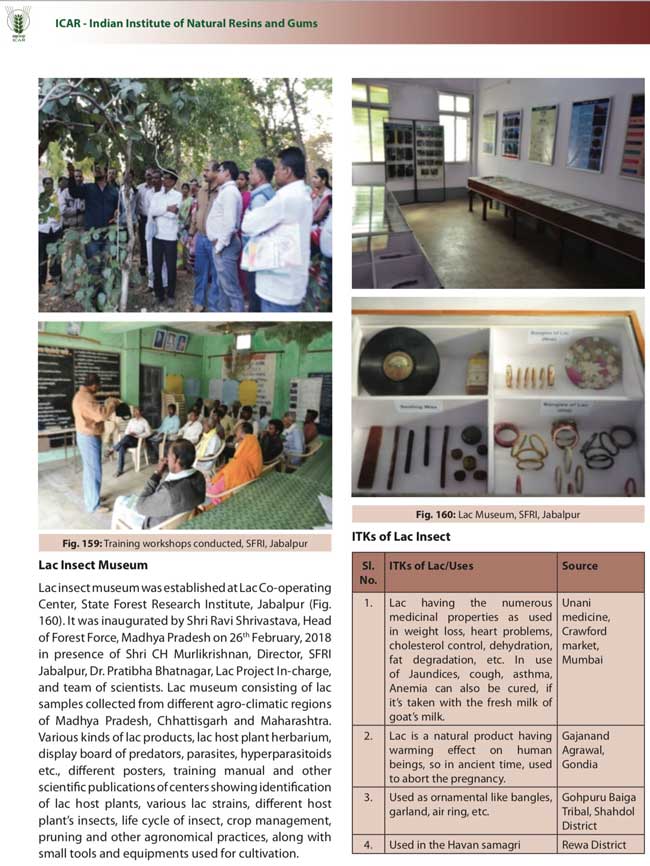
Lac insect museum was established at Lac Co-operating Center, State Forest Research Institute, Jabalpur (Fig. 160). It was inaugurated by Shri Ravi Shrivastava, Head of Forest Force, Madhya Pradesh on 26th February, 2018 in presence of Shri CH Murlikrishnan, Director, SFRI Jabalpur, Dr. Pratibha Bhatnagar, Lac Project In-charge, and team of scientists. Lac museum consisting of lac samples collected from different agro-climatic regions of Madhya Pradesh, Chhattisgarh and Maharashtra. Various kinds of lac products, lac host plant herbarium, display board of predators, parasites, hyperparasitoids etc., different posters, training manual and other scientific publications of centers showing identification of lac host plants, various lac strains, different host plant’s insects, life cycle of insect, crop management, pruning and other agronomical practices, along with small tools and equipments used for cultivation.
Network Projects (ICAR, New Delhi sponsored), p. 111
27. 2.1.054 Enabling tribal communities to improve their livelihoods through agroforestry systems on a sustainable basis – Principal Investigator: Dr. J Ghosh
Publication and Publicity, p. 115
Following papers were presented in 2nd National Conference on Doubling Farmers Income for Sustainable & Harmonious Agriculture (DISHA -2018), ICAR-IINRG, Ranchi, August 11-12, 2018 […]
Sharma KK. Potential of lac cultivation in doubling farm income and lac value chain for entrepreneurship development: An eco- friendly option for tribal areas (Lead Paper), p. 1-2.
p. 132 Hon’ble Chief Minister emphasized on the importance of lac in the economic upliftment of the farming community including forest dwellers, lac growers and small scale entrepreneurs. […]
Skill Development Programme on Lac based, pp. 137
Micro & Small Enterprises
State Govt. sponsored 15 days skill development programme on Lac based micro & small enterprises was organized at ICAR-IINRG, Ranchi during July 03-18, 2018. […]
p. 138 Dr. Nirmal Kumar, Principal Sc. & Head, TOT Division briefed about the importance of lac processing in the economic upliftment of the farming community including forest dwellers, lac growers and small scale entrepreneurs. He told that primary processing will supplement the income so that target of 2022 of doubling income may be achieved. Dr. Niranjan Prasad, Principal Sc. & Head, PPD Division briefed about the lac based technological interventions of the Institute. Shri Sanjit Kumar, Deputy Director, MLKUVB told that government will procure the produce from the tribal farmers at remunerative price and have a plan to support for processing and value addition. About 50 stakeholders including 30 master trainees participated in the inaugural function. […]
Her Excellency Mrs. Droupadi Murmu, The Governor of Jharkhand and the Chief Guest of the inaugural function emphasized the importance of minerals which is available in plenty in the state of Jharkhand. She also mentioned the importance of lac and gum, which is the livelihood of the tribal farmers in the state. She also stressed upon the need of the development in the agriculture and allied sector to double the farmers’ income by 2022 and appreciated the efforts made by ICAR in general and ICAR Institutes’ based at Ranchi in particular. She highlighted the challenge to convince the tribal farmers to adopt new generation farming technologies in order to overcome the poverty and distress.
Source: ICAR-Indian Institute of Natural Resins and Gums, Annual Report 2018-19, published by Dr. KK Sharma, Director
URL: https://iinrg.icar.gov.in/annualreport.pdf
Date visited: 4 December 2019
[Bold typeface added above for emphasis]
Research: explore PhD theses from all over India
Shodhganga (Open Access)
Search Worldcat.org for publications by reputed authors (select “Open Content/Open Access” for freely downloadable content)
Search tips
Combine the name of any particular state, language or region with that of any tribal (Adivasi) community.
Ask a question that includes “tribal” or “Adivasi”, for instance: “Adivasi way of life better?” (or “tribal way of life worse?”)
Add keywords of special interest (music, poetry, dance just as health, sacred grove and biodiversity); learn about the rights of Scheduled Tribes such as the “Forest Rights Act” (FRA); and the United Nations “Declaration on the Rights of Indigenous Peoples”, “Universal Declaration of Human Rights”, “women’s rights”, or “children’s right to education”.
Specify any particular issue or news item (biodiversity, bonded labour and human trafficking, climate change, ecology, economic development, ethnobotany, ethnomedicine, global warming, hunter-gatherers in a particular region or state, prevention of rural poverty, water access).
Basics
Tribal Cultural Heritage in India in the 21st century (printfriendly PDF)
Forest dwellers in early India – myths and ecology in historical perspective
Education
Background guide for education (free eBook)
Childhood | Child marriage | Children’s right to Education
! Contact: National helpline Childline & report trafficking
Customs | Marriage customs | Social conventions
Free comic books (Unicef)
Survival Int. on tribal education
Video | “Nations don’t make us human – languages make us human”: Ganesh Devy
Health, environment & nature
Biological Diversity: What is the Biodiversity Act?
Forest dwellers in early India – myths and ecology
Issues
Assimilationist & isolationist positions
“Casteism” and its effect on tribal communities
Denotified Tribe vs. “criminal tribe“
Fighting exploitation and women’s stigmatization
Particularly Vulnerable Tribal Groups & Endangered languages (interactive map)
President of India
National development and the development of tribal communities are linked
Government of India, national & international organizations
Endangered languages: Peoples’ Linguistic Survey of India
Govt. of India, NGOs, Indian universities and international organisations
Govt. What are the Rights of Scheduled Tribes (ST)
Human Rights Commission (posts) | www.nhrc.nic.in (Government of India)
India’s Constitutional obligation to respect their cultural traditions
India’s 28 States and 8 Union Territories
National Commission for Scheduled Tribes | Related posts
Particularly Vulnerable Tribal Groups (PVTG)
People’s Linguistic Survey of India | Volumes (PLSI) | PeoplesLinguisticSurvey.org
Universal Declaration of Human Rights & International Convention against Torture
Women | Safe search | President Droupadi Murmu on women’s empowerment
Legal provisions
Child rights & Right to education handbook
Constitution and Supreme Court
Denotified, nomadic and semi-nomadic (“hidden”) tribes: Classifications in different states
Forest Rights Act (FRA) | Legal rights | What is the Forest Rights Act about?
India’s Constitutional obligation to respect their cultural traditions
Right to Information Act (RTI)
Scheduled Tribes (ST) | Who are Scheduled Tribes?
Who is a forest dweller under this law, and who gets rights?
Resources
Adivasis’ struggle for India’s freedom and Independence
Anthropology & Anthropological Survey of India
The Anti-Autocracy Handbook: A Scholars’ Guide to Navigating Democratic Backsliding | Backup (PDF, 500 KB)
Books on tribal culture and related resources
Fact checking | Factchecker.in | Safe search examples with keywords:
“factchecker.in rural india“| “factchecker.in adivasi tribe“
Figures, census and other statistics | Primitive Tribes in Andaman and Nicobar Islands (Census 2011)
Indian magazines and web portals – news coverage and analysis
Indigenous knowledge: biodiversity, ecology, health, nutrition, nature, wildlife
Languages and linguistic heritage
Nehru’s 5 Principles: Panchsheel
News update in Indian periodicals: Tribal Affairs
People’s Linguistic Survey of India | Volumes (PLSI) | PeoplesLinguisticSurvey.org
Tips for using interactive maps
Toggle to normal view (from reader view) should the interactive map not be displayed by your tablet, smartphone or pc browser
For details and hyperlinks click on the rectangular button (left on the map’s header)
Scroll and click on one of the markers for information of special interest
Explore India’s tribal cultural heritage with the help of another interactive map >>