Josh Hall, The Guardian, Thursday 12 March 2015| For music examples and to read the full article, click here >>
To mark the 40th anniversary of the end of the Vietnam war, a new record has collected the work of the country’s traditional musicians. The result is an intensely affecting set of songs shot through with loss
[…] In April, Vietnam will mark the 40th anniversary of the end of the war. In commemoration of the conflict, German music label Glitterbeat, best known for its work with Tuareg rockers Tamikrest, has compiled an extraordinary record collecting the work of Vietnamese master musicians. Hanoi Masters: War Is a Wound, Peace Is a Scar is an intensely affecting set of songs performed by musicians in their later years. Some of the compositions are direct responses to the war, while others are new adaptations of traditional Vietnamese songs. Regardless of when the songs were written, though, the recordings are all shot through with a sense of intense loss – the loss, the listener feels, not only of friends and family, but also of the innocence that a country that has endured a long history of colonial conflict can perhaps never again enjoy. […]
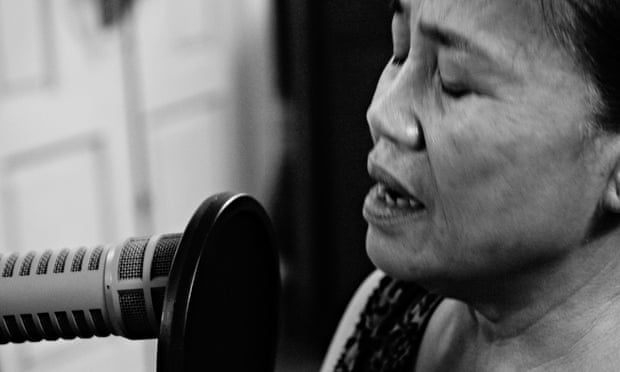
While her father was a guitarist, many of the songs on Hanoi Masters are performed on ancient Vietnamese instruments half-forgotten by almost everyone but these master musicians. Most fascinating among these is the K’ni, a “mouth violin” believed to have had mystical qualities of such power that to play it privately was outlawed. […]
Using traditional instruments as the foundation, I introduce a new and modern musical voice to help the young generation develop an appreciation for Vietnamese traditional arts and culture.”
Hanoi Masters offers a window into the stark and powerful beauty of traditional Vietnamese music, and into the nature of music as a salve and response to this most savage of wars. This is not simply a historical exercise; the songs recorded here feel alive and raw, as if the performers are acting as mediums for the horror that their countrymen endured, making it real and present yet again. For Brennan, notions of preservation are too simplistic. Instead, these ideas must be considered in the context of an imbalance born of America’s long cultural dominance. “Music cannot and should not be totally preserved,” he says. “It is a living and evolving thing. […]
Source: Hanoi Masters: the musicians keeping Vietnam’s lost songs alive | Music | The Guardian
Address: http://www.theguardian.com/music/2015/mar/12/hanoi-masters-40th-anniversary-end-vietnam-war-wound-peace-scar
Date Visited: Sun Dec 20 2015 16:58:41 GMT+0100 (CET)
Basics
Tribal Cultural Heritage in India in the 21st century (printfriendly PDF)
Forest dwellers in early India – myths and ecology in historical perspective
Education
Background guide for education (free eBook)
Childhood | Child marriage | Children’s right to Education
! Contact: National helpline Childline & report trafficking
Customs | Marriage customs | Social conventions
Free comic books (Unicef)
Survival Int. on tribal education
Video | “Nations don’t make us human – languages make us human”: Ganesh Devy
Health, environment & nature
Biological Diversity: What is the Biodiversity Act?
Forest dwellers in early India – myths and ecology
Issues
Assimilationist & isolationist positions
“Casteism” and its effect on tribal communities
Denotified Tribe vs. “criminal tribe“
Fighting exploitation and women’s stigmatization
Particularly Vulnerable Tribal Groups & Endangered languages (interactive map)
President of India
National development and the development of tribal communities are linked
Government of India, national & international organizations
Endangered languages: Peoples’ Linguistic Survey of India
Govt. of India, NGOs, Indian universities and international organisations
Govt. What are the Rights of Scheduled Tribes (ST)
Human Rights Commission (posts) | www.nhrc.nic.in (Government of India)
India’s Constitutional obligation to respect their cultural traditions
India’s 28 States and 8 Union Territories
National Commission for Scheduled Tribes | Related posts
Particularly Vulnerable Tribal Groups (PVTG)
People’s Linguistic Survey of India | Volumes (PLSI) | PeoplesLinguisticSurvey.org
Universal Declaration of Human Rights & International Convention against Torture
Women | Safe search | President Droupadi Murmu on women’s empowerment
Legal provisions
Child rights & Right to education handbook
Constitution and Supreme Court
Denotified, nomadic and semi-nomadic (“hidden”) tribes: Classifications in different states
Forest Rights Act (FRA) | Legal rights | What is the Forest Rights Act about?
India’s Constitutional obligation to respect their cultural traditions
Right to Information Act (RTI)
Scheduled Tribes (ST) | Who are Scheduled Tribes?
Who is a forest dweller under this law, and who gets rights?
Resources
Adivasis’ struggle for India’s freedom and Independence
Anthropology & Anthropological Survey of India
The Anti-Autocracy Handbook: A Scholars’ Guide to Navigating Democratic Backsliding | Backup (PDF, 500 KB)
Books on tribal culture and related resources
Fact checking | Factchecker.in | Safe search examples with keywords:
“factchecker.in rural india“| “factchecker.in adivasi tribe“
Figures, census and other statistics | Primitive Tribes in Andaman and Nicobar Islands (Census 2011)
Indian magazines and web portals – news coverage and analysis
Indigenous knowledge: biodiversity, ecology, health, nutrition, nature, wildlife
Languages and linguistic heritage
Nehru’s 5 Principles: Panchsheel
News update in Indian periodicals: Tribal Affairs
People’s Linguistic Survey of India | Volumes (PLSI) | PeoplesLinguisticSurvey.org