The few villages in Adilabad district that remain difficult to access […]
Much of tribal traditions with respect to agriculture and food habits can be seen in original form in these habitations as they were left untouched by developments elsewhere.
Seasonal and viral diseases account for death of scores of tribal people in this district every year. Anaemia, especially among young women and children, has been identified as the root cause of such deaths.
The Integrated Tribal Development Agency (ITDA), Utnoor, had conducted a survey on incidence of anaemia among tribal people inhabiting a dozen remote villages on the route to Jodeghat in Kerameri mandal. Of the nearly 300 persons subjected to tests, only one was found anaemic and the reason was not far to look for.
The villagers in Jodeghat, Patnapur, Babejhari, Shivguda, Chalbadi among others carried on with traditional desi crops while the rest of the agency migrated to commercial hybrid crops. Neither Bt cotton nor fertilizers and pesticides found their way into these villages owing to problems of logistics.
Local varieties of food grains like jowar (sorghum), maize, beans, green gram and a host of oil foods continue to be cultivated here. These provide for the nutrition that the tribal bodies require.
Rice, which was a luxury for the poor tribal people, became their staple diet after N.T. Rama Rao introduced the Rs. 2 a kg rice scheme. It replaced all the rich and varied food including a variety of tubers found in the jungles.
“Our people took to rice but shun the rich in nutrition starch which contains all the water soluble vitamins. The decrease in vitamin intake has decreased resistance among them,” says Thodsam Chandu, a Gond doctor who is Additional District Medical and Health Officer in the agency.
Dr. Chandu says tribal children can be made aware of various traditional vegetables if backyard gardening is introduced in ashram schools and other hostels. Old crops should also be brought back into cultivation as a permanent measure of food security in these parts, he adds.
Source: “Traditional diet helps tribal people keep anaemia at bay” by S. Harpal Singh, The Hindu, ADILABAD, April 20, 2012
Address : https://www.thehindu.com/news/states/andhra-pradesh/article3332923.ece
Date Visited: Fri May 18 2012 11:01:11 GMT+0200 (CEST)
Learn more about the Gond community >>
Reports in the Indian press | List of periodicals included in this search >>
Search tips
Combine the name of any particular state, language or region with that of any tribal (Adivasi) community.
Add keywords of special interest (music, poetry, dance just as health, sacred grove and biodiversity); learn about the rights of Scheduled Tribes such as the “Forest Rights Act” (FRA); and the United Nations “Declaration on the Rights of Indigenous Peoples”, “Universal Declaration of Human Rights”, “women’s rights”, or “children’s right to education”.
Ask a question that includes “tribal” or “Adivasi”, for instance: “Adivasi way of life better?” (or “tribal way of life worse?”)
Specify any particular issue or news item (biodiversity, bonded labour and human trafficking, climate change, ecology, economic development, ethnobotany, ethnomedicine, global warming, hunter-gatherers in a particular region or state, prevention of rural poverty, water access).
For official figures include “scheduled tribe ST” along with a union state or region: e.g. “Chhattisgarh ST community”, “Himalayan tribe”, “Scheduled tribe Tamil Nadu census”, “ST Kerala census”, “Particularly Vulnerable Tribal Group Jharkhand”, “PVTG Rajasthan”, “Adivasi ST Kerala”, “Adibasi ST West Bengal” etc.
SafeSearch browser tips
If your (mobile) browser fails to display “embedded” media contents, Google maps and SafeSearch windows
Try another browser like Firefox, Chrome or Safari available on your device
Ensure your favourite browser is up to date
Close your present browser
Check your browser and mobile (gsm) settings:
e.g. permission for video or JavaScript
(seen under Preferences >Security >Enable JavaSript)
Restart your computer (smartphone, tablet)
Reconnect to your wifi network or connect to a different one
On some iPhone models the following helps:
>Settings >Safari >scroll down to:
SETTING FOR WEBSITES
Enable “Request Desktop Website” (All Websites) temporarily
Return to the map-post in Safari and “Reload”
Return to >Settings and disable “Request Desktop Website” again
Return to the post in Safari and “Reload”which should now display “embedded” contents as intended (with the convenience of browsing the mobile version on a small screen)
Note: similar solutions may also work with other mobile operating systems.
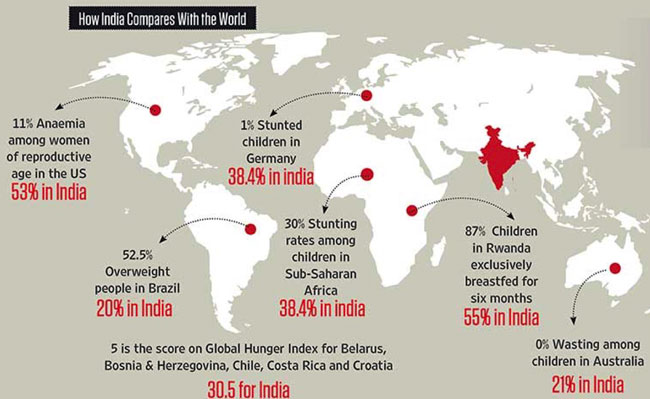
Graphic © Outlook India 26 August 2019 >>
The tribal food basket has always been diverse and nutritious >>
Childrens rights: UNICEF India | Childrens right to education >>
Health spending by the Indian government
“Health spending by the Indian government as percentage of GDP has long been one of the lowest for any major country, and the public health system is chronically dismal.” – Pranab Bardhan in “The two largest democracies in the world are the sickest now” | Learn more: Scroll.in, 24 August 2020 >>
Context | Health care for communities identified as “poorest of poor” (PVTGs)
India is designated as the melting pot of so many ethnic groups dwelling at the same time under the common umbrella of a unified nation. Among these varied ethnic groups, some of them have been categorized under article 342 (1) of the constitution and have been labelled as Scheduled Tribe. In the post independent scenario, several schemes for upliftment of STs were run by the government but it was found that all these groups did not come up to the same level of development. Some of them were at much lower strata than others. Thus, in order to ensure the development of these communities, they were, for the first time in 1975-76 (during 5th Five-year plan) and thereafter-in 1993, identified as poorest of poor among the STs and were designated as Primitive Tribal Groups and thereafter constitution of India renamed and declared as Particularly Vulnerable Tribal Groups (PVTGs). Out of the 75 particularly vulnerable tribal groups, 13 are residing in Odisha; they are becoming increasing vulnerable due to loss of their customary habitat. The health troubles of rural areas especially in the tribal areas need a unique concentration, because the tribal people have typical health problem.
Source: 2019 PhD thesis (Abstract) by Jayanta Kumar Nayak titled “Health Seeking Behaviour and Health Care Services among the Hill Kharia Mayurbhanj District Odisha”, Department of Anthropology, Central University of Orissa
URL: http://hdl.handle.net/10603/257651
Date Visited: 21 May 2025
Factchecker.in | Safe search examples with keywords:
“tribal rights unesco“ | “rural india unesco“ | “tribal education india unesco“
Learn from M S Swaminathan – a world renowned scientist – how biological diversity contributes to public health, people’s livelihood and environmental security in addition to food security: his call on fellow citizens to use and share resources in a more sustainable and equitable manner; outlining the long journey from the 1992 Earth Summit to a commitment to foster inherited knowledge through India’s Biodiversity Act and Genome Saviour Award; an award intended to reward those who are “primary conservers” – guardians of biological diversity!
More about the work of his foundation which “aims to accelerate use of modern science and technology for agricultural and rural development to improve lives and livelihoods of communities.” – www.mssrf.org | Regarding the issues of food security raised above, and the nutritional value of indigenous grains, seeds and millets, read an in-depth report that concludes that “the tribal food basket has always been diverse and nutritious” >>
Up-to-date reports by Indian experts and journalists
List of sites covered by this Google SafeSearch engine
Academia.edu (platform for academics to share research papers) – www.academia.edu
Archive.org – https://archive.org
Centre for Science and Environment – https://www.cseindia.org
Current Conservation – https://www.currentconservation.org
Development and Cooperation (D+C) https://www.dandc.eu
Down To Earth (India) – www.downtoearth.org.in
India Environment Portal – www.indiaenvironmentportal.org.in
Harnessing Nature Magazine – https://harnessingnature.online
Kalpavriksh Environmental Action Group – https://kalpavriksh.org
Mongabay-India – https://india.mongabay.com
M S Swaminathan Research Foundation – www.mssrf.org
Navdanya (protecting India’s biodiversity based food heritage) – https://navdanya.org
People’s Archive of Rural India – https://ruralindiaonline.org/
Third World Network (Penang, Malaysia) – https://twn.my
The Shola Trust (nature conservation in the Nilgiri region) – www.thesholatrust.org
TribalConnect (“uplift and benefit the community without adversely affecting or changing their vernacular”) – https://tribalconnect.org.in
WorldCat (“the world’s largest library catalog, helping you find library materials online”) – https://worldcat.org
More SafeSearch on this website
Search tips
Combine the name of any particular state, language or region with that of any tribal (Adivasi) community.
Add keywords of special interest (music, poetry, dance just as health, sacred grove and biodiversity); learn about the rights of Scheduled Tribes such as the “Forest Rights Act” (FRA); and the United Nations “Declaration on the Rights of Indigenous Peoples”, “Universal Declaration of Human Rights”, “women’s rights”, or “children’s right to education”.
Ask a question that includes “tribal” or “Adivasi”, for instance: “Adivasi way of life better?” (or “tribal way of life worse?”)
Specify any particular issue or news item (biodiversity, bonded labour and human trafficking, climate change, ecology, economic development, ethnobotany, ethnomedicine, global warming, hunter-gatherers in a particular region or state, prevention of rural poverty, water access).
For official figures include “scheduled tribe ST” along with a union state or region: e.g. “Chhattisgarh ST community”, “Himalayan tribe”, “Scheduled tribe Tamil Nadu census”, “ST Kerala census”, “Particularly Vulnerable Tribal Group Jharkhand”, “PVTG Rajasthan”, “Adivasi ST Kerala”, “Adibasi ST West Bengal” etc.
SafeSearch browser tips
If your (mobile) browser fails to display “embedded” media contents, Google maps and SafeSearch windows
Try another browser like Firefox, Chrome or Safari available on your device
Ensure your favourite browser is up to date
Close your present browser
Check your browser and mobile (gsm) settings:
e.g. permission for video or JavaScript
(seen under Preferences >Security >Enable JavaSript)
Restart your computer (smartphone, tablet)
Reconnect to your wifi network or connect to a different one
On some iPhone models the following helps:
>Settings >Safari >scroll down to:
SETTING FOR WEBSITES
Enable “Request Desktop Website” (All Websites) temporarily
Return to the map-post in Safari and “Reload”
Return to >Settings and disable “Request Desktop Website” again
Return to the post in Safari and “Reload”which should now display “embedded” contents as intended (with the convenience of browsing the mobile version on a small screen)
Note: similar solutions may also work with other mobile operating systems.
What does it mean to be Indigenous?
Indigenous Peoples can be identified according to certain characteristics:
They are politically and socially marginalized.
Most importantly, they self-identify as Indigenous Peoples.
They share an ancestral link with those who inhabited a country or region before they were colonized or before other peoples became dominant.
They have a strong link to particular territories and the surrounding natural resources.
They have distinct social, economic or political systems, which they are resolved to maintain and reproduce.
They have a distinct language, culture and beliefs.
There are more than 5,000 different Indigenous Peoples around the world comprising 476 million people – around 6.2% of the global population. They are spread across more than 90 countries in every region and speak more than 4,000 languages. | Learn more (Amnesty International) >>
Source: “INDIGENOUS PEOPLES’ RIGHTS” by Amnesty International
URL: https://www.amnesty.org/en/what-we-do/indigenous-peoples/
Date Visited: 10 May 2025
Learn more on the Rights of Indigenous Peoples, their Languages & linguistic heritage & Tribal culture worldwide >>
Learn more
Anthropology | Ekalavya (Eklavya) | Government | Networking | Organisations
Colonial policies | Bonded labour, Forced labour, Slavery & Zamindar | “Criminal tribe”
Biodiversity | Biodiversity hotspot | Hyderabad biodiversity pledge | Western Ghats – tribal heritage & ecology
Climate change | Audio | The Climate Question (BBC Podcast)
Coastal region | Mangrove forest | Water | Wetland
Customs | Homes and utensils | Modernity | Native science | Revival of traditions
eBooks, eJournals & reports | eLearning
eBook | Background guide for education
Ecology | Eco tourism | Ethnobotany | Sustainable agriculture | Wildlife tourism
Food distribution | Recommendations
Forest Rights Act (FRA) | Hunter-gatherers | Nishad (Nishada, Sanskrit Niṣāda, “tribal, hunter, mountaineer, degraded person outcast”) | Vanavasi (Vanvasi, Vanyajati)
Health and nutrition | Antivenom | Ayurveda
History | Environmental history and what makes for a civilization – Romila Thapar
Hunter-gatherer | Man animal conflict | Vanavasi | Sakuntala narrative
Fruit | Honey & bees | Indigenous knowledge systems | Mushroom | Vegetable
Involving tribal communities in conservation (Kanyakumari)
Mountains | Nishad (Nishada, Sanskrit Niṣāda, “tribal, hunter, mountaineer, degraded person outcast”) | Particularly vulnerable tribal group (PVTG)
Nature and wildlife | Bamboo | Bird | Crocodile | Elephant | Insect | Snake | Tiger | Trees
Sacred grove | Worship and rituals
Scheduled Tribes | Classifications in different states
Success story | “The tribal food basket has always been diverse and nutritious”
United Nations on climate change
What is the Forest Rights Act about?
Who is a forest dweller under this law, and who gets rights?
Tips for using interactive maps
Toggle to normal view (from reader view) should the interactive map not be displayed by your tablet, smartphone or pc browser
For details and hyperlinks click on the rectangular button (left on the map’s header)
Scroll and click on one of the markers for information of special interest
Explore India’s tribal cultural heritage with the help of another interactive map >>