“The Anganwadi Programme, started by the Government of India in 1975 as part of the Integrated Child Development Scheme (ICDS), is a grassroots programme that reaches out to women in rural areas and urban slums, to educate them on matters of basic health and hygiene, nutrition, pre-natal and post-natal maternal and childcare and child rearing.” – Govt of India Anganwadis Report Part 1.pdf (Backup dated 18 November 2013)
“In 1975, on the auspicious day of Gandhi Jayanti, Integrated Child Development Services (ICDS) Scheme had started its odyssey with an aspiration to make our country a more habitable place for mothers and children.” – Directorate of Child Rights and Trafficking (Government of West Bengal)
“The Directorate of Integrated Child Development Services (ICDS) provides a range of services addressing the education, as well as health and nutrition needs of children below 6, including: supplementary nutrition, immunisation, health check-ups, referral services, pre-school and non-formal education, nutrition and health education. In addition it implements schemes to curb the evil of child marriage.” – Directorate of ICDS (“Implementation Status: Anganwadi Centres”, accessed 24 October 2014)
Tip: for recent reports, type “Anganwadi centres”, “child marriage” etc. in the search field seen below
“If women are empowered, there is more development in society”
– Droupadi Murmu | More speeches by the President of India >>
Up-to-date information: Adivasi women’s health >>
“We shall first have to give up this hubris of considering tribes backward. Every tribe has a rich and living cultural tradition and we must respect them.” – Vice President M. Venkaiah Naidu on the constitutional obligation to respect the cultural traditions of India’s tribal communities
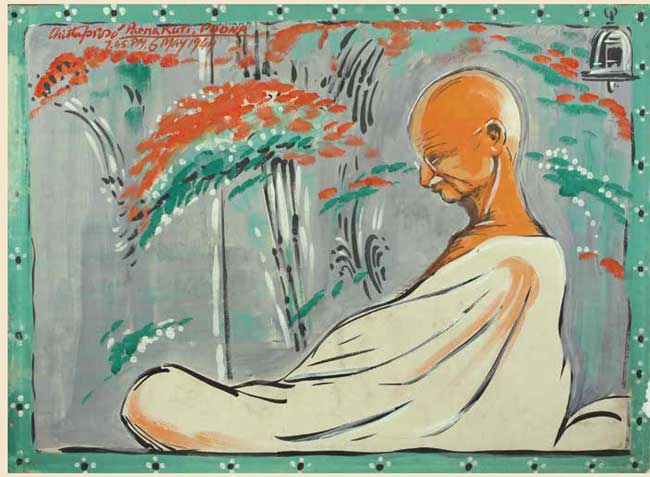
Gandhian social movement | Constitution | Adverse inclusion >>
“Air is free to all but if it is polluted it harms our health… Next comes water… From now on we must take up the effort to secure water. Councillors are servants of the people and we have a right to question them.” – Mohandas K. Gandhi, Ahmedabad address on 1 January 1918; quoted by his grandson, Gopalkrishna Gandhi, in “On another New Year’s Day: Mahatma Gandhi’s ‘khorak’ a 100 years ago” (The Hindu, 1 January 2018)
“The world has enough for everyone’s need but not for anyone’s greed.” – Mahatma Gandhi quoted by Medha Patkar and Baba Amte (Narmada Bachao Andolan)
People have started contributing vegetables, fruits and herbs to the centres
Local communities, especially in rural areas, are getting more involved in their neighbourhood anganwadis, which are playing a major role in combating malnutrition among children.
They have started contributing locally grown vegetables and herbs (mainly coriander and pudina) used in cooking as well as fruits (banana, sapota and papaya) to the anganwadis, which are run under the Integrated Child Development Services (ICDS).
This has shored up efforts made to address nutritional deficiencies among children.
Community participation in anganwadis was introduced around two years ago, but the concept is now catching on among local people.
They are showing more interest in contributing wholesome ingredients to the anganwadis, according to authorities in the Department of Women and Child Development. The community also provides ‘ginnu’, a sweet made from fresh cow’s milk, which is an energy-rich food item. […]
Deputy Director of Women and Child Development N.R. Vijay told The Hindu that the community had come out in support of the anganwadis in their neighbourhoods. […]
To a question, Mr. Vijay said: “Our idea is not to get the food items, but to connect with the community and get their support for programmes aimed at enhancing nutrition in children and health of pregnant women and lactating mothers.” […]
Source: Local communities get more involved in their neighbourhood anganwadis – MYSORE, July 18, 2014
Address : https://www.thehindu.com/news/national/karnataka/local-communities-get-more-involved-in-their-neighbourhood-anganwadis/article6222004.ece
Date Visited: Fri Oct 24 2014 12:43:19 GMT+0200 (CEST)
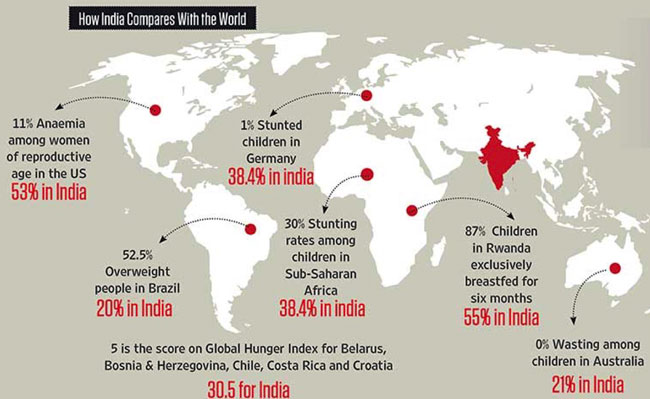
Graphic © Outlook India 26 August 2019 >>
The tribal food basket has always been diverse and nutritious >>
Childrens rights: UNICEF India | Childrens right to education >>
Health spending by the Indian government
“Health spending by the Indian government as percentage of GDP has long been one of the lowest for any major country, and the public health system is chronically dismal.” – Pranab Bardhan in “The two largest democracies in the world are the sickest now” | Learn more: Scroll.in, 24 August 2020 >>
Context | Health care for communities identified as “poorest of poor” (PVTGs)
India is designated as the melting pot of so many ethnic groups dwelling at the same time under the common umbrella of a unified nation. Among these varied ethnic groups, some of them have been categorized under article 342 (1) of the constitution and have been labelled as Scheduled Tribe. In the post independent scenario, several schemes for upliftment of STs were run by the government but it was found that all these groups did not come up to the same level of development. Some of them were at much lower strata than others. Thus, in order to ensure the development of these communities, they were, for the first time in 1975-76 (during 5th Five-year plan) and thereafter-in 1993, identified as poorest of poor among the STs and were designated as Primitive Tribal Groups and thereafter constitution of India renamed and declared as Particularly Vulnerable Tribal Groups (PVTGs). Out of the 75 particularly vulnerable tribal groups, 13 are residing in Odisha; they are becoming increasing vulnerable due to loss of their customary habitat. The health troubles of rural areas especially in the tribal areas need a unique concentration, because the tribal people have typical health problem.
Source: 2019 PhD thesis (Abstract) by Jayanta Kumar Nayak titled “Health Seeking Behaviour and Health Care Services among the Hill Kharia Mayurbhanj District Odisha”, Department of Anthropology, Central University of Orissa
URL: http://hdl.handle.net/10603/257651
Date Visited: 21 May 2025
Factchecker.in | Safe search examples with keywords:
“tribal rights unesco“ | “rural india unesco“ | “tribal education india unesco“
Reports in the Indian press | List of periodicals included in this search >>
Search tips
Combine the name of any particular state, language or region with that of any tribal (Adivasi) community.
Add keywords of special interest (music, poetry, dance just as health, sacred grove and biodiversity); learn about the rights of Scheduled Tribes such as the “Forest Rights Act” (FRA); and the United Nations “Declaration on the Rights of Indigenous Peoples”, “Universal Declaration of Human Rights”, “women’s rights”, or “children’s right to education”.
Ask a question that includes “tribal” or “Adivasi”, for instance: “Adivasi way of life better?” (or “tribal way of life worse?”)
Specify any particular issue or news item (biodiversity, bonded labour and human trafficking, climate change, ecology, economic development, ethnobotany, ethnomedicine, global warming, hunter-gatherers in a particular region or state, prevention of rural poverty, water access).
For official figures include “scheduled tribe ST” along with a union state or region: e.g. “Chhattisgarh ST community”, “Himalayan tribe”, “Scheduled tribe Tamil Nadu census”, “ST Kerala census”, “Particularly Vulnerable Tribal Group Jharkhand”, “PVTG Rajasthan”, “Adivasi ST Kerala”, “Adibasi ST West Bengal” etc.
SafeSearch browser tips
If your (mobile) browser fails to display “embedded” media contents, Google maps and SafeSearch windows
Try another browser like Firefox, Chrome or Safari available on your device
Ensure your favourite browser is up to date
Close your present browser
Check your browser and mobile (gsm) settings:
e.g. permission for video or JavaScript
(seen under Preferences >Security >Enable JavaSript)
Restart your computer (smartphone, tablet)
Reconnect to your wifi network or connect to a different one
On some iPhone models the following helps:
>Settings >Safari >scroll down to:
SETTING FOR WEBSITES
Enable “Request Desktop Website” (All Websites) temporarily
Return to the map-post in Safari and “Reload”
Return to >Settings and disable “Request Desktop Website” again
Return to the post in Safari and “Reload”which should now display “embedded” contents as intended (with the convenience of browsing the mobile version on a small screen)
Note: similar solutions may also work with other mobile operating systems.
Learn more
Adivasi Academy & Museum of Adivasi Voice at Tejgadh
Anganwadi | Community facilities | Ekalavya
Appropriate education for Adivasi children – the Vidyodaya School model
Childhood | Children’s books | Childrens rights: UNICEF India | Safe search
Childrens rights: UNICEF India
Convention on the Rights of the Child: The children’s version | Unicef
eBook | Background guide for education
eBook | Free resources for rural education and health care – Unicef
eBook | “Where the mind is without fear”: Tagore, Gitanjali and the Nobel Prize
Education and literacy | A View of Higher Education in India | Right to education
Forest Rights Act (FRA) | Illegal mining
Health and nutrition | Recommendations by the Expert Committee
Multi-lingual education & Central Institute of Indian Languages (CIIL)
Multilingual education is a pillar of intergenerational learning – Unesco
People’s Linguistic Survey of India | Volumes (PLSI) | PeoplesLinguisticSurvey.org
Rabindranath Tagore: a universal voice – Unesco
RSV School & Museum of Santal Culture (West Bengal)
Scheduled Tribes (ST) | Success story
Tribal Children’s Right to Education in India
Unesco | Unicef | Unicef India | United Nations
United Nations International Days and Weeks
Video | “Nations don’t make us human – languages make us human”: Ganesh Devy
Women | Safe search | President Droupadi Murmu on women’s empowerment