With over 10,000 stories in 124 languages, StoryWeaver is a vibrant reading site that helps children learn while giving a boost to obscure languages
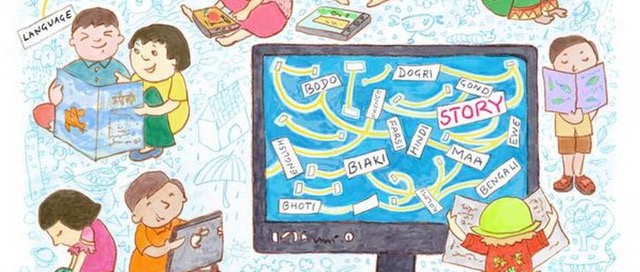
StoryWeaver’s champions who translate stories into different languages for free
CGnet Swara, the online voice portal that allows people in the central tribal belt to report local news, partnered with the platform to translate stories into Gondi. The website has over 250 stories in the language now. […]
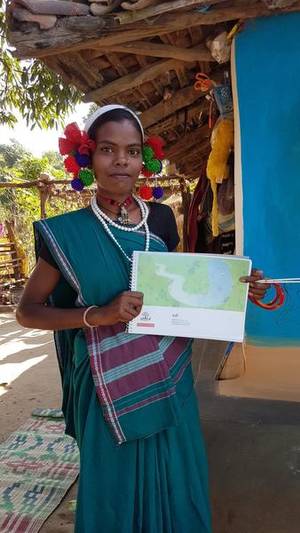
StoryWeaver boasts a handful of “champions” — people who have translated hundreds of stories into a particular language for free. And then there are those like Sarayu Kamat who have taken the stories into the community. On a recent trip to Bastar, she took with her 200 stories in Gondi, each of them printed in colour on A4 sheets and spiral bound into small books. “We visited several houses in Kanker and distributed the books. We also donated some to the local school library,” Kamat says. She shares pictures of young Manisha, who belongs to the Muria tribe in Chhattisgarh, enjoying the Gondi book Kamat had gifted her. […]
Source: “Tell me a story” by P. Anima in The Hindu BusinessLine (28 December 2018)
URL: https://www.thehindubusinessline.com/blink/know/tell-me-a-story/article25848620.ece
Date visited: 5 April 2024
“One’s mother tongue is closest to any person as is one’s mother” – Ganesh Devy
One’s mother tongue is closest to any person as is one’s mother. It is from the mother that a child learns language skills. No mother ever teaches a newborn the rules of grammar; yet all those extremely complicated rules are internalised by the child by merely watching the lip movements and gestures of its mother and by imbibing the tones and textures of her speech. There is a somewhat wrong and widespread impression that children learn languages in school. That may be true of the languages other than the language of one’s home. One has to “learn” through grammar and translation the second or the third language, or more. But, the making of the human brain allows a child to learn most of the complexities of the mother tongue by the time the child is three years old. Writing is another matter. In any case, in the several million years history of Homo sapiens, writing emerged as an apparatus of expression, communication, and memory-storing just about seven thousand years ago. Language is essentially speech; writing is an additional feature that enables long-distance and inter-generational language transactions.
Ganesh Devy in “Languages not liked by Hindutva ideology suffer existential crisis”, Frontline Magazine, 15 June 2023 >>
[Bold typeface added above for emphasis]
Learn more
Anganwadi | Community facilities | Ekalavya
Bhasha | Free eBooks & Magazine: Adivasi literature and languages
Books on tribal culture and related resources
Childhood | Childrens rights: Childrens right to education | UNICEF India | Safe search
Daricha Foundation | Daricha YouTube channel
eBook | Background guide for education
The Food Book of four communities in the Nilgiri mountains: Gudalur Valley – Tamil Nadu
Misconceptions | “Casteism” and its effect on tribal communities
Multilingual education is a pillar of intergenerational learning – Unesco