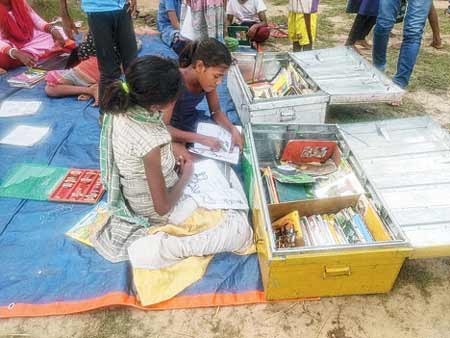
by a mobile library | Photo © The Telegraph >>
Books take tribal kids back to school
Calcutta: Churki Hansda remembers standing on the road instead of going to school on most days of the week because she was too scared.
“I wouldn’t understand anything. The lessons were all in Bengali and I knew only Santhali,” she said.
Now 28, Churki translates stories from Bengali to Santhali for tribal children as part of an initiative by Suchana, an NGO based five kilometres from Santiniketan.
Started in 2005 as an education support group for children from Santhali and Kora villages around Santiniketan, Suchana now has 12 translators. “We realised that a lot of the difficulties the children were facing were because they went to schools where they were learning in an unfamiliar language,” said Kirsty Milward from the UK, who along with husband Rahul Bose started the NGO. […]
Suchana has published close to 40 storybooks in Santhali and Kora, all in the Bengali script. Some are translations and the rest original stories written by the NGO’s translators or older children.
The NGO also makes alphabet and number flashcards in Santhali and Kora for primary schoolchildren enrolled in its literacy programme. Older children have access to translated books.
The translated storybooks travel to 25 neighbouring villages in two mobile libraries. Each library goes to two villages a day on a designated day of the week after 3pm, by when schools usually give over. The libraries – a cycle rickshaw and a Maruti van – transport the books in two trunks.
In the hour and a half that the libraries are parked in each village, the librarian and a few others engage the children in drawing, craftwork and storytelling with puppets. They are also shown stories on laptops with the help of StoryWeaver, an online platform by education NGO Pratham Books.
Suchana tied up with StoryWeaver three years ago. The platform, designed so that children can read in their mother tongue, has made the the translation and printing process easier and quicker. What took nearly a year earlier now takes about a month. A 100-odd titles have been translated into the two tribal languages and some have been printed into books.
Suchana tries to integrate aspects of tribal culture into its activities. […]
Most of the children are first-generation learners. “Earlier, a lot of girls would drop out by Class VII, now they want to finish school,” Bose said.
Source: “Books take tribal kids back to school” by Boishakhi Dutt, The Telegraph (Calcutta), 21 June 2018
URL: https://www.telegraphindia.com/states/west-bengal/books-take-tribal-kids-back-to-school/cid/1419234
Date visited: 8 July 2022
[Bold typeface added above for emphasis]
Find educational and children’s books on tribal culture published in India – Custom search
List of sites covered by this Google SafeSearch engine
https://books.katha.org (Katha Books)
https://publicationsdivision.nic.in
Search tips
Combine the name of any particular state, language or region with that of any tribal (Adivasi) community.
Add keywords of special interest (music, poetry, dance just as health, sacred grove and biodiversity); learn about the rights of Scheduled Tribes such as the “Forest Rights Act” (FRA); and the United Nations “Declaration on the Rights of Indigenous Peoples”, “Universal Declaration of Human Rights”, “women’s rights”, or “children’s right to education”.
Ask a question that includes “tribal” or “Adivasi”, for instance: “Adivasi way of life better?” (or “tribal way of life worse?”)
Specify any particular issue or news item (biodiversity, bonded labour and human trafficking, climate change, ecology, economic development, ethnobotany, ethnomedicine, global warming, hunter-gatherers in a particular region or state, prevention of rural poverty, water access).
For official figures include “scheduled tribe ST” along with a union state or region: e.g. “Chhattisgarh ST community”, “Himalayan tribe”, “Scheduled tribe Tamil Nadu census”, “ST Kerala census”, “Particularly Vulnerable Tribal Group Jharkhand”, “PVTG Rajasthan”, “Adivasi ST Kerala”, “Adibasi ST West Bengal” etc.
SafeSearch browser tips
If your (mobile) browser fails to display “embedded” media contents, Google maps and SafeSearch windows
Try another browser like Firefox, Chrome or Safari available on your device
Ensure your favourite browser is up to date
Close your present browser
Check your browser and mobile (gsm) settings:
e.g. permission for video or JavaScript
(seen under Preferences >Security >Enable JavaSript)
Restart your computer (smartphone, tablet)
Reconnect to your wifi network or connect to a different one
On some iPhone models the following helps:
>Settings >Safari >scroll down to:
SETTING FOR WEBSITES
Enable “Request Desktop Website” (All Websites) temporarily
Return to the map-post in Safari and “Reload”
Return to >Settings and disable “Request Desktop Website” again
Return to the post in Safari and “Reload”which should now display “embedded” contents as intended (with the convenience of browsing the mobile version on a small screen)
Note: similar solutions may also work with other mobile operating systems.
More SafeSearch on this website
Search Worldcat.org for publications by reputed authors (select “Open Content/Open Access” for freely downloadable content)
Search tips
Combine the name of any particular state, language or region with that of any tribal (Adivasi) community.
Ask a question that includes “tribal” or “Adivasi”, for instance: “Adivasi way of life better?” (or “tribal way of life worse?”)
Add keywords of special interest (music, poetry, dance just as health, sacred grove and biodiversity); learn about the rights of Scheduled Tribes such as the “Forest Rights Act” (FRA); and the United Nations “Declaration on the Rights of Indigenous Peoples”, “Universal Declaration of Human Rights”, “women’s rights”, or “children’s right to education”.
Specify any particular issue or news item (biodiversity, bonded labour and human trafficking, climate change, ecology, economic development, ethnobotany, ethnomedicine, global warming, hunter-gatherers in a particular region or state, prevention of rural poverty, water access).
See also
Adivasi Academy & Museum of Adivasi Voice at Tejgadh | Lecture “A View of Higher Education in India”
Anganwadi | Community facilities | Ekalavya
Appropriate education for Adivasi children – the Vidyodaya School model at Gudalur
Bringing indigenous knowledge systems into a “pedagogy of the collective”
Childhood | Children’s books | Childrens rights: Education | UNICEF India | Safe search
People’s Linguistic Survey of India | Volumes (PLSI) | PeoplesLinguisticSurvey.org
Multi-lingual education | Residential school | Ekalavya
Multilingual education is a pillar of intergenerational learning – Unesco
Santali education | Teaching Santal children by Boro Baski
Unesco | Unicef | Unicef India | United Nations
United Nations International Days and Weeks
Video | “Nations don’t make us human – languages make us human”: Ganesh Devy
Women | Safe search | President Droupadi Murmu on women’s empowerment