
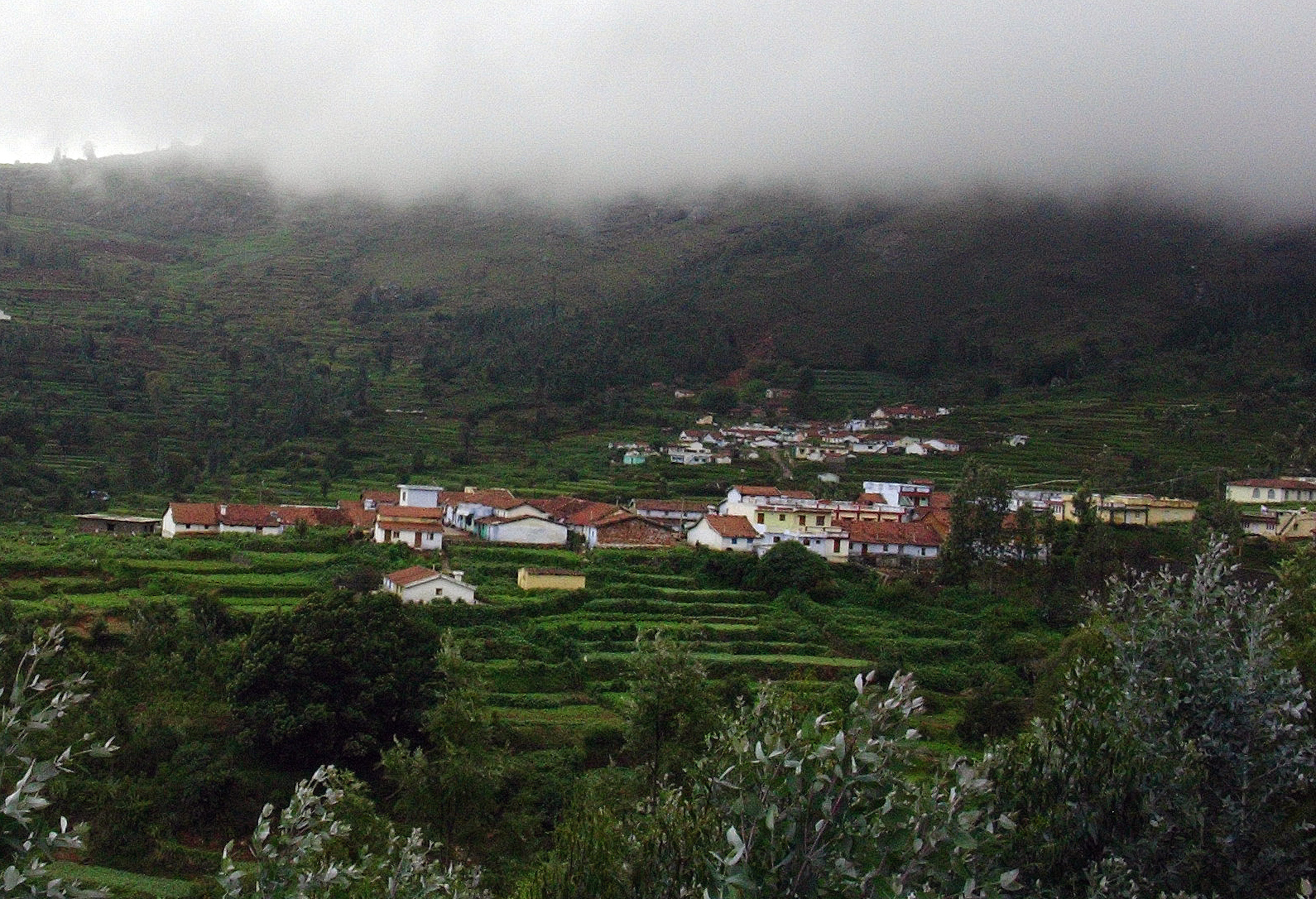
The Badagas are a unique community living mainly in the Nilgiris District in Tamil nadu in South India. They are also the single largest community of the Nilgiris. Though classified backward, a significant factor is the high status of their women says Indu K Malla, a Badaga writer of distinction, in her article ” The myth of Badaga origin & migration […]
Since the Badagas have no script, their history has been documented in other languages (mostly English) by non-Badaga historians and anthropologists (mostly westerners). Since the Nilgiris formed part of the Mysore state domains till 1799, the question of the migrations of the Badagas to the Nilgiris, does not arise. […]
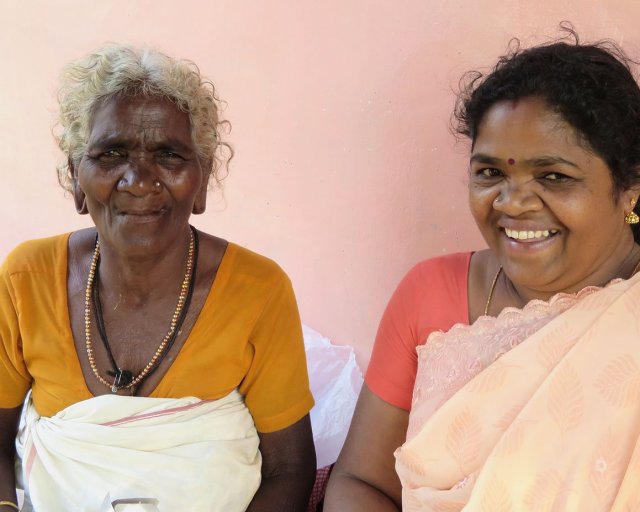
Badaga Henno, Sathiyada MannoThe title is only a rough translation of Badaga woman-hood, for there is no exact English translation for Sathiya – the nearest words are blessed or divine. (‘Mannu’ means soil). The Badaga woman is the epitome of ‘Shakthi’, and many of their festivals, legends, ballads and folk – tales are centred around women. In fact, the chief festival of the Badagas, Hethai Habba, is centred around ‘Hethai’, a woman imbued with divine powers, and who was subsequently deified. It is significant that though the Badagas are a patriarchal society, their women are held in high esteem. The high status of Badaga women perhaps derives from three main factors – the absence of a dowry – system, divorce by mutual consent, and widow-re-marriage. There is no stigma attached to widows; in fact they are part of the mainstream community, and in the fore – front of auspicious functions like engagement and wedding coremonies. Also, there is the practice of ‘hengava nadathodu” – a tradition of giving a daughter / sister material, emotional and moral support throughout her life.Traditional Badaga women are very hardworking, and are the mainstay of the family and the community. They till the soil, harvest the produce, collect fire – wood and water, and tend the cows, in addition to looking after their families. Since the Badagas have been mainly agriculturists, the Badaga women’s ethos is closely connected to the soil. In fact, even the proverbs of the Badagas evoke this ethos – for e.g : “Hennogiri, mannogiri” (A daughter’s / sister’s curse will turn the soil barren). […]
Source: http://badaga.in/
Address : http://badaga.in/
Date Visited: Sun Jan 25 2015 20:33:53 GMT+0100 (CET)
Shantha Thiagarajan, TNN | Nov 13, 2014
UDHAGAMANDALAM: They’ve been fighting to regain their lost status as tribals from the 1970s, and on Tuesday the Badagas, an indigenous community in the Nilgiris, filed a petition in the Madras High court to demand that they be included in the list of scheduled tribes. […]
The Badagas are classified as Backward Class in Tamil Nadu through constitutional orders. The 1901 census classified them as tribals and the 1911 census denoted Badagas as Hindu animist tribals having a tribal mother tongue. In 1931, they were classified as important primitive tribals of southern India. […]
Source: Badagas take fight for scheduled tribe status to Madras high court – The Times of India
Address : http://timesofindia.indiatimes.com/city/coimbatore/Badagas-take-fight-for-scheduled-tribe-status-to-Madras-high-court/articleshow/45128857.cms
Date Visited: Sun Jan 25 2015 20:56:00 GMT+0100 (CET)
Shantha Thiagarajan | May 16, 2012
UDHAGAMANDALAM: To mark the 25th ‘Badaga Day’, the community members launched on Tuesday the ‘Academy for Badaga Culture‘ (ABC), a trust which will focus on many things including setting up of a museum for the community’s archives.
The Badagas, a predominant community in the Nilgiris, have been celebrating May 15 as ‘Badaga Day’ since 1989. On May 15, 1989, the Badagas gathered in large numbers and took out a rally in Ooty town to show their solidarity. Founder of the academy Manjai V Mohan said, “The academy will collect data about the community and its important personalities. Also, a list of firsts in the community will be compiled for future records.” […]
Source: “Badagas to dig into their past” by Shantha Thiagarajan, The Times of India, , 16 May 2012
Address : https://timesofindia.indiatimes.com/city/coimbatore/Badagas-to-dig-into-their-past/articleshow/13159221.cms
Date Visited: 17 April 2022
Learn more about the Badaga community >>
Gender-based violence against women is at an all-time high in Tamil Nadu. For a State that is counted as progressive otherwise, the latest National Family Health Survey findings are a sobering call to action against spousal violence primarily spurred by alcoholism. Even as the State’s coffers are regularly filled by selling alcohol, it is important for the government to devise strategies to protect the women of this State from violence. […]
While a contradiction of such a degree between educational and financial indicators and the indicators on gender-based violence is almost unique in Tamil Nadu, activists and experts say it need not come as a surprise.
Swarna Rajagopalan, founder, Prajnya, says the numbers are not surprising as it is only a myth that better education, economic progress or an ideology that espouses something different would automatically yield a gender-equitable culture. […]
Poet and writer Meena Kandasamy says the problem lies in society’s approach towards violence, which is seen as a corrective disciplinary force. “Parents think it is completely okay to whack a child. Since childhood, violence within the family is seen as a virtuous force because the ‘intent is good’,” she says, adding that within a patriarchal society, women are infantilised and husbands are later given the ‘obligatory’ role of a disciplinarian. […]
S. Anandhi, professor, Madras Institute of Development Studies, says spousal violence is very much related to compulsory marriages. She points out that though the percentage of women accessing higher education in Tamil Nadu is high, a majority of them drop out of the job market after that. She says higher education in a way becomes a step, not towards jobs, but towards marriage, in which women have a limited choice. […]
Professor Anandhi says the purpose of educating women often turns out to be to prepare them for the economic mobility of families and not their own. The purpose itself is patriarchal. She adds that to address genderbased violence, society has to address the crisis of masculinity in the context of neo-liberal economic policies and the lack of quality jobs, particularly for men.
Prasanna Gettu, managing trustee and co-founder, International Foundation for Crime Prevention and Victim Care (PCVC), says that contrary to assumption in a highly patriarchal society, improvement in education and economic independence may in fact increase domestic violence. […]
Source: “No safe haven for women at home” by by Pon Vasanth B.A (*Name changed to protect identity) (With inputs from Vignesh Radhakrishnan and Rebecca Rose Varghese), The Hindu 17 April 2022
URL: www.thehindu.com
Date Visited: 17 April 2022
[Bold typeface added above for emphasis]
“The forest in Shanthi Teacher’s classroom” on Ruralindiaonline.org >>
More about Tribal elders & Women >>
Success stories >>
“National development and the development of tribal communities are linked to each other” – Droupadi Murmu | Learn more >>
“Tribal communities are a standing example of how women play a major role in preservation of eco historic cultural heritage in India.” – Mari Marcel Thekaekara (writer and Co-Founder of ACCORD-Nilgiris) | Learn more >>
“When you are leaving 60 percent of the people behind, you cannot have the ambition to be an economic power.” – Poonam Muttreja (Executive Director of the Population Foundation of India) >>
“Women and girls are disproportionately affected by modern slavery. As they transition through childhood, adolescence and adult life, the impacts of discrimination multiply and gender inequality grows.” – Walk Free Foundation | Learn more >>
“There is no social bias against women in tribal communities such as there exists among the middle castes, especially landed ones. Women can ask for a divorce, and in many communities, money is paid to the girl’s family at the time of marriage.” – Abhay Bang, the award-winning doctor and social activist from Gadchiroli in Maharashtra | Learn more >>
Tribal languages are a treasure trove of knowledge about a region’s flora, fauna and medicinal plants
“Tribal languages are a treasure trove of knowledge about a region’s flora, fauna and medicinal plants. Usually, this information is passed from generation to generation. However, when a language declines, that knowledge system is completely gone.” – Ayesha Kidwai (Centre for Linguistics, School of Language, Literature and Culture Studies, Jawaharlal Nehru University, New Delhi) quoted by Abhijit Mohanty in “Seven decades after independence, many tribal languages in India face extinction threat” | Learn more about the work done by the People’s Linguistic Survey of India and endangered languages worldwide >>
“India’s geographic location at the confluence of three major biogeographic zones – i.e. the Indo-Malayan, the Eurasian and the Afro-Tropical – makes it extremely biodiverse in its genes, species and ecosystems. It is one of the world’s 17 megadiverse countries (Mittermeier et al. 1997). India can boast of over 8.1% of the world’s biodiversity supported on 2.4% of the earth’s surface. An estimated 47,000 identified plant species represent 11% of the world’s flora.” | Learn more: eBook | Disseminating environment related information to improve peoples’ livelihoods >>
“The notion of ‘mainstreaming’ needs to be challenged not just because Adivasi culture is being crushed, but also because Adivasi values and ways of life offer insights that the ‘mainstream’ needs. If we are to halt the destruction of ecosystems, we need to understand how closely biodiversity and cultural diversity are intertwined. Perhaps it is time to reverse the gaze and begin to learn afresh from Adivasis.” – Felix Padel & Malvika Gupta (The Hindu) | Learn more about the role of tribal communities in fostering biodiversity, ethnobotany and cultural diversity | Success stories | Tribal identity >>
“I think that by retaining one’s childhood love of such things as trees, fishes, butterflies and … toads, one makes a peaceful and decent future a little more probable, and that by preaching the doctrine that nothing is to be admired except steel and concrete, one merely makes it a little surer that human beings will have no outlet for their surplus energy except in hatred and leader worship.” – George Orwell | Learn more: Childhood | Customs | Games and leisure time | Literature – fiction | Storytelling >>
Adivasi communities: stewards of India’s cultural heritage and biodiversity
[…] India’s tribal communities — over 104.5 million people, or 8.6 per cent of the population — remain among the most marginalised despite decades of welfare schemes and development promises. In states such as Chhattisgarh, Jharkhand, Bihar, Rajasthan and Odisha, tribal districts consistently record higher poverty levels than non-tribal areas, even as these regions supply land, forests and minerals for the country’s growth. These communities have often been compelled to relinquish their lands for large-scale infrastructure projects, resulting in the erosion of their identity, livelihoods, and future prospects.
It is crucial to recognise the value these communities bring, particularly their eco-friendly lifestyles, which offer important insights into addressing climate-related challenges. For instance, during the 2018 drought in Sundergarh, Odisha, a visit to a remote tribal village revealed thriving vegetation and effective water-harvesting systems. Kiri village in Lahunipara block of Sundergarh district, inhabited by the Paudi Bhuyan community — a Particularly Vulnerable Tribal Group (PVTG) — has demonstrated remarkable resilience.
This observation underscores the importance of learning from traditional ecological knowledge, especially sustainable farming practices that rely on drought-resistant and indigenous seeds.
Adivasi communities, as stewards of India’s cultural heritage and biodiversity, must be central to the nation’s development narrative. Their lives are intricately linked to land, forests and water, yet they face growing threats from climate change, livelihood insecurity and displacement. Addressing these challenges requires more than welfare initiatives; it demands robust enforcement of constitutional rights, substantial public investment and the strengthening of Gram Sabha–based governance. […]
Source: “Union Budget must shift from welfare to rights-based public investment for Adivasi communities” by Debabrat Patra, Sion Kongari & Saurabh Kumar, Down to Earth, 9 February 2026
URL: https://www.downtoearth.org.in/governance/union-budget-must-shift-from-welfare-to-rights-based-public-investment-for-adivasi-communities
Date Visited: 30 June 2026
Up-to-date reports by Indian journalists and commentators
To search Indian periodicals, magazines, web portals and other sources safely, click here. To find an Indian PhD thesis on a particular tribal community, region and related issues, click here >>
Learn more
Anthropology | Irish Journal of Anthropology | Folio Special issue
Colonial policies | History | Indus Valley | Mohenjo Daro
eBooks, eJournals & reports | eLearning
eBook | Background guide for education
Ekalavya (Eklavya)
Forest Rights Act (FRA) | Hunter-gatherers | Nishad (Nishada, Sanskrit Niṣāda, “tribal, hunter, mountaineer, degraded person outcast”) | Vanavasi (Vanvasi, Vanyajati)
India’s Constitutional obligation to respect their cultural traditions
Jawaharlal Nehru’s “five principles” for the policy to be pursued vis-a-vis the tribals
Particularly vulnerable tribal group (PVTG)
Rabindranath Tagore: a universal voice – Unesco
Remembering Birsa Munda: The charismatic tribal leader who shook the British Empire – Jharkhand
Scheduled Tribes | Classifications in different states
Video | Adivasi Academy & Museum of Adivasi Voice at Tejgadh – Gujarat
Video | Tribes in Transition-III: “Indigenous Cultures in the Digital Era”
What is the Forest Rights Act about?
Who is a forest dweller under this law, and who gets rights?