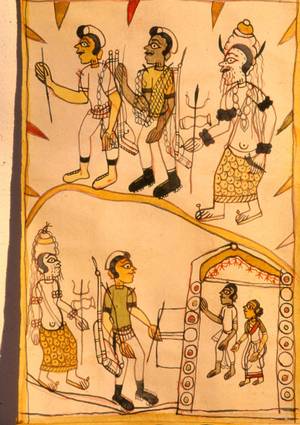
An exhibition in New Delhi that gives a glimpse of diverse storytelling traditions in India.
IGNCA lay enveloped in an eerie silence during the mega cultural festival held during the just-concluded Commonwealth Games in the Capital. Security issues are believed to have spoilt the party. However, with ‘Akhyan’, an exhaustive month-long event put together by SNA and IGNCA presenting the fascinating storytelling traditions of India, the cultural centre seems to have regained its lost vigour.
The venue was abuzz with film shows, daily performances and live demonstrations showcasing the three varied performing traditions — masks, puppets and picture showmen. The three distinct artistic expressions meet on the ground that the stories they narrate either come from the Ramayan, the Mahabharat or the Puranas. […]
Scrolls
It is in the Patua scrolls of Kalighat that one witnesses traditional artists sans any interference negotiating contemporaneity for a long time. Jyotindra Jain, Member Secretary, IGNCA, says contemporary events began finding their way to the scrolls as early as the 1950s. “Nobody commissioned it but Kalighat painters made a scroll depicting the detrimental effects of cinema on the society of West Bengal in 1950. In a Santhal scroll displayed here, you see Shiva visiting a devotee’s house accompanied by two gunmen. The artist imagines him as a VIP and this was done almost 25 years ago.”
Patuas depicting the 9/11 attack and tsunami can also be seen. “Osama Bin Laden has been personified as an airplane and, like in the traditional mythological scroll where you have a scene depicting reward or punishment, Osama is depicted regretting what he did. “In the Pabuji ki Phad religious scroll style of Rajasthan, a few years ago an artist even painted the life story of Amitabh Bachchan which is now at a museum in Amsterdam.”
Source: “Stories behind the masks” by Shailaja Tripathi, The Hindu : Arts / Crafts, 4 November 2010
Address : https://www.thehindu.com/arts/crafts/article868711.ece
Date Visited: 19 February 2021
Find educational and children’s books on tribal culture published in India – Custom search
List of sites covered by this Google SafeSearch engine
https://books.katha.org (Katha Books)
https://publicationsdivision.nic.in
Search tips
Combine the name of any particular state, language or region with that of any tribal (Adivasi) community.
Add keywords of special interest (music, poetry, dance just as health, sacred grove and biodiversity); learn about the rights of Scheduled Tribes such as the “Forest Rights Act” (FRA); and the United Nations “Declaration on the Rights of Indigenous Peoples”, “Universal Declaration of Human Rights”, “women’s rights”, or “children’s right to education”.
Ask a question that includes “tribal” or “Adivasi”, for instance: “Adivasi way of life better?” (or “tribal way of life worse?”)
Specify any particular issue or news item (biodiversity, bonded labour and human trafficking, climate change, ecology, economic development, ethnobotany, ethnomedicine, global warming, hunter-gatherers in a particular region or state, prevention of rural poverty, water access).
For official figures include “scheduled tribe ST” along with a union state or region: e.g. “Chhattisgarh ST community”, “Himalayan tribe”, “Scheduled tribe Tamil Nadu census”, “ST Kerala census”, “Particularly Vulnerable Tribal Group Jharkhand”, “PVTG Rajasthan”, “Adivasi ST Kerala”, “Adibasi ST West Bengal” etc.
SafeSearch browser tips
If your (mobile) browser fails to display “embedded” media contents, Google maps and SafeSearch windows
Try another browser like Firefox, Chrome or Safari available on your device
Ensure your favourite browser is up to date
Close your present browser
Check your browser and mobile (gsm) settings:
e.g. permission for video or JavaScript
(seen under Preferences >Security >Enable JavaSript)
Restart your computer (smartphone, tablet)
Reconnect to your wifi network or connect to a different one
On some iPhone models the following helps:
>Settings >Safari >scroll down to:
SETTING FOR WEBSITES
Enable “Request Desktop Website” (All Websites) temporarily
Return to the map-post in Safari and “Reload”
Return to >Settings and disable “Request Desktop Website” again
Return to the post in Safari and “Reload”which should now display “embedded” contents as intended (with the convenience of browsing the mobile version on a small screen)
Note: similar solutions may also work with other mobile operating systems.
More SafeSearch on this website
[Bold typeface added above for emphasis]

A commemoration of times when the Santals had to defend
themselves and hide their identity behind masks
Learn more about this and other murals in West Bengal >>
Related post
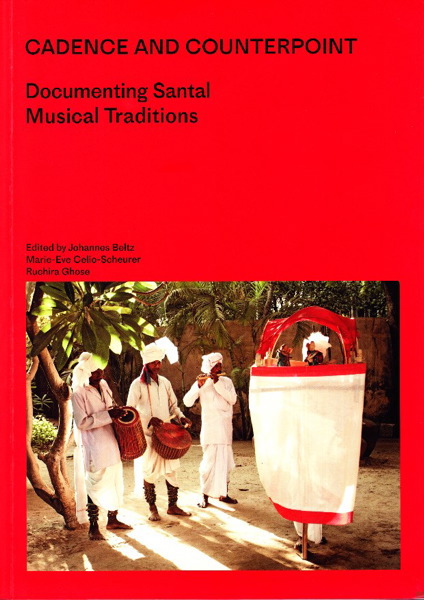
Learn more
Adivaani (platform for indigenous expression and assertion)
Biodiversity and development – Jharkhand
Education and literacy | Right to education
Ghosaldanga Bishnubati Adibasi Trust
Hul (Santal rebellion 1855-1856) | Tribal freedom fighters
Literature and bibliographies | Literature – fiction | Poetry
Santal | Santal Parganas | The Santals by Boro Baski
Video | Hul Sengel: The Spirit of the Santal Revolution (1855)
Video | Poetry reading by “Marshal” Parimal Hembram – West Bengal
Tips for using interactive maps
Toggle to normal view (from reader view) should the interactive map not be displayed by your tablet, smartphone or pc browser
For details and hyperlinks click on the rectangular button (left on the map’s header)
Scroll and click on one of the markers for information of special interest
Explore India’s tribal cultural heritage with the help of another interactive map >>