Rites of Passage | Read the full article with illustrations here >>
In general, women have a strong connection with the idea of a “vital cycle” not only as life givers, care-takers of children and the home; and their own monthly menstrual cycles. Some women, especially those from the tattoo community within the Gond tribe have a strong connection to the rites of passage — which are marked by the application of a certain godna tattoo motif on a specific part of the body — to mark the entrance into a new phase of life (such as puberty or pregnancy), for a woman. The motif and the placement varies according to the tribe they are inscribing the tattoo on. Baiga tribe motifs vary for instance, from Bhil tribes. That the tattoos are mainly done by women on women is another strong connection they have to the cycle of life.
Similarly, both Chittara and Mithila art was traditionally painted on the walls and floors outside the home — according to the season, festival or special occasion (for instance, marriage) by the lady of the house. The motifs (in the case of Chittara) and the subject matter (in the case of Mithila) reflect the changing of seasons and represent the different stages of life — from birth to death. […]
The over-arching idea for each new typecraft, is, to challenge both the craftsperson and ourselves as designers. The aim is to be able to engage and work with a number of forms of craft and tribal art from all parts of the country — that are made with varying materials for different purposes and a diverse set of meanings associated with the craft or tribal art.
Since I work a lot in the cultural sector, my goal is to include the completed typefaces from, The Typecraft Initiative, into these projects and also have more and more people and state governments use the these typefaces. It is only then that the project will be successful and can make a bigger impact.
The Akshara experiment: “Together by Design” (Caravan Magazine)
[…] The Akshara experiment, carried out over five years, brought together 58 artists in crafts, textiles and traditional paintings on a journey of discovery into the world of letters, scripts and calligraphy, and texts. Guided by politician, social activist and crafts expert Jaitly, who founded and has been the president of Dastkari Haat Samiti since 1986, the idea at the heart of the project was to combine two of our finest, and most neglected, cultural properties: the wealth of Indian crafts and our unparalleled linguistic diversity.
The project had a long germination. At the Frankfurt Book Fair in 2006, where India was the Guest of Honour country, Jaitly was asked to take an exhibition of 24 maps she had created to represent India’s culture of handcrafting, along with a showcase of India’s old manuscripts belonging to the Ministry of Human Resources Development. In addition to mounting her large, colourful maps, which introduced selected artefacts and craftspeople from regions across India, she decided to create graphics in the respective scripts over parts of the illustrations in order to blend the concept with the book fair. The result was striking.
Jaitly had worked on craft maps of India over a period of 14 years, an initiative that led her to work with artists, graphic designers, researchers and typesetters and which had become part of the Indian Crafts Journey Exhibition that went to London, Frankfurt, Ahmedabad, Chennai and Delhi, culminating in the publication of her Crafts Atlas of India last year. Aside from these events, the idea of Akshara was also a response from Jaitly to the constant laments she heard from very gifted craftspersons about a sense of inadequacy arising from their illiteracy. “The idea of Akshara began with the knowledge that craftspeople are not widely literate, and feel a lack of self-worth when the world around them is going the English-speaking and computer way. Also, we have a great civilisational history involving scripts. We have 22 official languages and hundreds of dialects. However, we do not do much to respect and preserve them as an important part of our culture,” Jaitly told me. […]
The treatment of the language scripts and texts as design elements allows for new and productive ways of seeing and understanding the changing contexts within which craftspeople operate today. This also gives numerous “unlettered” craftspeople a way of establishing their presence in the rapidly urbanising new India. For one, the book shows that Indian craftspeople imbued with a strong sense of their place in a traditional continuum are infinitely more than just the faithful custodians of traditions. It also draws our attention to the great need for “saaksharta” or literacy, a huge and persistent missing link in India’s development story, a need more persuasively expressed because it takes place outside the political and policy planning arena. For it is in spaces such as the one occupied by the crafts that echoes of forgotten ideas like Gandhi’s “Nai Taleem” and socialist leader Ram Manohar Lohia’s views on a more rooted education system and linguistic policy can be found—though the nation’s self-image today is openly antagonistic to such cultural values. Akshara can be viewed in this context as a reminder of the opportunity to make the transition from a feudal system, founded on social exclusion, to a more modern but also a more mature, compassionate society.
THE AKSHARA BOOK, which contains more than a hundred beautifully produced photographs of 24 craft-and-text projects, begins with two essays by Jaitly and Bhowmick. The first essay, “Inspiration for Crafting Indian Scripts”, presents a brief overview of the significance of books and manuscripts in various cultures before expanding on UNESCO’s efforts to preserve languages that express the total “pool of ideas” gathered over time. It also mentions the Art of Writing exhibition consisting of 50 panels mounted by UNESCO in 1965, which recognised the histories of language and script and the origin of art forms associated with writing. […]
The fact remains, though, that in the modern urban order of art shows dominated by curators, catalogues and openings, craftspeople do not fit in in their own right. Even acknowledged shilpa gurus (crafts mentors) of whom many are unlettered, consider themselves inferior, especially when confronted with the disorganisation in their own sector and the fact that their buyers and patrons are from a world to which they can never hope to belong. Responding to such issues, the metal workers of Odisha created a statuette in dhokra, or the lost-wax method of metal casting, showing a tribal man covered in traditional ornaments confidently working on a computer, complete with mouse and keyboard. […]
OR THOSE WHO STILL ASK if the crafts are a separate category from the visual arts, the Akshara project can be a persuasive reiteration of what many leading artists have called an artificial divide. Artists in post-independence India and institutions such as the Santiniketan, Baroda and Madras schools have had a deep understanding of and engagement with the crafts. J Swaminathan, who set up the Roopankar Museum of Fine Arts at Bharat Bhavan in Bhopal, showed contemporary urban modern art and tribal art side by side. […]
Many other narratives in the Akshara project point to this ingrained Indian tendency to disregard indigenous art, a collective misjudgement that is all but legitimised by official attitudes. Since independence, government agencies handling crafts have been divided between the Khadi Gramodyog department and various ministries such as Industry, Rural Development and Textiles. Sometimes programmes are duplicated, or slip between the floorboards altogether, or crafts proposals are crushed under the weight of bigger interests within the same ministry. A real appreciation of the contexts from which crafts emerge, and a forum for their sustenance and propagation, cannot materialise if crafts are considered merely a cottage industry, manufacturing merchandise that forever needs subsidies. The power of Akshara lies in the fact that 60 years after planned development in a modern democracy, the project shows the way for a new institution for old ideas.
Source: “Together by Design” by Devina Dutt | Caravan Magazine – A Journal of Politics and Culture, 1 February 2013 Address : https://caravanmagazine.in/arts/together-design Date Visited: 20 March 2013
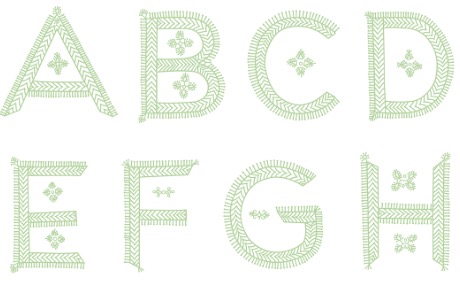
Godna typeface | To view more photos and read the full text, click here >> Godna is a display typeface based on Gond tribal tattoo drawings. For this edition of the project, we engaged with three tribal women artists — Ram Keli, Sumitra and Sunita — who belong to the Gond tribe of Chhattisgarh in Central India. These and other women from this tribe etch tattoos onto the Baiga and other tribal women. […] All the drawings and artworks are completely done by them and we never drew anything for the artists except as part of the instruction.
Chittara| To view more photos and read the full text, click here >> Chittara originated from ancient cave paintings and eventually found its way to the walls and floors of village homes. The Kannada word Chittara (which is related to chittra) means creating an image or drawing. Historically, the artform has been practiced by women of the Deevaru community in the Sagar district of Karnataka, where these images were painted on auspicious occasions on the interiors and exteriors of the home. These paintings are a part of the family and community rituals associated with daily life and festive seasons.
This form is only done by the woman of the house to make the entrance auspicious and to welcome the gods. In this project we had to explain the rules of type design as well as how this specific artwork can be transformed into type. We intentionally let the artist, Radha Sullur, draw and paint all the letters herself. […]
Sanchari Pal, The Better India, June 14, 2016 | To read the full article and view more photos, click here >>
Even among the tribes of western India, the craft of tattooing is revered, with tattoos having a close relation to secular and religious subjects of devotion. The Rabari women of Kutch have practised tattooing for decorative, religious, and therapeutic purposes for hundreds of years. A traditional Rabari tattoo kit is simple: a single needle and gourd bowl to hold the liquid pigment, which is made by mixing lamp soot with tannin from the bark of local trees. A small quantity of turmeric powder is also added to brighten the colour and to prevent swelling.
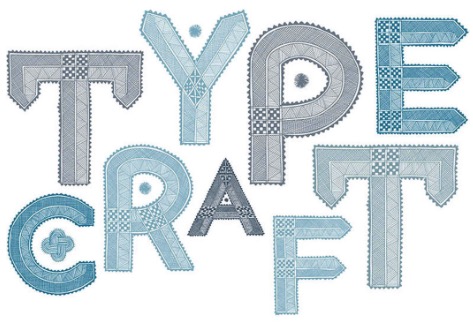
The Typecraft Initiative is a self-initiated and self-funded project that aims to create — display typefaces from languishing crafts and tribal arts from each state of India. Each typeface is made from a craft or tribal art, which belongs to a specific region, material, process and context. | Learn more >>