“It is almost impossible to characterize all of India’s tribals in a single ethnographic or historic framework. […]
After Independence, these communities were ‘denotified’ and placed quite randomly in the schedules of tribes, castes and other ‘backward communities’. Yet anyone with any experience of tribal culture will find these listings mind-boggingly oversimplified.
The most useful indicator of tribal identity, then, is language. This book is an introductory sampling of the literary imaginations of those communities whose speech traditions face the prospect of forced aphasia. The selections are representative works from languages that have remained largely spoken and are just beginning to be written; languages that have slowly started acquiring scripts and developing written forms of literature, dialects that are fast perishing because they are on the margins of the main languages, or from communities that have remained outside the caste fold of Indian society. […]” – From the Introduction by Prof. G.N. Devy (pp. ix-xvi)
Source: Bhasha E Books | Free download: https://www.bhasharesearch.org/ebook/read-PaintedWords-bhasha
[Bold typeface added above for emphasis]
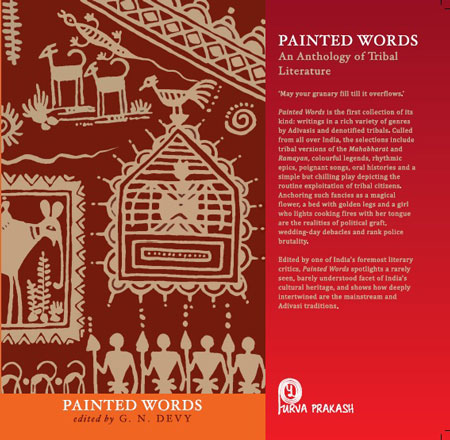
Description: Painted Words: An Anthology of Tribal Literature
Description : Painted Words is the first collection of its kind: writings in a rich variety of genres by Adivasis and denotified tribals. Culled from all over India, the selections include tribal versions of the Mahabharat and Ramayan, colourful legends, rhythmic epics, poignant songs, oral histories and a simple but chilling play depicting the routine exploitation of tribal citizens.
Author : G. N. Devy
Publisher : Purva Prakash Publication
Edition : 2012
Price : INR 350
Language : English
No. of Pages : 312
ISBN No. : 978-81-922405-4-1
Tribal Literature by G.N. Devy >>
Free eBooks & Magazine: Adivasi literature and languages >>
Find scholarly books, poetry and fiction relating to tribal culture – Indian publishers
List of sites covered by this Google SafeSearch engine
https://www.alephbookcompany.com
More SafeSearch on this website
Search tips
Combine the name of any particular state, language or region with that of any tribal (Adivasi) community.
Add keywords of special interest (music, poetry, dance just as health, sacred grove and biodiversity); learn about the rights of Scheduled Tribes such as the “Forest Rights Act” (FRA); and the United Nations “Declaration on the Rights of Indigenous Peoples”, “Universal Declaration of Human Rights”, “women’s rights”, or “children’s right to education”.
Ask a question that includes “tribal” or “Adivasi”, for instance: “Adivasi way of life better?” (or “tribal way of life worse?”)
Specify any particular issue or news item (biodiversity, bonded labour and human trafficking, climate change, ecology, economic development, ethnobotany, ethnomedicine, global warming, hunter-gatherers in a particular region or state, prevention of rural poverty, water access).
For official figures include “scheduled tribe ST” along with a union state or region: e.g. “Chhattisgarh ST community”, “Himalayan tribe”, “Scheduled tribe Tamil Nadu census”, “ST Kerala census”, “Particularly Vulnerable Tribal Group Jharkhand”, “PVTG Rajasthan”, “Adivasi ST Kerala”, “Adibasi ST West Bengal” etc.
SafeSearch browser tips
If your (mobile) browser fails to display “embedded” media contents, Google maps and SafeSearch windows
Try another browser like Firefox, Chrome or Safari available on your device
Ensure your favourite browser is up to date
Close your present browser
Check your browser and mobile (gsm) settings:
e.g. permission for video or JavaScript
(seen under Preferences >Security >Enable JavaSript)
Restart your computer (smartphone, tablet)
Reconnect to your wifi network or connect to a different one
On some iPhone models the following helps:
>Settings >Safari >scroll down to:
SETTING FOR WEBSITES
Enable “Request Desktop Website” (All Websites) temporarily
Return to the map-post in Safari and “Reload”
Return to >Settings and disable “Request Desktop Website” again
Return to the post in Safari and “Reload”which should now display “embedded” contents as intended (with the convenience of browsing the mobile version on a small screen)
Note: similar solutions may also work with other mobile operating systems.
Search Worldcat.org for publications by reputed authors (select “Open Content/Open Access” for freely downloadable content)
Search tips
Combine the name of any particular state, language or region with that of any tribal (Adivasi) community.
Ask a question that includes “tribal” or “Adivasi”, for instance: “Adivasi way of life better?” (or “tribal way of life worse?”)
Add keywords of special interest (music, poetry, dance just as health, sacred grove and biodiversity); learn about the rights of Scheduled Tribes such as the “Forest Rights Act” (FRA); and the United Nations “Declaration on the Rights of Indigenous Peoples”, “Universal Declaration of Human Rights”, “women’s rights”, or “children’s right to education”.
Specify any particular issue or news item (biodiversity, bonded labour and human trafficking, climate change, ecology, economic development, ethnobotany, ethnomedicine, global warming, hunter-gatherers in a particular region or state, prevention of rural poverty, water access).
Research: explore PhD theses from all over India
Shodhganga (Open Access)
Learn more
Adivasi Academy & Museum of Adivasi Voice at Tejgadh
Adverse inclusion | Casteism | Rural poverty
Anthropology | eBooks, eJournals & reports | eLearning
Central Institute of Indian Languages (CIIL) Mysore
Colonial policies | Denotified Tribe vs. “criminal tribe“ | Imprisonment & rehabilitation
eBook | Adivasi Stories from Gujarat – Bhasha Research and Publication Centre (Vadodara)
eBook | Background guide for education
Endangered language | PeoplesLinguisticSurvey.org
Ganesh [G.N.] Devy | Publications | Lecture “A View of Higher Education in India”
History | Colonial policies | Freedom Struggle | Independence
Human Rights Commission (posts) | www.nhrc.nic.in (Government of India)
India’s Constitutional obligation to respect their cultural traditions
Languages and linguistic heritage
Literature and bibliographies | Literature – fiction | Poetry
Multilingual education is a pillar of intergenerational learning – Unesco
Museum & Society – A re-evaluation of Adivasi Heritage by Prof. Ganesh Devy
People’s Linguistic Survey of India | Volumes (PLSI) | PeoplesLinguisticSurvey.org
Scheduled Tribes | Classifications in different states
Video clips taken at Tejgadh and related information
Video | “Nations don’t make us human – languages make us human”: Ganesh Devy
Video | Tribes in Transition-III: “Indigenous Cultures in the Digital Era”