Rose Eveleth, The Atlantic, Sep 23 2014 | To read the full article, click here >>
An online-media company has teamed up with linguists to preserve endangered tongues.[…]
Viki has teamed up with the the Living Tongues Institute for Endangered Languages to encourage those who speak endangered languages to contribute their own translations of the shows. They’re currently adding projects for everything from Cherokee, a language spoken by about 18,000 people in the southeastern United States to Maori, a language spoken in New Zealand by about 60,000. The most popular endangered language on the site is Basque, spoken by about 720,000 people in the Basque region on the border between Spain and France.
Viki wasn’t designed as a safe haven for endangered languages. The company’s goal when it launched in 2010 was to build translation communities, and have them share culture from other parts of the world. “We’re opening up the world,” Viki’s CEO Razmig Hovaghimian told me. “Not only the content travels, but the language, the nuance, the culture is suddenly crossing borders.”
And in fact, the site has seen some interesting trends when it comes to who watches and translates what. […]
David Harrison, a linguist at Swarthmore University and the director of research for the Living Tongues Institute, thinks partnering with Viki is an effective way to bring languages like Udmurt to younger people. “Suddenly you have something that isn’t a dry textbook or a grammar lesson,” he says. “Seeing it on TV or on the Internet helps them see that it’s not backwards or obsolete, it’s suited for the modern world. They can restore their pride in the language, which is really the X factor that causes language to be abandoned.”
But there are still a number of challenges associated with this kind of preservation. Some communities in which endangered languages are spoken don’t have access to reliable Internet, which makes it hard for them to participate. A full two-thirds of the world’s languages don’t have a written form, Harrison says, which makes subtitling difficult. And translation is hard work—it takes hours and hours to translate a single episode of a television show. Shklyaev has assembled a dedicated team of volunteers, but finding people who are willing or able to put the time in can be difficult.
Still, Harrison believes in the work groups like Viki are doing. […]
“Everybody knows that we benefit from biodiversity and we’ll suffer if we lose it. It’s not clear to people why that’s true for linguistic diversity.” […]
Source: Saving Languages Through Korean Soap Operas – The Atlantic
Address : http://www.theatlantic.com/international/archive/2014/09/saving-languages-through-korean-soap-operas/380537/
Date Visited: 7 May 2025
Translation is an inseparable component of literature
Translation is an inseparable component of literature without which the idea of multiculturalism holds no concrete value. Every human being is indulged in it in almost every moment of their life, as G. N. Devy puts it that Indian have “translating consciousness”. We are constantly translating our thoughts into words, of any language that is known to us, through which we can help others to understand our views and feelings. This process can be noticed when we use second language or any other language which is not our mother tongue. There has been a long tradition of translation, in larger sense it is as old as human existence. Translations were always done, though with different orientations, for different purposes and mostly to fulfill different needs of the people of different consciousness and cultural backgrounds.
Source: Shruti Mishra in “The Confluence of Ganga and Yamuna: Interpreting the Cultural Nuances Involved in the Writing of Doob Dhaan”, The Achievers Journal Volume 6, Issue 3, July to September 2020
URL: http://theachieversjournal.org/index.php/taj/article/view/397/102
Date Visited: 7 May 2025
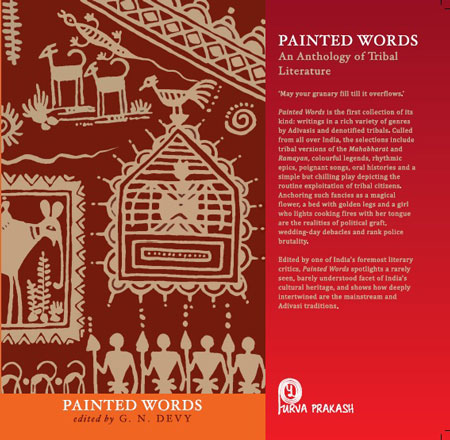
Tribal Literature by G.N. Devy >>
Free eBooks & Magazine: Adivasi literature and languages >>