Read the full paper by Sam Grey & Raj Patel with References here >>
[…] An intimate, long-term relationship with traditional territories also gives rise to Indigenous systems of governance, social organization, and science. Philosopher Gregory Cajete refers to this as ‘Native science,’ the practice and product of a “lived and storied participation” with the totality of creation, entailing “a wide range of tribal processes of perceiving, thinking, acting, and ‘coming to know’‘” (2004, p. 46). Examples of ‘Native science’ at work in food systems are among the best documented, having commanded the attention of natural and social scientists for at least the past century and a half.
The process is both simple and complex. Engaging with the land—or rather, with the enspirited and sensate gestalt of plants, animals, weather, and geography that is ‘the land’—yields a formidable pool of knowledge. This initial pool is augmented by inspiration, enriched via communication with outsiders, refined through continual trial-and-error, and passed down by cultural transmission (see among others, Berkes 2008). Even traditional Indigenous food storage techniques can be traced to a discourse between humans, spirits, plants, and animals, as Shuswap Elder Mary Thomas points out:
See these scattered pine cone pieces? […] If you look carefully, you will find a pile of pieces nearby. Underneath the pile will be a cache of pine cones belonging to a squirrel. The little cones will be arranged in rows with the tops pointed downward. This is what my Grandmother taught me. When I was a little girl, I asked my Grandmother why the cones were all pointed downward. “Because,” she told me, “when the winter snows begin to melt, and water drips into the cache, it will run downward off the cones and not wreck the nutmeats inside them.” I asked, “How do the little squirrels know to do that?” Granny said, “They learn like we do, and then they pass their knowledge on to us.” (Greenwood and de Leew 2007, p. 49)
There is, as one might expect, a linguistic component to this scientific endeavour. Okanagan Elders understand that language is place-specific because it is given to the people by the land. Since the knowledge housed in each territory is unique, a shift in location catalyzes new vocabularies to voice new understandings (Armstrong 1998). Socio-political formations are similarly rooted, as in general, the Indigenous perception of clan and kinship systems amongst other actors in the natural world correlates with human political organization along these same lines (Deloria 2000). Because of this conceptualization of ‘land’ and ‘place,’ removal from, commodification of, or destruction in traditional territories is a simultaneously physical, economic, social, and metaphysical rupture, as well as an emotional and intellectual blow. […]
Sam Grey is a doctoral student in Political Science and a graduate research fellow at the Centre for Studies in Religion and Society at the University of Victoria. She holds prior degrees from Trent University (BAs, International Development Studies, Philosophy, and Indige- nous Studies) and the University of Victoria (MA, Human and Social Development). Sam has published on Indigenous women’s human rights, decolonization praxis, and historical injustice; and is the editor of three books on Indigenous knowledge and rights-based advocacy. Her current work explores the intersection of politics, emotion, and virtue.
Raj Patel is an award-winning writer, activist and academic. He is a Research Professor in the Lyndon B Johnson School of Public Affairs at the University of Texas, Austin and a Senior Research Associate at the Unit for the Humanities at the university currently known as Rhodes University (UHURU), South Africa. Learn more >>

Source: Food sovereignty as decolonization: some contributions from Indigenous movements to food system and development politics by Sam Grey & Raj Patel © Springer Science+Business Media Dordrecht 2014
URL: http://rajpatel.org/wp-content/uploads/2009/11/Grey-Patel-2015-Food-Sovereignty-as-Decolonization.pdf
Date visited: 20 March 2024
What does it mean to be Indigenous?
Indigenous Peoples can be identified according to certain characteristics:
They are politically and socially marginalized.
Most importantly, they self-identify as Indigenous Peoples.
They share an ancestral link with those who inhabited a country or region before they were colonized or before other peoples became dominant.
They have a strong link to particular territories and the surrounding natural resources.
They have distinct social, economic or political systems, which they are resolved to maintain and reproduce.
They have a distinct language, culture and beliefs.
There are more than 5,000 different Indigenous Peoples around the world comprising 476 million people – around 6.2% of the global population. They are spread across more than 90 countries in every region and speak more than 4,000 languages. | Learn more (Amnesty International) >>
Source: “INDIGENOUS PEOPLES’ RIGHTS” by Amnesty International
URL: https://www.amnesty.org/en/what-we-do/indigenous-peoples/
Date Visited: 10 May 2025
Learn more on the Rights of Indigenous Peoples, their Languages & linguistic heritage & Tribal culture worldwide >>
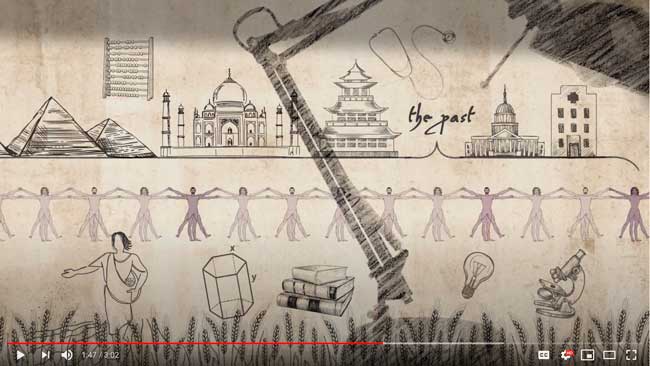
Watch “The Good Ancestor – The Legacies We Leave” (3 min.): An animation that explores the legacies we might leave for future generations >>
Links to some of the most important organisations, thinkers and doers that are leading the way and that have inspired the book The Good Ancestor by Roman Krznaric >>
Facts and figures: India’s biological, cultural and geographic diversity
Spread over 3,287,240 km2 and despite a total human population of over 1,210,000,000, India represents a wide spectrum of biological, cultural and geographic diversity. It has been identified as one of the top 12 global biodiversity hotspots and has 91 eco-cultural zones inhabited by 4,635 ethnic communities. India also has amongst the largest indigenous/tribal population, constituting 8.08% of the country’s population, representing 461 tribes. The term ‘Indigenous Peoples’ is not officially recognized in the country, instead the Constitution of India uses the term ‘Scheduled Tribes’. The total forest cover is estimated to be approximately 20% of the total area of the country. About 1,70,379 villages with a population of 10,674,334 inhabit areas in close proximity of forests.
Source: RECOGNITION AND SUPPORT OF ICCAs IN INDIA by Neema Pathak Broome and Tushar Dash, p. 4 | PDF-Repository
URL: https://kalpavriksh.org/wp-content/uploads/2021/01/IndiaICCARecognition_Final_SEPT2012-as-published.pdf
Date Visited: 10 March 2025
For strategic planners, forests are ‘an administrative category implying a desired land use’ whether or not trees are included, but it is useful in making claims to ‘extend the control of the forest service’. […]
To tribal people, forests involve habitat and identity and are thus inseparably linked to their lives and livelihoods. Because of this reality, several inter-disciplinarians see forests as something linked to human rights for indigenous communities.
Source: “An analysis of the impact of the Forest Rights Act (2006) in three states of India” by Rebecca S . David (Edited version of the author’s MPhil Dissertation at the University of Cambridge, UK completed in the year 2014, pp. 1 & 10
URL: https://www.academia.edu/30648733/
Date visited: 20 March 2024
“Cover Your Country” by PARI: Rural people speak about their lives through photos, narratives, film, and audio materials >>
Video | “I saw women working 90 per cent of the time. They did backbreaking jobs for which you need an erect spine,” says P. Sainath in Visible Work, Invisible Women: Bricks, coal and stone | RuralIndiaOnline.org >>
In Marginalised but not Defeated, Tarun Kanti Bose (a seasoned public interest journalist) asserts that “the mainstream development paradigm is being questioned and new rainbows of collective, community reassertions are happening across the tribal belt in India. More so, in most cases, led by brave, empowered and resilient women.” | Learn more: https://countercurrents.org/2023/05/book-review-marginalised-but-not-defeated >>
“In less than 200 years, photography has gone from an expensive, complex process to an ordinary part of everyday life. From selfies to satellites, most of the technology we use and spaces we inhabit rely on cameras. […] While photographic documentation can aid in shaping history, it can also be a window into the horrors of the past.” – Read more or listen to Butterfly Effect 9 – The Camera on CBC Radio Spark 26 May 2023 >>
[Bold typeface added above for emphasis]
Search Worldcat.org for publications by reputed authors (select “Open Content/Open Access” for freely downloadable content)
Search tips
Combine the name of any particular state, language or region with that of any tribal (Adivasi) community.
Ask a question that includes “tribal” or “Adivasi”, for instance: “Adivasi way of life better?” (or “tribal way of life worse?”)
Add keywords of special interest (music, poetry, dance just as health, sacred grove and biodiversity); learn about the rights of Scheduled Tribes such as the “Forest Rights Act” (FRA); and the United Nations “Declaration on the Rights of Indigenous Peoples”, “Universal Declaration of Human Rights”, “women’s rights”, or “children’s right to education”.
Specify any particular issue or news item (biodiversity, bonded labour and human trafficking, climate change, ecology, economic development, ethnobotany, ethnomedicine, global warming, hunter-gatherers in a particular region or state, prevention of rural poverty, water access).
Learn more
Atree.org | Ashoka Trust for Research in Ecology & the Environment (posts)
Biodiversity | Hyderabad biodiversity pledge | Nilgiri Biosphere
Climate change | Audio | The Climate Question (BBC Podcast)
eJournals & eBooks | Background guide for education
eLearning: Center for World Indigenous Studies
Forest Rights Act (FRA) | Hunter-gatherers | Legal rights over forest land
Health and nutrition | Recommendations by the Expert Committee
“The tribal food basket has always been diverse and nutritious”
United Nations on climate change
What is the Forest Rights Act about?
Who is a forest dweller under this law, and who gets rights?