IN BRIEF
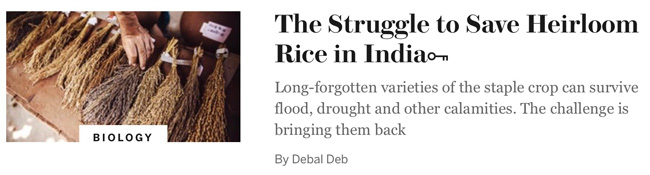
India originally possessed some 110,000 landraces of rice with diverse and valuable properties. These include enrichment in vital nutrients and the ability to withstand flood, drought, salinity or pest infestations. The Green Revolution covered fields with a few high-yielding varieties, so that roughly 90 percent of the landraces vanished from farmers’ collections.
High-yielding varieties require expensive inputs. They perform abysmally on marginal farms or in adverse environmental conditions, forcing poor farmers into debt.
Collecting, regenerating, documenting the traits of and sharing with farmers the remaining landraces, to restore some of the lost biodiversity of rice, is the author’s life mission.
One scorching summer day in 1991, having spent hours surveying the biodiversity of sacred groves in southern West Bengal, India, I approached Raghu Murmu’s hut to rest. Raghu, a young man of the Santal tribe, sat me under the shade of a huge mango tree while his daughter fetched me cold water and sweets made from rice. As I was relishing these, I noticed that Raghu’s pregnant wife was drinking a reddish liquid. Raghu explained that it was the starch drained from cooked Bhutmuri rice—meaning “ghost’s head” rice, perhaps because of its dark hull. It “restores blood in women who become deficient in blood during pregnancy and after childbirth,” he said. I gathered that this starch is believed to cure peripartum anemia in women. Another rice variety, Paramai-sal, meaning “longevity rice,” promotes healthy growth in children, Raghu added.
As I would subsequently establish, Bhutmuri is one of several varieties of indigenous rice in South Asia that are rich in iron, and it also contains certain B vitamins. And Paramaisal rice has high levels of antioxidants, micronutrients and labile starch, which can be converted rapidly to energy. At the time, however, such uncommon rice varieties, with their evocative names and folk medicinal uses, were new to me. When I returned home to Kolkata, I conducted a literature survey on the genetic diversity of Indian rice and realized that I had been lucky to encounter Raghu. Farmers like him, who grow indigenous rice and appreciate its value, are as endangered as the varieties themselves.
In the years since, I have become familiar with a cornucopia of native rice varieties (also called landraces) that possess astonishingly useful and diverse properties. Some can withstand flood, drought, salinity or pest attacks; others are enriched in valuable vitamins or minerals; and yet others are endowed with an enticing color, taste or aroma that has given them special roles in religious ceremonies. Collecting, regenerating and sharing with farmers these exceedingly rare but valuable varieties has become my life’s mission. […]
SAVING FARMERS
Given the failure of modern agricultural research to provide marginal farmers with any reliable germ lines of rice, a large collection of folk rice varieties, with their fine-tuned adaptations to adverse conditions, is our best bet. Convinced by the superior yield stability of the landraces, more than 2,000 farmers in Odisha, Andhra Pradesh, West Bengal, Karnataka, Kerala and Maharashtra have adopted several folk rice varieties from Vrihi and abandoned cultivation of HYVs.
When Cyclone Aila hit the Sundarbans coast of West Bengal and Bangladesh in May 2009, it killed almost 350 people and destroyed the homes of more than a million. A storm surge inundated fields with seawater and left them salinated—which meant that quite apart from the immediate devastation, the food security of the region was likely to suffer long-term damage. We distributed a small amount of seeds from the Vrihi seed bank’s repertoire of traditional salinity-tolerant landraces, such as Lal Getu, Nona bokra and Talmugur, among a few farmers on island villages of the Sundarbans. These were the only rice varieties that yielded a sizable amount of grain on the salinated farms in that disastrous season. Similarly, in 1999 several folk varieties such as Jabra, Rani kajal and Lakshmi dighal ensured rice production for southern Bengal farmers after a flash flood of the Hugli River. In 2010 Bhutmuri, Kalo gorah, Kelas and Rangi rescued many indigenous farmers in the western district of Puruliya when delayed arrival of monsoon rains caused a severe drought.
Such disasters prove, time and again, that the long-term sustainability of rice farming depends crucially on the restoration of traditional farming practices based on biodiversity and use of the full diversity of crop varieties that have survived the onslaught of industrial farming.
Debal Deb is founder of the Basudha rice conservation farm and Vrihi seed distribution center in Kerandiguda and founder and chair of the Center for Interdisciplinary Studies in Barrackpore, all in India.
Source: Debal Deb: “Restoring Rice Biodiversity”, Scientific American, October 2019
URL: https://www.scientificamerican.com/magazine/sa/2019/10-01/
Date visited: 3 December 2019
[Bold typeface added above for emphasis]
Up-to-date reports by Indian experts and journalists
Search tips
Combine the name of any particular state, language or region with that of any tribal (Adivasi) community.
Add keywords of special interest (music, poetry, dance just as health, sacred grove and biodiversity); learn about the rights of Scheduled Tribes such as the “Forest Rights Act” (FRA); and the United Nations “Declaration on the Rights of Indigenous Peoples”, “Universal Declaration of Human Rights”, “women’s rights”, or “children’s right to education”.
Ask a question that includes “tribal” or “Adivasi”, for instance: “Adivasi way of life better?” (or “tribal way of life worse?”)
Specify any particular issue or news item (biodiversity, bonded labour and human trafficking, climate change, ecology, economic development, ethnobotany, ethnomedicine, global warming, hunter-gatherers in a particular region or state, prevention of rural poverty, water access).
For official figures include “scheduled tribe ST” along with a union state or region: e.g. “Chhattisgarh ST community”, “Himalayan tribe”, “Scheduled tribe Tamil Nadu census”, “ST Kerala census”, “Particularly Vulnerable Tribal Group Jharkhand”, “PVTG Rajasthan”, “Adivasi ST Kerala”, “Adibasi ST West Bengal” etc.
SafeSearch browser tips
If your (mobile) browser fails to display “embedded” media contents, Google maps and SafeSearch windows
Try another browser like Firefox, Chrome or Safari available on your device
Ensure your favourite browser is up to date
Close your present browser
Check your browser and mobile (gsm) settings:
e.g. permission for video or JavaScript
(seen under Preferences >Security >Enable JavaSript)
Restart your computer (smartphone, tablet)
Reconnect to your wifi network or connect to a different one
On some iPhone models the following helps:
>Settings >Safari >scroll down to:
SETTING FOR WEBSITES
Enable “Request Desktop Website” (All Websites) temporarily
Return to the map-post in Safari and “Reload”
Return to >Settings and disable “Request Desktop Website” again
Return to the post in Safari and “Reload”which should now display “embedded” contents as intended (with the convenience of browsing the mobile version on a small screen)
Note: similar solutions may also work with other mobile operating systems.
List of websites covered by this Google custom search engine
Academia.edu (platform for academics to share research papers) – www.academia.edu
Archive.org – https://archive.org
Centre for Science and Environment – https://www.cseindia.org
Current Conservation – https://www.currentconservation.org
Development and Cooperation (D+C) https://www.dandc.eu
Down To Earth (India) – www.downtoearth.org.in
India Environment Portal – www.indiaenvironmentportal.org.in
Harnessing Nature Magazine – https://harnessingnature.online
Mongabay-India – https://india.mongabay.com
M S Swaminathan Research Foundation – www.mssrf.org
Navdanya (protecting India’s biodiversity based food heritage) – https://navdanya.org
People’s Archive of Rural India – https://ruralindiaonline.org/
Third World Network (Penang, Malaysia) – https://twn.my
The Shola Trust (nature conservation in the Nilgiri region) – www.thesholatrust.org
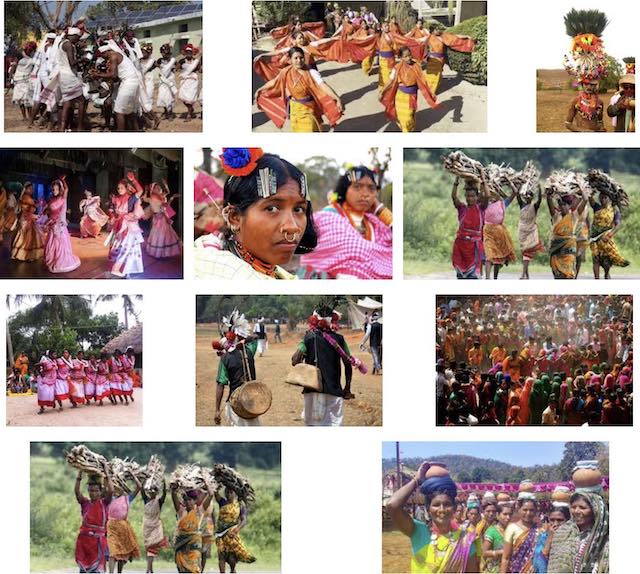
Indian online periodicals and platforms | Images view >>
~ ~ ~
Personalize your CustomSearch by combining other search words >>
(e.g. name of a tribal community and region, a craft, or dance and puppetry)
Research: explore PhD theses from all over India
Shodhganga (Open Access)
Basudha Centre for Interdisciplinary Studies
Explore the Link between Biological and Cultural Diversity
Basudha (= ‘Earth Mother’ in Bengali) is a 1.7 acre farmland, on rent in a tribal village, surrounded by forests and hills in Bissam Cuttack block, Rayagada district of southern Odisha. A small farm house can accommodate visiting activists, research students and farmers.
Basudha farm was established in early 2001 in Bankura district of West Bengal initially as a field station of the Centre for Interdisciplinary Studies, and registered as an independent Trust body, which is currently comprised by Dr. Debal Deb, Mr. Avik Saha, Mr. Tathagata Banerjee, Dr. Mita Dutta and Mr. Debdulal Bhattacharjee, and as Trustees.
Source: Basudha
URL: https://cintdis.org/basudha/
Date visited: 3 December 2019
Tribal languages are a treasure trove of knowledge about a region’s flora, fauna and medicinal plants
“Tribal languages are a treasure trove of knowledge about a region’s flora, fauna and medicinal plants. Usually, this information is passed from generation to generation. However, when a language declines, that knowledge system is completely gone.” – Ayesha Kidwai (Centre for Linguistics, School of Language, Literature and Culture Studies, Jawaharlal Nehru University, New Delhi) quoted by Abhijit Mohanty in “Seven decades after independence, many tribal languages in India face extinction threat” | Learn more about the work done by the People’s Linguistic Survey of India and endangered languages worldwide >>
“India’s geographic location at the confluence of three major biogeographic zones – i.e. the Indo-Malayan, the Eurasian and the Afro-Tropical – makes it extremely biodiverse in its genes, species and ecosystems. It is one of the world’s 17 megadiverse countries (Mittermeier et al. 1997). India can boast of over 8.1% of the world’s biodiversity supported on 2.4% of the earth’s surface. An estimated 47,000 identified plant species represent 11% of the world’s flora.” | Learn more: eBook | Disseminating environment related information to improve peoples’ livelihoods >>
“The notion of ‘mainstreaming’ needs to be challenged not just because Adivasi culture is being crushed, but also because Adivasi values and ways of life offer insights that the ‘mainstream’ needs. If we are to halt the destruction of ecosystems, we need to understand how closely biodiversity and cultural diversity are intertwined. Perhaps it is time to reverse the gaze and begin to learn afresh from Adivasis.” – Felix Padel & Malvika Gupta (The Hindu) | Learn more about the role of tribal communities in fostering biodiversity, ethnobotany and cultural diversity | Success stories | Tribal identity >>
“I think that by retaining one’s childhood love of such things as trees, fishes, butterflies and … toads, one makes a peaceful and decent future a little more probable, and that by preaching the doctrine that nothing is to be admired except steel and concrete, one merely makes it a little surer that human beings will have no outlet for their surplus energy except in hatred and leader worship.” – George Orwell | Learn more: Childhood | Customs | Games and leisure time | Literature – fiction | Storytelling >>
Adivasi communities: stewards of India’s cultural heritage and biodiversity
[…] India’s tribal communities — over 104.5 million people, or 8.6 per cent of the population — remain among the most marginalised despite decades of welfare schemes and development promises. In states such as Chhattisgarh, Jharkhand, Bihar, Rajasthan and Odisha, tribal districts consistently record higher poverty levels than non-tribal areas, even as these regions supply land, forests and minerals for the country’s growth. These communities have often been compelled to relinquish their lands for large-scale infrastructure projects, resulting in the erosion of their identity, livelihoods, and future prospects.
It is crucial to recognise the value these communities bring, particularly their eco-friendly lifestyles, which offer important insights into addressing climate-related challenges. For instance, during the 2018 drought in Sundergarh, Odisha, a visit to a remote tribal village revealed thriving vegetation and effective water-harvesting systems. Kiri village in Lahunipara block of Sundergarh district, inhabited by the Paudi Bhuyan community — a Particularly Vulnerable Tribal Group (PVTG) — has demonstrated remarkable resilience.
This observation underscores the importance of learning from traditional ecological knowledge, especially sustainable farming practices that rely on drought-resistant and indigenous seeds.
Adivasi communities, as stewards of India’s cultural heritage and biodiversity, must be central to the nation’s development narrative. Their lives are intricately linked to land, forests and water, yet they face growing threats from climate change, livelihood insecurity and displacement. Addressing these challenges requires more than welfare initiatives; it demands robust enforcement of constitutional rights, substantial public investment and the strengthening of Gram Sabha–based governance. […]
Source: “Union Budget must shift from welfare to rights-based public investment for Adivasi communities” by Debabrat Patra, Sion Kongari & Saurabh Kumar, Down to Earth, 9 February 2026
URL: https://www.downtoearth.org.in/governance/union-budget-must-shift-from-welfare-to-rights-based-public-investment-for-adivasi-communities
Date Visited: 30 June 2026
“If we take action, the right action – as the report [on Biological Diversity] proposes – we can transition to a sustainable planet.” […] Many good things are happening around the world and these should be celebrated and encouraged […] We have to act now. It is not too late. Otherwise, our children and grandchildren will curse us because we will leave behind a polluted, degraded and unhealthy planet.” – Elizabeth Maruma Mrema, executive secretary, UN Convention on Biological Diversity – “Extinction: Urgent change needed to save species, says UN”, BBC News, 15 September 2020 >>
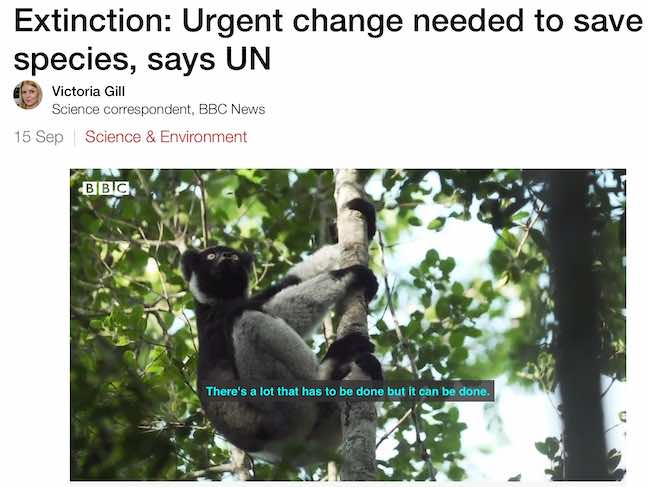
Watch the video on BBC News | More about Biodiversity in India >>
Photo and video recommendation: a voice from rural India worth being heard
Whether you plan a visit or seek to learn more about India’s rural life – perhaps inspired by the Gandhian social movement or Rabindranath Tagore – explore “a living journal, a breathing archive” in the Adivasi category of PARI: the People’s Archive of Rural India initiated by distinguished photo journalist-turned-activist P. Sainath, continually enriched by stories from all over India.
“In less than 200 years, photography has gone from an expensive, complex process to an ordinary part of everyday life. From selfies to satellites, most of the technology we use and spaces we inhabit rely on cameras. […] While photographic documentation can aid in shaping history, it can also be a window into the horrors of the past.” – Read more or listen to Butterfly Effect 9 – The Camera on CBC Radio Spark 26 May 2023 >>
Learn more
Atree.org | Ashoka Trust for Research in Ecology & the Environment (posts)
Biodiversity | Hyderabad biodiversity pledge | Nilgiri Biosphere
Climate change | United Nations on climate change
eBook | Background guide for education
eLearning: Center for World Indigenous Studies
Health and nutrition | Recommendations by the Expert Committee