Vaacha – The Museum of Voice
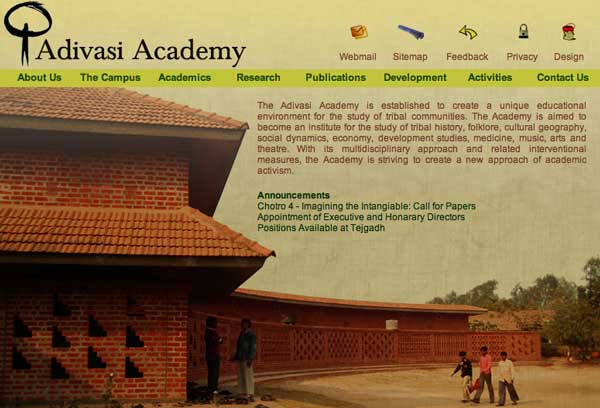
The Adivasi Academy has been built brick by brick with the support of the tribal community and well wishers of Bhasha. It took nearly four years of continuous construction work for the Museum and Library, the first major buildings of the Academy to be completed, so intricate is the craftsmanship invested in creating the combination of simplicity and majesty. The Advisors to the Academy and the Community of Activists associated with the Academy decided not to have any formal ‘inauguration’ ceremony for the structure. Instead, they decided to install a plaque declaring that the structure, which is named Vachaa, The Voice, has been blessed by Mahashweta Devi on the 15th August 2004.
Museumization of culture is not on the Academy’s agenda. Vaacha functions more as a forum and a platform for expression of adivasi creativity. It offers intellectual space for adivasis interested in documenting social practices, and creating dynamic displays of adivasi expressions, both artistic and cultural, in the form of objects, artifacts, performances and digitized multimedia images. The Museum is seen as the ‘laboratory’ for contemporary ethnic, anthropological and artistic studies carried out from the perspective of adivasis themselves. It is conceptualized as a unique Museum of Voice and is the largest resource centre of Tribal Culture in India.
Visitors to the Museum include community members, artists, culture studies scholars, anthropologists, museum experts, university and college faculty and researchers and school children.
Source: Adivasi Academy
Address: https://www.adivasiacademy.org.in/MajorBuildings.aspx
Date Visited: Sat Oct 24 2015 10:36:15 GMT+0200 (CEST)
Tribal communities of Gujarat: Bhil, Chaudhari, Dehwali, Dhodia, Gamit, Kathodi, Kolgha, Kotwalia, Kunkna, Padhar, Warli [Varli] | In-depth research >>
Names of tribal communities found on this website
Please note: this page serves the purpose of orientation without being comprehensive; an official list of tribal communities (“State/UT wise population”) is found here >>
Adiya Andamanese Angami Ao Apatani Asur Baiga Banjara Bettakurumba Bhatra Bhil Bhilala Bhumij Birhor Birjia Bisonhorn Maria Bodo Bonda Chakma Chaudhari Chenchu Chero Dehwali Dongria Kondh Dorla Gadaba Garo Gond Great Andamanese Gujjar Halakki Halba Ho Irula Jaintia Jarawa Jenu Kuruba Kaani (Kani) Kadar Karbi Kattunayakan (Kattunaika, Kattunaicken) Katunaikar Kawar Kharia Khasi Khond Kol Kolam Konda Reddi (Kondareddi) Kondh Konyak Koraga Korku Kota Koya Kuki Kunkna Kurukh Kurumba Kutia Kondh Lambada Lepcha Limbu Madia Malayarayar Mannan Maria Mina Mishing Mizo Monpa Mudugar Muduvan Mullukurumba Munda Muria Muthuvan Naga Nicobarese Onge Oraon Paliyar Paniya Paniyar Raj Gond Rathwa Sabar Saharia (Sahariya) Santal (Santhal) Saora Saura Savara Sentinelese Shompen Sidhi (Siddi) Soliga Tiwa Toda Warli Yerukula
Learn more
Adivasi Academy & Museum of Adivasi Voice at Tejgadh
Bhasha | Free eBooks & Magazine: Adivasi literature and languages
eBook | Adivasi Stories from Gujarat
Endangered language | Multi-lingual education
Ganesh [G.N.] Devy | Publications | Lecture “A View of Higher Education in India”
Languages and linguistic heritage | Central Institute of Indian Languages (CIIL)
Literature and bibliographies | Literature – fiction | Poetry
People’s Linguistic Survey of India | Volumes (PLSI) | PeoplesLinguisticSurvey.org
Video | A conversation with Pradeep Marawi – Gondi artist from Bhopal
Video | Adivasi pithora artist Desing Rathwa
Video | “Nations don’t make us human – languages make us human”: Ganesh Devy
Video | South Gujarat tribal music documentation by Bhasha – Gujarat
Tips for using interactive maps
Toggle to normal view (from reader view) should the interactive map not be displayed by your tablet, smartphone or pc browser
For details and hyperlinks click on the rectangular button (left on the map’s header)
Scroll and click on one of the markers for information of special interest
Explore India’s tribal cultural heritage with the help of another interactive map >>