There is a need to reclaim descriptions of the tribes; the onus must reside with the tribes themselves, since they have endured these portrayals for far too long.
Richard Kamei in “Uncivilising the Mind: How anthropology shaped the discourse on tribes in India” (Caravan Magazine, 1 March 2021)
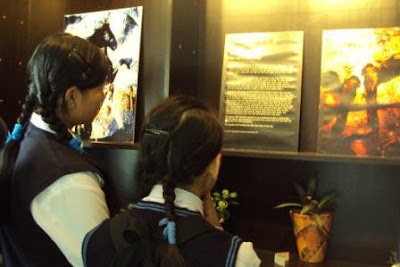
The Great Story-Wall is a 100 metre long banner on digital art, the design of which is based on myths, legends and indigenous stories of Eastern Himalayas. The feat is also setting a World Record (Limca Book of Records 2010) on the Tuesday at Paljor Namgyal Girls High School in Gangtok.
The Great Story Wall Project, however, isn’t only about creating a world record feat. It extends to a 6-month travel based storytelling tour (along with the banner) across various cities of the country beginning from Bangalore, the base of Acoustic Traditional, continuing its journey to Hyderabad, Chennai, Mumbai, Pune, Kolkatta, Delhi, Darjeeling, Shillong, Imphal, Itanagar that will also bring the support and involvement of various folklore-based organizations (NGO”s), government agencies and youth organizations of the city/state.said Salil Mukhia designer and founder of Bangalore based NGO Acoustic Traditional. […]
The design/art is based on the myths, legends and stories shared by various storytellers during the Indigenous storytellers’ Fest conducted in Gangtok this year which was the first meeting of indigenous storytellers ever held in South Asia. The stories that will comprise the backdrop of the present artwork are mainly from ethnic groups of Sikkim and Eastern Himalayas like the Lepchas, Limboos, Bhutias,Gurungs, Rai , Apatani, Mayeti and other groups like Paniyars from Nilgiris and Potwas from West Bengal with whom Acoustic Traditional had worked with in the past, he said.
The Great Story-Wall Project primarily aims to build interest and awareness in folklore among the youth and also engage the media and all stakeholders towards the promotion of our tradition of oral storytelling and preservation of our disappearing folklores and indigenous knowledge.
The 100 metre Digital art-Story-wall will extend by 25 metres in each city with the indigenous stories/ folklore and the images/art based on them of the respective state.
Source: Pratham Books: The Great Story-Wall Project, Thursday, November 4, 2010
Address : http://blog.prathambooks.org/2010/11/great-story-wall-project.html
Date Visited: Fri Aug 26 2011 13:34:43 GMT+0200 (CEST)
Find educational and children’s books on tribal culture published in India – Custom search
List of sites covered by this Google SafeSearch engine
https://books.katha.org (Katha Books)
https://publicationsdivision.nic.in
Search tips
Combine the name of any particular state, language or region with that of any tribal (Adivasi) community.
Add keywords of special interest (music, poetry, dance just as health, sacred grove and biodiversity); learn about the rights of Scheduled Tribes such as the “Forest Rights Act” (FRA); and the United Nations “Declaration on the Rights of Indigenous Peoples”, “Universal Declaration of Human Rights”, “women’s rights”, or “children’s right to education”.
Ask a question that includes “tribal” or “Adivasi”, for instance: “Adivasi way of life better?” (or “tribal way of life worse?”)
Specify any particular issue or news item (biodiversity, bonded labour and human trafficking, climate change, ecology, economic development, ethnobotany, ethnomedicine, global warming, hunter-gatherers in a particular region or state, prevention of rural poverty, water access).
For official figures include “scheduled tribe ST” along with a union state or region: e.g. “Chhattisgarh ST community”, “Himalayan tribe”, “Scheduled tribe Tamil Nadu census”, “ST Kerala census”, “Particularly Vulnerable Tribal Group Jharkhand”, “PVTG Rajasthan”, “Adivasi ST Kerala”, “Adibasi ST West Bengal” etc.
SafeSearch browser tips
If your (mobile) browser fails to display “embedded” media contents, Google maps and SafeSearch windows
Try another browser like Firefox, Chrome or Safari available on your device
Ensure your favourite browser is up to date
Close your present browser
Check your browser and mobile (gsm) settings:
e.g. permission for video or JavaScript
(seen under Preferences >Security >Enable JavaSript)
Restart your computer (smartphone, tablet)
Reconnect to your wifi network or connect to a different one
On some iPhone models the following helps:
>Settings >Safari >scroll down to:
SETTING FOR WEBSITES
Enable “Request Desktop Website” (All Websites) temporarily
Return to the map-post in Safari and “Reload”
Return to >Settings and disable “Request Desktop Website” again
Return to the post in Safari and “Reload”which should now display “embedded” contents as intended (with the convenience of browsing the mobile version on a small screen)
Note: similar solutions may also work with other mobile operating systems.
More SafeSearch on this website
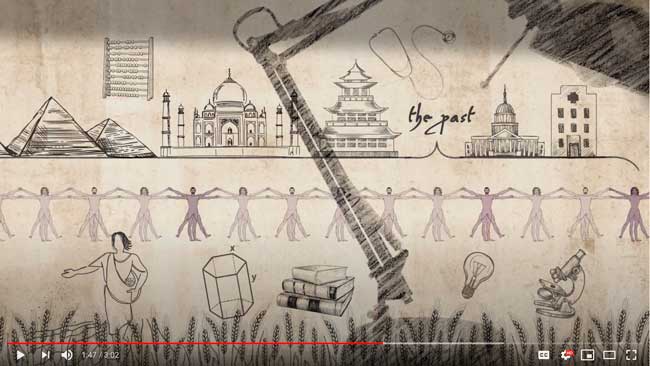
Watch “The Good Ancestor – The Legacies We Leave” (3 min.): An animation that explores the legacies we might leave for future generations >>
Links to some of the most important organisations, thinkers and doers that are leading the way and that have inspired the book The Good Ancestor by Roman Krznaric >>
Facts and figures: India’s biological, cultural and geographic diversity
Spread over 3,287,240 km2 and despite a total human population of over 1,210,000,000, India represents a wide spectrum of biological, cultural and geographic diversity. It has been identified as one of the top 12 global biodiversity hotspots and has 91 eco-cultural zones inhabited by 4,635 ethnic communities. India also has amongst the largest indigenous/tribal population, constituting 8.08% of the country’s population, representing 461 tribes. The term ‘Indigenous Peoples’ is not officially recognized in the country, instead the Constitution of India uses the term ‘Scheduled Tribes’. The total forest cover is estimated to be approximately 20% of the total area of the country. About 1,70,379 villages with a population of 10,674,334 inhabit areas in close proximity of forests.
Source: RECOGNITION AND SUPPORT OF ICCAs IN INDIA by Neema Pathak Broome and Tushar Dash, p. 4 | PDF-Repository
URL: https://kalpavriksh.org/wp-content/uploads/2021/01/IndiaICCARecognition_Final_SEPT2012-as-published.pdf
Date Visited: 10 March 2025
Learn more
Anganwadi | Community facilities | Ekalavya
Childhood | Childrens rights: UNICEF India | Safe search
Crafts and visual arts | Masks
Education and literacy | Right to education
eBook | Adivasi Stories from Gujarat
eBook | “Where the mind is without fear”: Tagore, Gitanjali and the Nobel Prize
Literature and bibliographies | Literature – fiction | Poetry