A Mexican wave of empathy – Tribal culture strikes a chord with filmmaker couple
One may be forgiven for asking “hom what?” But Mexican filmmaker couple Francesco Taboada Tabone and Fernanda Robinson has the answer. […]
The couple, whose films are about indigenous issues in contemporary Mexico and South America, are especially interested in watching Sarhul festivities, where tribals welcome spring. A Sarhul celebration will be hosted on the campus of Ranchi University’s Tribal and Regional Language department on March 25.
Jharkhand, also grappling with the forces of modernity in its tribal heartland, has “fascinated” the couple, who is even mulling a film here.
“I had heard about rich culture and political struggles of tribal people of Jharkhand. That’s why I came here for a first-hand feel. I have not come prepared now but I may think of making a film on the tribal people here, their culture, struggling languages and political struggles,” Tabone told The Telegraph.
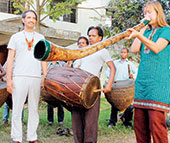
Robinson, showing no sign of jetlag, even held an impromptu jamming session with tribal musicians and dancers at the Tribal and Regional Language department premises, her hom pax proving to be an able icebreaker.
On Friday, the Mexican couple will get a glimpse of the rich biodiversity and culture of Netarhat hills. On Saturday they will get to see tribal dance accompanied by the nagada.
“We have come to your beautiful state on the invitation of filmmakers Meghnath and Biju Toppo,” smiled Robinson, catching her breath after blowing the Mayan trumpet.
The couple’s own films include acclaimed ones such as Los Ultimos Zapatistas (The Last Zapatista), Pancho Villa, La Revolution no ha Terminado (Revolution Not Over).
They focus on indigenous issues, particularly the disappearing native languages of Mexico and South America. […]
In Jharkhand, tribal intellectuals are concerned about how youngsters are losing touch with tribal languages. […]
We hope our visit opens up channels of communication between Mexico and Jharkhand. Both have much in common culturally,” Tabone said.
Source: “A Mexican wave of empathy” by SANTOSH K. KIRO, The Telegraph, 23 March 2012
Address : http://www.telegraphindia.com/1120323/jsp/jharkhand/story_15283344.jsp#.T4qz2I4ZPxY
Date Visited: Sun Apr 15 2012 13:41:42 GMT+0200 (CEST)
Up-to-date reports by Indian experts and journalists
Search tips
Combine the name of any particular state, language or region with that of any tribal (Adivasi) community.
Add keywords of special interest (music, poetry, dance just as health, sacred grove and biodiversity); learn about the rights of Scheduled Tribes such as the “Forest Rights Act” (FRA); and the United Nations “Declaration on the Rights of Indigenous Peoples”, “Universal Declaration of Human Rights”, “women’s rights”, or “children’s right to education”.
Ask a question that includes “tribal” or “Adivasi”, for instance: “Adivasi way of life better?” (or “tribal way of life worse?”)
Specify any particular issue or news item (biodiversity, bonded labour and human trafficking, climate change, ecology, economic development, ethnobotany, ethnomedicine, global warming, hunter-gatherers in a particular region or state, prevention of rural poverty, water access).
For official figures include “scheduled tribe ST” along with a union state or region: e.g. “Chhattisgarh ST community”, “Himalayan tribe”, “Scheduled tribe Tamil Nadu census”, “ST Kerala census”, “Particularly Vulnerable Tribal Group Jharkhand”, “PVTG Rajasthan”, “Adivasi ST Kerala”, “Adibasi ST West Bengal” etc.
SafeSearch browser tips
If your (mobile) browser fails to display “embedded” media contents, Google maps and SafeSearch windows
Try another browser like Firefox, Chrome or Safari available on your device
Ensure your favourite browser is up to date
Close your present browser
Check your browser and mobile (gsm) settings:
e.g. permission for video or JavaScript
(seen under Preferences >Security >Enable JavaSript)
Restart your computer (smartphone, tablet)
Reconnect to your wifi network or connect to a different one
On some iPhone models the following helps:
>Settings >Safari >scroll down to:
SETTING FOR WEBSITES
Enable “Request Desktop Website” (All Websites) temporarily
Return to the map-post in Safari and “Reload”
Return to >Settings and disable “Request Desktop Website” again
Return to the post in Safari and “Reload”which should now display “embedded” contents as intended (with the convenience of browsing the mobile version on a small screen)
Note: similar solutions may also work with other mobile operating systems.
List of websites covered by this Google custom search engine
Academia.edu (platform for academics to share research papers) – www.academia.edu
Archive.org – https://archive.org
Centre for Science and Environment – https://www.cseindia.org
Current Conservation – https://www.currentconservation.org
Development and Cooperation (D+C) https://www.dandc.eu
Down To Earth (India) – www.downtoearth.org.in
India Environment Portal – www.indiaenvironmentportal.org.in
Harnessing Nature Magazine – https://harnessingnature.online
Mongabay-India – https://india.mongabay.com
M S Swaminathan Research Foundation – www.mssrf.org
Navdanya (protecting India’s biodiversity based food heritage) – https://navdanya.org
People’s Archive of Rural India – https://ruralindiaonline.org/
Third World Network (Penang, Malaysia) – https://twn.my
The Shola Trust (nature conservation in the Nilgiri region) – www.thesholatrust.org
Indian online periodicals and platforms | Images view >>
~ ~ ~
Personalize your CustomSearch by combining other search words >>
(e.g. name of a tribal community and region, a craft, or dance and puppetry)
Research: explore PhD theses from all over India
Shodhganga (Open Access)

Mongabay-India contributors >>
Mongabay-India is a nonprofit environment and conservation news platform that brings high-quality, original reports from nature’s frontline in India. We look at India’s development through the prism of environment and conservation >>
“From transforming barren lands into forests, to practicing planet-friendly organic farming in the backyards, the permaculture movement is led by youngsters who believe in reconnecting with the ancient roots and re-establishing a connect with nature.” – Babli Yadav (Mongabay-India) in India’s permaculture movement is being taken forward by young people >>
More about Biodiversity | Economy and development | Health and nutrition | Success stories | Women >>
Learn more
Chotanagpur | Chota Nagpur | Fact checking
Colonial policies | Freedom Struggle | Independence
Communities: Asur | Ho| Kharia | Munda | Oraon | Santal | State wise ST list (Scheduled Tribes)
Forest Rights Act (FRA) | Legal rights over forest land
Hul (Santal rebellion 1855-1856) | Tribal freedom fighters
Video | Hul Sengel: The Spirit of the Santal Revolution (1855) – Jharkhand