Despite having lower literacy rates than “others”, scheduled caste households have higher sex ratios, and tribals the highest of all, newly released Census data shows.
While census data is not yet available by religious group, the primary data of scheduled castes and scheduled tribes was made available by the office of the Registrar General of India and Census Commissioner […]
Yet despite the common belief that education will improve attitudes to female children, the data shows that India’s least educated social groups are those with better sex ratios. The child sex ratio (girls for every 1000 boys aged 1-6) is 957 for STs and 933 for SCs as compared to 910 for “others”. In urban areas, the child sex ratio of the non-scheduled caste, non-tribal population is just over 900, meaning there are 100 less girls for every 1000 boys.
Better sex ratios among tribals could reflect a combination of positive and negative factors; cultural gender parity as well as lack of access to pre-natal diagnostic technology. Dr. Abhay Bang, the award-winning doctor and social activist from Gadchiroli in Maharashtra who is a member of the central government’s new High-Level Committee on Status of Tribal Communities, says that both factors could co-exist. “It is true that there is no social bias against women in tribal communities such as there exists among the middle castes, especially landed ones. Women can ask for a divorce, and in many communities, money is paid to the girl’s family at the time of marriage,” Dr. Bang told The Hindu. Simultaneously, most tribal communities either do not know of pre-natal sex determination, or do not have access to it, Dr. Bang said. “But among more educated tribals, those who get government jobs, sex selection has begun,” he said. […]
The new numbers also show that tribals are undergoing a massive occupational change. While there has been a fall in the proportion of people working as cultivators and a rise in agricultural labour across the country, this shift is most marked in the case of Sts [Scheduled Tribes]. Nearly 10 lakh fewer tribals reported being cultivators in 2011 as compared to ten years ago, while there were 73 lakh more tribal agricultural labourers.
Source: Higher sex ratio among tribal, SC groups: census by
Address: https://www.thehindu.com/news/national/higher-sex-ratio-among-tribal-sc-groups-census/article5300478.ece
Date Visited: 5 April 2020
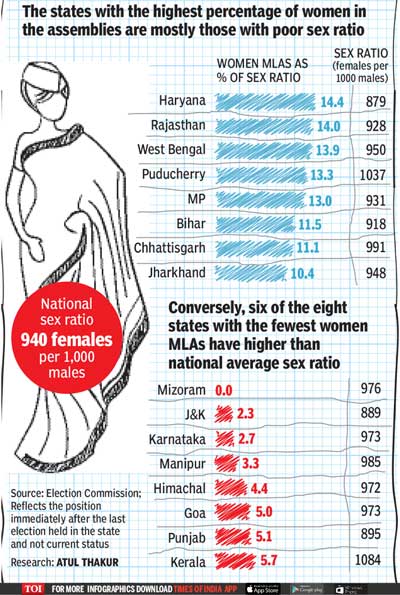
It is logical to think that states where ratio of females in population is high would have more women as lawmakers. However, census data and Election Commission of India figures show exactly the reverse to be true
Source: Infographic: One gender ratio on which Haryana puts Mizoram to shame – Times of India
Address: https://timesofindia.indiatimes.com/india/one-gender-ratio-on-which-haryana-puts-mizoram-to-shame/articleshow/58041332.cms
Date Visited: Date Visited: 7 April 2017
See also
Adivasi Academy & Museum of Adivasi Voice at Tejgadh | Lecture “A View of Higher Education in India”
Anganwadi | Community facilities | Ekalavya
Appropriate education for Adivasi children – the Vidyodaya School model at Gudalur
Bringing indigenous knowledge systems into a “pedagogy of the collective”
Childhood | Children’s books | Childrens rights: Education | UNICEF India | Safe search
People’s Linguistic Survey of India | Volumes (PLSI) | PeoplesLinguisticSurvey.org
Multi-lingual education | Residential school | Ekalavya
Multilingual education is a pillar of intergenerational learning – Unesco
Santali education | Teaching Santal children by Boro Baski
Unesco | Unicef | Unicef India | United Nations
United Nations International Days and Weeks
Video | “Nations don’t make us human – languages make us human”: Ganesh Devy
Women | Safe search | President Droupadi Murmu on women’s empowerment