https://youtu.be/cQi3NBX_LgY
Votive terracotta painted plaques produced by the terracotta artisans of Molela is a hand modelled hollow relief of Hindu deities, especially of the neo-Vaishnava deity, Dev Narayan.
Dev Narayan is accompanied by his characteristic snake symbol in the plaque. Made from clay, mixed with rice husk and donkey dung in required proportion, the plaque is sun dried and baked in an indigenous kiln before it is painted with mineral colours and eventually coated with a local made lacquer, called ‘jala’. Several tribes in Gujarat and Rajasthan travel for more than 200 km once in a year to buy these plaques from Molela and bring them to their villages. Each group is led by a ‘bhopa’, the family priest, who helps to identify the appropriate deity for the family.
These deities are installed and worshipped for 3 to 5 years in the shrines located in their villages till they are replaced by the new ones. Each shrine inhabits a minimum of nine such plaques of several gods and goddesses including Dev Narayan. Terracotta artisans from Molela are the only community entitled to meet this requirement of the tribes. This system has provided sustenance to the traditional craftsmanship for several generations.
Source: National List for Intangible Cultural Heritage (ICH), Ministry of Culture, Government of India
URL: https://www.indiaculture.nic.in/national-list-intangible-cultural-heritage-ich
Date visited: 14 May 2021
[Bold typeface added above for emphasis]
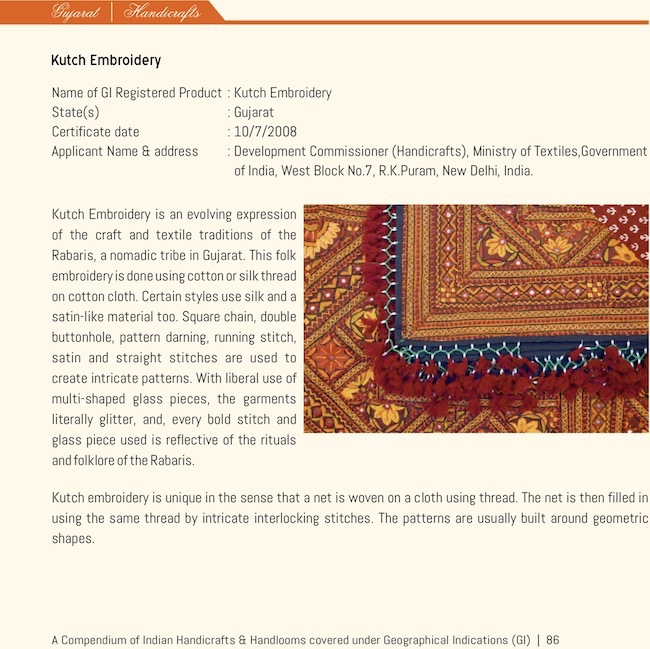
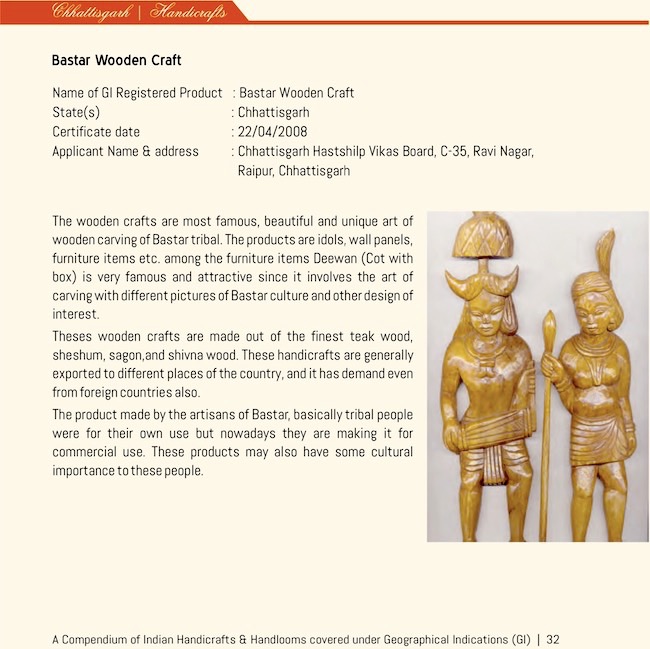
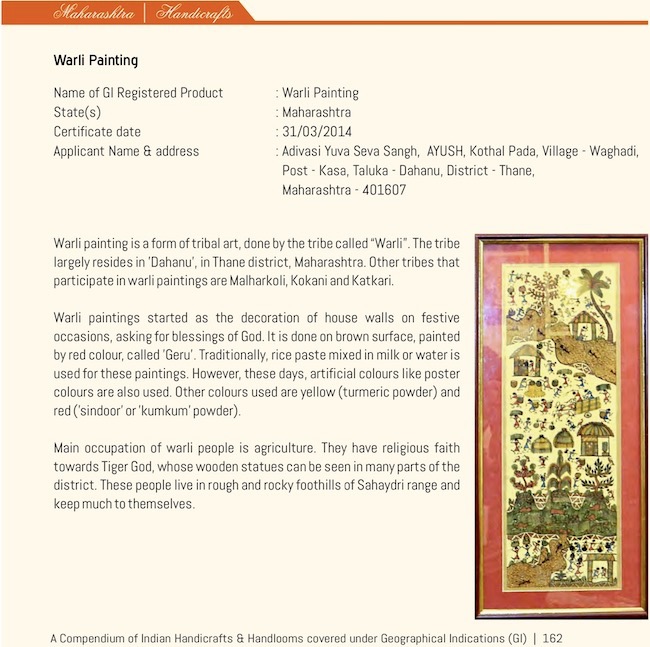
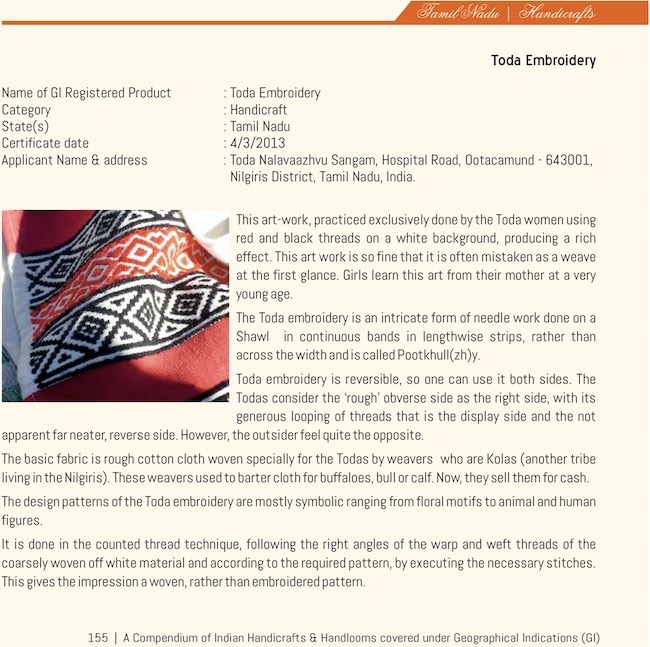
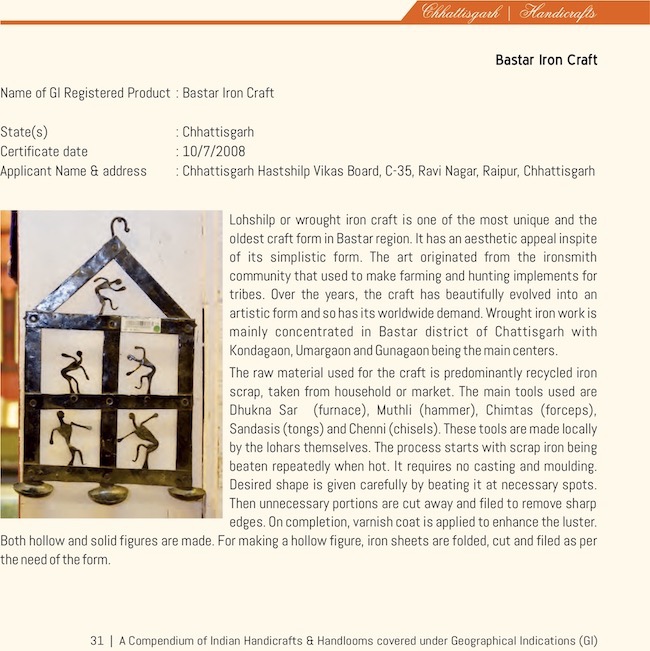
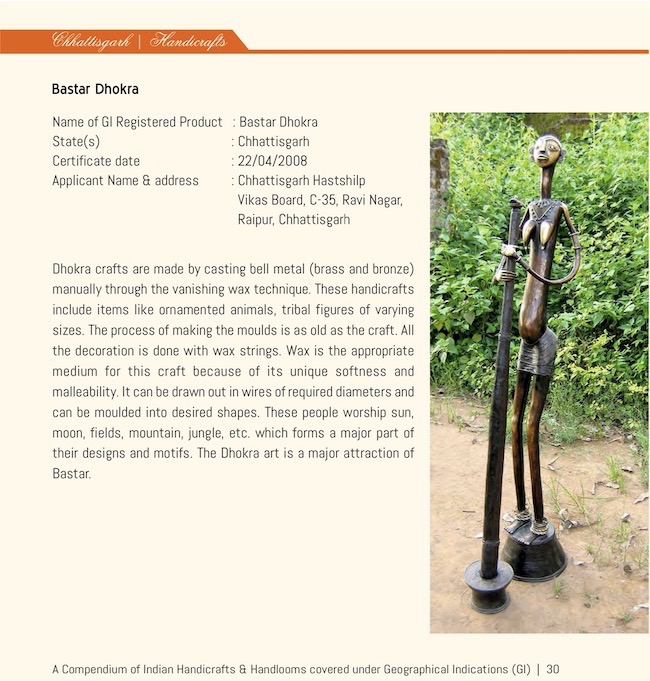
Source: A Compendium of Indian Handicrafts & Handlooms under
Geographical Indications (April 2017) | Find updates via custom search >>
Learn more about India’s tribal cultural heritage covered by this edition:
Bastar, Chhattisgarh, Gujarat, Maharashtra & Tamil Nadu >>
Tribal Arts in India: The National Inventory of Tribal Museums >>
Ethnographic Museums >>
Up-to-date reports by Indian experts and journalists
Search tips
Combine the name of any particular state, language or region with that of any tribal (Adivasi) community.
Add keywords of special interest (music, poetry, dance just as health, sacred grove and biodiversity); learn about the rights of Scheduled Tribes such as the “Forest Rights Act” (FRA); and the United Nations “Declaration on the Rights of Indigenous Peoples”, “Universal Declaration of Human Rights”, “women’s rights”, or “children’s right to education”.
Ask a question that includes “tribal” or “Adivasi”, for instance: “Adivasi way of life better?” (or “tribal way of life worse?”)
Specify any particular issue or news item (biodiversity, bonded labour and human trafficking, climate change, ecology, economic development, ethnobotany, ethnomedicine, global warming, hunter-gatherers in a particular region or state, prevention of rural poverty, water access).
For official figures include “scheduled tribe ST” along with a union state or region: e.g. “Chhattisgarh ST community”, “Himalayan tribe”, “Scheduled tribe Tamil Nadu census”, “ST Kerala census”, “Particularly Vulnerable Tribal Group Jharkhand”, “PVTG Rajasthan”, “Adivasi ST Kerala”, “Adibasi ST West Bengal” etc.
SafeSearch browser tips
If your (mobile) browser fails to display “embedded” media contents, Google maps and SafeSearch windows
Try another browser like Firefox, Chrome or Safari available on your device
Ensure your favourite browser is up to date
Close your present browser
Check your browser and mobile (gsm) settings:
e.g. permission for video or JavaScript
(seen under Preferences >Security >Enable JavaSript)
Restart your computer (smartphone, tablet)
Reconnect to your wifi network or connect to a different one
On some iPhone models the following helps:
>Settings >Safari >scroll down to:
SETTING FOR WEBSITES
Enable “Request Desktop Website” (All Websites) temporarily
Return to the map-post in Safari and “Reload”
Return to >Settings and disable “Request Desktop Website” again
Return to the post in Safari and “Reload”which should now display “embedded” contents as intended (with the convenience of browsing the mobile version on a small screen)
Note: similar solutions may also work with other mobile operating systems.
List of websites covered by this Google custom search engine
Academia.edu (platform for academics to share research papers) – www.academia.edu
Archive.org – https://archive.org
Centre for Science and Environment – https://www.cseindia.org
Current Conservation – https://www.currentconservation.org
Development and Cooperation (D+C) https://www.dandc.eu
Down To Earth (India) – www.downtoearth.org.in
India Environment Portal – www.indiaenvironmentportal.org.in
Harnessing Nature Magazine – https://harnessingnature.online
Mongabay-India – https://india.mongabay.com
M S Swaminathan Research Foundation – www.mssrf.org
Navdanya (protecting India’s biodiversity based food heritage) – https://navdanya.org
People’s Archive of Rural India – https://ruralindiaonline.org/
Third World Network (Penang, Malaysia) – https://twn.my
The Shola Trust (nature conservation in the Nilgiri region) – www.thesholatrust.org
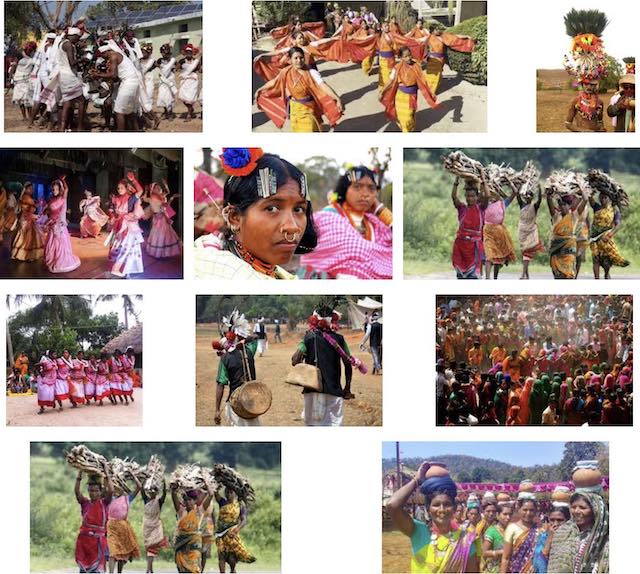
Indian online periodicals and platforms | Images view >>
~ ~ ~
Personalize your CustomSearch by combining other search words >>
(e.g. name of a tribal community and region, a craft, or dance and puppetry)
Research: explore PhD theses from all over India
Shodhganga (Open Access)
Learn more
Crafts and visual arts | Fashion and design | Masks
eBooks, eJournals & reports | eLearning
eBook | Background guide for education
Forest dwellers in early India – myths and ecology in historical perspective
Himalayan region: Biodiversity & Water
History | Hunter-gatherers | Indus Valley | Megalithic culture | Rock art
Languages and linguistic heritage
Modernity | Revival of traditions
Tribal Research and Training Institutes with Ethnographic museums