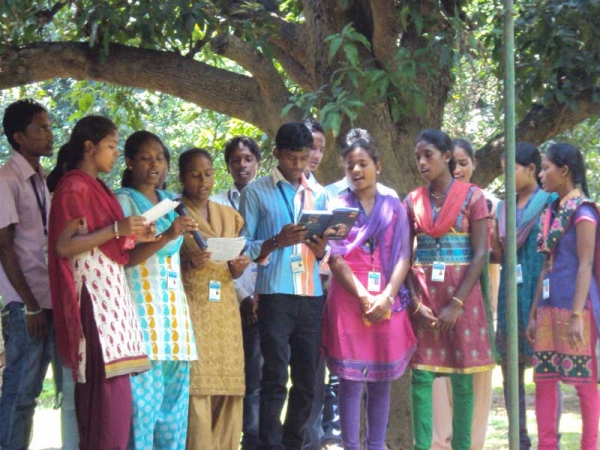
“If all of us unite together beyond the limitations of religion,
political parties and caste system we can bring the change.”
“Adivasi concerns caste while Sarna is about religious affinity.” – Jharkhand tribal lawmaker Bandhu Tirkey explaining his opposition to a so-called “Sarna/Adivasi” code during a special Assembly session (The Telegraph) | Adivasi / Adibasi | Worship and rituals >>
Date: 9th August 2013
Text and photos courtesy 12-8-13 © Remish Ekka
Secretary cum Executive Director ANGNA
- Organizer:- Adivasi Bikas Mahasangh ( ABM)
- Chief speaker of the day;- Joachim Dungdung, Principal BISWAS College, Rajgangpur
- Chief Guest:- Mohanlal Kishan, President, Adivasi Bikas Mahasangh
- Guests of Honors:-
- Mansid Ekka, Ex MLA
- Rev. Fr. Emanuel Toppo, Parish Priest Kahupani
- Rev. Sr. Aloisia Lugun, Head Mistress Vidya Jyoti Girls’ High School Kahupani
- Shri. Dhanwar Sarpanch Khatkurbahal Gram Panchayat
- Manohar Pahule, Advisor ABM, Maharaja Gond tribe
- Bimbadhar Amat, V. President ABM
- Nuas Kulu, Local leader
- V. Tigga, Social Worker
- Public gathering of about 1500 students, youths and villagers
- Brief Report
- Chief Speaker Joachim Dungdung: He high lighted the purpose and need of declaration of Indigenous day by UN. He briefly narrated response of then Prim Minister of India Mr. P.V. Nara Singha Rao regarding the status of indigenous people in India. India’s response was that in India there are no indigenous people. India till date does not recognize tribals as indigenous people. If india agrees that there are indigenous people in India, then India has obligation to give the right of indigenous people. It is most unfortunate that tribals of India are said Scheduled tribe. They are put under category. Further the main speaker high lighted on the situation of tribals in this region. Specially impact of LPG. Number of industries and mines in Schedule area has increased. Pollution has affected health of both people, animals and plants. He said that if today we have to live a dignified life then we have to fight for our rights. Singly it is impossible. If all of us unite together beyond the limitations of religion, political parties and caste system we can bring the change.
- Other speakers Mr. Mansid Ekka, Mr. Mohanlal Kisan, Mr. Bimbadhar Amat, Mr. Mahohar Paule, Fr. Emanuel Toppo, Sr, Aloisia and Sarpanch Dhanwar highlighted problems of region why development is really not taking place. Over use of alcohol specially affecting youths who are getting lost. Industries, factories and mines in Sundergarh distrsict one of the main reason which is responsible for ruining the peaceful life of local indigenous people.
- Cultural Programmes:- college students from Biswas College Rajgangpur, Studentss from Vidyajyoti Girls High school, Organization ANGNA presented entertaining cultural dance and songs
Address
Remish Ekka
Secretary cum Executive Director ANGNA
At/P.O. Kutra-770018
Dt. Sundargarh
Orissa, India
ekka remish@rediffmail.com
web site- wwww.angnango.org
Mb-9937875466
List of sites covered by this Google SafeSearch engine
www.timesofindia.indiatimes.com
Suggest another Indian periodical for inclusion here >>
More SafeSearch on this website
Search tips
Combine the name of any particular state, language or region with that of any tribal (Adivasi) community.
Add keywords of special interest (music, poetry, dance just as health, sacred grove and biodiversity); learn about the rights of Scheduled Tribes such as the “Forest Rights Act” (FRA); and the United Nations “Declaration on the Rights of Indigenous Peoples”, “Universal Declaration of Human Rights”, “women’s rights”, or “children’s right to education”.
Ask a question that includes “tribal” or “Adivasi”, for instance: “Adivasi way of life better?” (or “tribal way of life worse?”)
Specify any particular issue or news item (biodiversity, bonded labour and human trafficking, climate change, ecology, economic development, ethnobotany, ethnomedicine, global warming, hunter-gatherers in a particular region or state, prevention of rural poverty, water access).
For official figures include “scheduled tribe ST” along with a union state or region: e.g. “Chhattisgarh ST community”, “Himalayan tribe”, “Scheduled tribe Tamil Nadu census”, “ST Kerala census”, “Particularly Vulnerable Tribal Group Jharkhand”, “PVTG Rajasthan”, “Adivasi ST Kerala”, “Adibasi ST West Bengal” etc.
SafeSearch browser tips
If your (mobile) browser fails to display “embedded” media contents, Google maps and SafeSearch windows
Try another browser like Firefox, Chrome or Safari available on your device
Ensure your favourite browser is up to date
Close your present browser
Check your browser and mobile (gsm) settings:
e.g. permission for video or JavaScript
(seen under Preferences >Security >Enable JavaSript)
Restart your computer (smartphone, tablet)
Reconnect to your wifi network or connect to a different one
On some iPhone models the following helps:
>Settings >Safari >scroll down to:
SETTING FOR WEBSITES
Enable “Request Desktop Website” (All Websites) temporarily
Return to the map-post in Safari and “Reload”
Return to >Settings and disable “Request Desktop Website” again
Return to the post in Safari and “Reload”which should now display “embedded” contents as intended (with the convenience of browsing the mobile version on a small screen)
Note: similar solutions may also work with other mobile operating systems.
Learn more
Articles on Adivasi culture in Folio Special issue
Contents on this website by and about Prof. Ganesh Devy
eBook | Background guide for education
eBooks, eJournals & reports | eLearning
Education and literacy | Right to education
Figures, census and other statistics
Forest Rights Act (FRA) | Nishad (Nishada, Sanskrit Niṣāda, “tribal, hunter, mountaineer, degraded person outcast”) | Vanavasi (Vanvasi, Vanyajati)
Human Rights Commission (posts) | www.nhrc.nic.in (Government of India)
International Day of the World’s Indigenous People
Irish Journal of Anthropology: Special issue on Adivasi identity
Misconceptions | “Casteism” and its effect on tribal communities
Remembering Birsa Munda: The charismatic tribal leader who shook the British Empire – Jharkhand
Scheduled Tribes | Classifications in different states
Tribal groups (Indian tribal communities)
Tribal Politics – adivasi culture, language, and religion in Encyclopedia of India
United Nations Declaration for the Rights of Indigenous Peoples