“My (mobile) browser fails to display embedded media content” | Tips >>
Living amidst the forest in symphony with the ways of nature, the Sahariyas are one of the last remaining tribes of Rajasthan. This group of self sufficient people has lived all their lives without the use of modern day implements and speaks a local dialect called Haroti that is influenced by the languages of Hindi and Braj.
The tribe possesses rich cultural traditions a paradigm of which is the Swang Nritya– literally implying dance drama. It is an open air performance conducted by a group of about a dozen people and involves mimicry, acting, dialogues, songs and dance. Sequenced episodes of drama are punctuated by the singing of season specific folk songs like Langhuria, Fag and Rasia to the accompaniment of Harmonium, Dholki, Nagri, Ginghra and Majhira. Swang Nritya is commonly performed at the time of the festival of colors – ‘Holi’ and unique to it is the use of pronounced body painting and masks. The tribal history is brought forth beautifully in the strokes of vibrant colours on the faces and bodies of the artists and traditional headgear and costumes made from things garnered from the forest are also used.
Members of the audience are addressed in calling out to them and making them a part of the performance adding to its energy, vibrance and collective revelry. Themes are largely religious and mythological; for example folk tales of Lord Rama and Tejaji are recounted and the tone of the performance is celebratory. The contemporary form of this theatre has secular themes as well and during the course of one performance several themes can be brought about one after the other. Also, activism and health programs now employ the theatre-form to spread awareness about social issues like child marriage, women’s rights, the need of education etc. and about prenatal care and deadly diseases like AIDS.
Source: Sahariya Artists on Vimeo
Address : http://vimeo.com/36678404
Date Visited: Tue May 27 2014 19:50:54 GMT+0200 (CEST)
[Bold typeface added above for emphasis]
Learn more about the tribal cultural heritage celebrated in Rajasthan and the Sahariya community >>
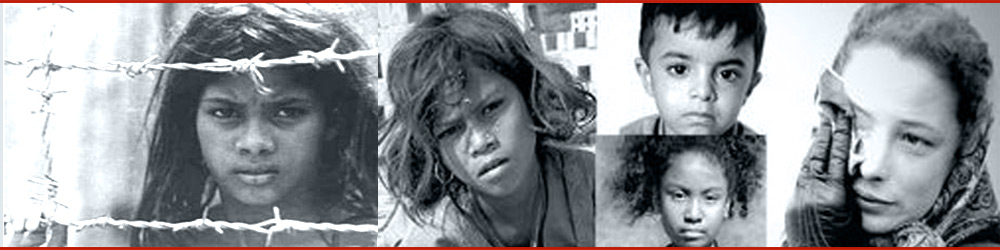
Human trafficking | Violence against women
Slavery | Zamindari
Human trafficking is a crime. To report in India, contact
Shakti Vahini https://shaktivahini.org/contact-us >> shaktivahini@gmail.com
+91-9899710847 +91-9582909025
and/or Childline 1098 (national helpline)
National Programme for Child Labour Free India | PDF-Repository (70 KB)
“Child marriage is not just an age-old social evil, but also a heinous crime that robs children of their childhood. Child marriage is a “crime against children” that violates basic human rights, minor girls are forced to marry and live a life of mental trauma, physical and biological stress, domestic violence including limited access to education and increased vulnerability to domestic violence. […] early pregnancies leading to complications and higher rate of maternal mortality and death of infants, malnutrition.” – Shakti Vahini’s campaign for a Child Marriage Free India >>
“As per a study on human trafficking, the state of Jharkhand has emerged as India’s trafficking hub with thousands of tribal women and girls being trafficked out of the state each year to Delhi, Punjab, Haryana and beyond [while] human traffickers are also involved in many cases of missing children.” – The Wire | Shakti Vahini | Tourism locations | Adivasi tribal bondage slavery trafficking (Safe search) >>
“Childline 1098 is a 24×7 emergency, free phone outreach for children in distress. It is one of the world’s biggest emergency helpline services dedicated to children, and is considered to be among the country’s largest emergency response systems” – The Hindu, 17 April 2022 >>
Tip: discover publications released by Indian publishers and institutions by typing “tribal children stories” in combination with the name of a tribal community (e.g. “Gond”, “Santal”, “Warli”), an Indian State or Union Territory (e.g. “Andaman”, “Tripura”, “Telangana”), a region (e.g. “Bastar”, “Northeast India”, “Nilgiri”), name of artist, author or publisher, and preferred language (“Tamil”, “Hindi”, “bilingual”).
List of sites covered by this Google SafeSearch engine
https://books.katha.org (Katha Books)
https://publicationsdivision.nic.in
Search tips
Combine the name of any particular state, language or region with that of any tribal (Adivasi) community.
Add keywords of special interest (music, poetry, dance just as health, sacred grove and biodiversity); learn about the rights of Scheduled Tribes such as the “Forest Rights Act” (FRA); and the United Nations “Declaration on the Rights of Indigenous Peoples”, “Universal Declaration of Human Rights”, “women’s rights”, or “children’s right to education”.
Ask a question that includes “tribal” or “Adivasi”, for instance: “Adivasi way of life better?” (or “tribal way of life worse?”)
Specify any particular issue or news item (biodiversity, bonded labour and human trafficking, climate change, ecology, economic development, ethnobotany, ethnomedicine, global warming, hunter-gatherers in a particular region or state, prevention of rural poverty, water access).
For official figures include “scheduled tribe ST” along with a union state or region: e.g. “Chhattisgarh ST community”, “Himalayan tribe”, “Scheduled tribe Tamil Nadu census”, “ST Kerala census”, “Particularly Vulnerable Tribal Group Jharkhand”, “PVTG Rajasthan”, “Adivasi ST Kerala”, “Adibasi ST West Bengal” etc.
SafeSearch browser tips
If your (mobile) browser fails to display “embedded” media contents, Google maps and SafeSearch windows
Try another browser like Firefox, Chrome or Safari available on your device
Ensure your favourite browser is up to date
Close your present browser
Check your browser and mobile (gsm) settings:
e.g. permission for video or JavaScript
(seen under Preferences >Security >Enable JavaSript)
Restart your computer (smartphone, tablet)
Reconnect to your wifi network or connect to a different one
On some iPhone models the following helps:
>Settings >Safari >scroll down to:
SETTING FOR WEBSITES
Enable “Request Desktop Website” (All Websites) temporarily
Return to the map-post in Safari and “Reload”
Return to >Settings and disable “Request Desktop Website” again
Return to the post in Safari and “Reload”which should now display “embedded” contents as intended (with the convenience of browsing the mobile version on a small screen)
Note: similar solutions may also work with other mobile operating systems.
More SafeSearch on this website
Research: explore PhD theses from all over India
Shodhganga (Open Access)
Related posts
Tips for using interactive maps
Toggle to normal view (from reader view) should the interactive map not be displayed by your tablet, smartphone or pc browser
For details and hyperlinks click on the rectangular button (left on the map’s header)
Scroll and click on one of the markers for information of special interest
Explore India’s tribal cultural heritage with the help of another interactive map >>
See also
Audio | Santali Traditional and Fusion Songs: Ghosaldanga Bishnubati Adibasi Trust – West Bengal
Childhood | Child marriage | Children’s right to Education
Crafts and visual arts | Masks
India’s tribal, folk and devotional music: Secular and ceremonial songs
Memory of the World Programme – Unesco
Music and dance | Musicology | Adivasi music and the public stage by Jayasri Banerjee
Video | Banam lutes and fiddles of the Santal people – Jharkhand & West Bengal
Video | Celestial Dancers of Manipur
Video | Cultural traditions of the Halakki people – Karnataka
Video | Khasi musical heritage of Meghalaya
Video | Kota women’s dance: Shivaratri celebrations – Nilgiris – Tamil Nadu
Video | Santali video album “Ale Ato” (Our Village, Part 1 of 2) – West Bengal
Video | South Gujarat tribal music documentation by Bhasha – Gujarat
Video | Tribes in Transition-III: “Indigenous Cultures in the Digital Era”
Video | Safe contents for educational use on many topics (music, visual arts and more)