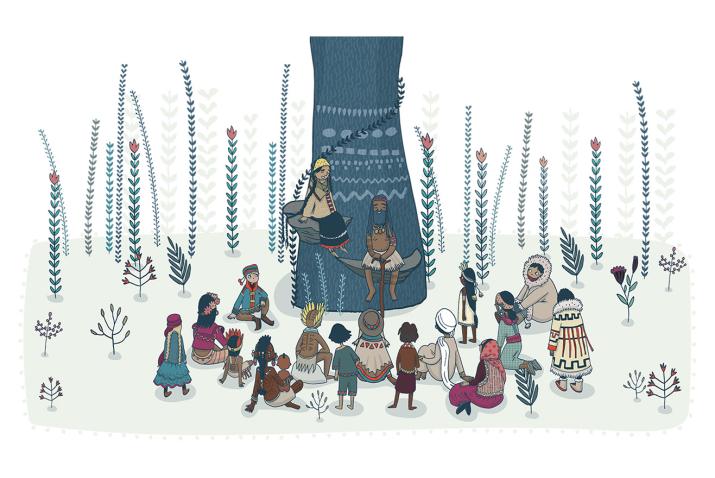
Indigenous Peoples make up less than 6% of the global population, but they represent at least 15% of the extremely poor.
Indigenous Peoples’ territories encompass 28% of the surface of the globe and contain 11% of the world’s forests. They are guardians of most of the world’s remaining biodiversity.
Indigenous Peoples’ food systems have high levels of self-sufficiency, ranging from 50% to 80% in food and resource generation.
Learn more: https://indiantribalheritage.org/international-day-of-the-worlds-indigenous-people-9-august-
How tribal communities have protected India’s forests and preserved biodiversity all over the world
“Tribal communities have proven that they are the best guardians of the forest and die-hard conservationists”: Illegal mining destroys the life and culture of the conservators of forests >>
“Even though they are responsible for protecting the largest part of the global forest heritage […] a third of indigenous and community lands in 64 countries are under threat due to the lack of land tenure rights.” – Pressenza Rio de Janerio in “Indigenous people are heading to CoP26: ‘There is no solution to the climate crisis, without us’” (Down To Earth, 1 November 2021) >>
“The British established mode of forest governance imposed restrictions on local forest-dwelling communities. In 1860, the Company withdrew all access rights for using the forests (food, fuel, medicine and selling forest products) since the forests and forest-dwelling communities provided refuge to the rebels during the Sepoy Mutiny.” – Bharat Rural Livelihoods Foundation >>
“Tribal population was spread all over India and most of them occupied wild tracts, hilly and forested areas, away from more civilized centers. In 1880 their population was estimated at about seventy million. They had existed for centuries with their own social traditions and beliefs and subsisted on natural resources. They had preserved their near isolation and way of life until the British administration and policies made inroads into their territories.” – Subha Johari in Tribal Dissatisfaction Under Colonial Economy of 19th Century >>

“Two main streams within Indian anthropology influenced the literary and visual representations of tribes by mainstream writers, artists and film-makers.” – Dr. Ivy Hansdak clarifies how they are associated with “assimilationist” and “isolationist” positions or policies >>
In Marginalised but not Defeated, Tarun Kanti Bose (a seasoned public interest journalist) “documents the hard and difficult struggle to implement the Forest Rights Act, how the oppressed adivasis have united into forest unions, how they are now entering into new thresholds of protracted struggles and victories in a non-violent manner.” | Learn more: https://countercurrents.org/2023/05/book-review-marginalised-but-not-defeated >>
“Tribal men and women mix freely, but with respect for each other [but] caste Hindu society in India is so convinced of its own superiority that it never stops to consider the nature of social organisation among tribal people. In fact it is one of the signs of the ‘educated’ barbarian of today that he cannot appreciate the qualities of people in any way different from himself – in looks or clothes, customs or rituals.” – Guest Column in India Today >>
Learn more about colonial policies, the Forest Rights Act, its importance for ecology, biodiversity, ethnobotany and nutrition, and about the usage of Adivasi (Adibasi) communities in different states of India: in legal and historical records, in textbooks, scholarly papers and the media >>
Tip: click on any red marker for details on endangered languages in a particular region of India.
Please note: facts and figures cited in map entries (via hyperlinks) often require updates (fact checking) | Cultural invisibility – India’s 600 potentially endangered languages | Linguistic Survey of India (official website) >>