A recent butterfly survey in North Wayanad Forest Division of Kerala organised jointly by the Ferns Naturalists Society and the Forest and Wildlife Department reported the sighting of 140 species, including 17 which had not been hitherto reported in the region.
The three-day survey was conducted at three locations under the division at Brahmagiri, Makkimala, and Kunjome. Four researchers, V.C. Balakrishnan, Padman Karayad, Sasi Gayathri, and P.A. Vinayan, and 40 students from the Department of Wildlife Biology, AVC College, Mayiladuthurai, Tamil Nadu; Centre for Wildlife Biology, veterinary college, Pookode; Department of Applied Zoology, Kannur University; Department of Zoology, Mary Matha College, Mananthavadi, and the College of Forestry, Mannuthy, took part in the survey. […]
The sighting of 140 species of butterflies is an evidence of a healthy butterfly habitat in the region, V.C. Balakrishnan of the Society for Environment Education in Kerala (SEEK) said.
The new species in the region included Black-Veign Sergeant, Dark Pierrot, Nilgiri Tiger, Blue Pansy, Common Banded Demon, and Yellow-Jack Sailer, he added.
Source: Butterfly survey records 140 species by E. M. Manoj (The Hindu, 30 October 2011)
Address : https://www.thehindu.com/sci-tech/science/article2582434.ece
Date Visited: 1 April 2020
Contact
Ferns Naturalists Society
Arun P.A., Secretary
PB No 28, Mananthavady, Wayanad
Mananthavady
Kerala 670645
Indiafernmails@gmail.com
Source: Ferns | India Water Portal
Address : https://www.indiawaterportal.org
Date Visited: Sun Mar 17 2013 12:22:44 GMT+0100 (CET)
“What we are telling to the outer world is that no conservation would be possible without cooperation of the local community [and] integrating their traditional wisdom with modern-day scientific approach.” – WWF’s Kerala consultant KH Amitha Bachan | Learn more: Biodiversity | Climate change | Ethnobotany & ethnomedicine | Nature and wildlife | Sacred grove | United Nations on climate change >> >>
Up-to-date reports by Indian experts and journalists
List of sites covered by this Google SafeSearch engine
Academia.edu (platform for academics to share research papers) – www.academia.edu
Archive.org – https://archive.org
Centre for Science and Environment – https://www.cseindia.org
Current Conservation – https://www.currentconservation.org
Development and Cooperation (D+C) https://www.dandc.eu
Down To Earth (India) – www.downtoearth.org.in
India Environment Portal – www.indiaenvironmentportal.org.in
Harnessing Nature Magazine – https://harnessingnature.online
Kalpavriksh Environmental Action Group – https://kalpavriksh.org
Mongabay-India – https://india.mongabay.com
M S Swaminathan Research Foundation – www.mssrf.org
Navdanya (protecting India’s biodiversity based food heritage) – https://navdanya.org
People’s Archive of Rural India – https://ruralindiaonline.org/
Third World Network (Penang, Malaysia) – https://twn.my
The Shola Trust (nature conservation in the Nilgiri region) – www.thesholatrust.org
TribalConnect (“uplift and benefit the community without adversely affecting or changing their vernacular”) – https://tribalconnect.org.in
WorldCat (“the world’s largest library catalog, helping you find library materials online”) – https://worldcat.org
More SafeSearch on this website
Search tips
Combine the name of any particular state, language or region with that of any tribal (Adivasi) community.
Add keywords of special interest (music, poetry, dance just as health, sacred grove and biodiversity); learn about the rights of Scheduled Tribes such as the “Forest Rights Act” (FRA); and the United Nations “Declaration on the Rights of Indigenous Peoples”, “Universal Declaration of Human Rights”, “women’s rights”, or “children’s right to education”.
Ask a question that includes “tribal” or “Adivasi”, for instance: “Adivasi way of life better?” (or “tribal way of life worse?”)
Specify any particular issue or news item (biodiversity, bonded labour and human trafficking, climate change, ecology, economic development, ethnobotany, ethnomedicine, global warming, hunter-gatherers in a particular region or state, prevention of rural poverty, water access).
For official figures include “scheduled tribe ST” along with a union state or region: e.g. “Chhattisgarh ST community”, “Himalayan tribe”, “Scheduled tribe Tamil Nadu census”, “ST Kerala census”, “Particularly Vulnerable Tribal Group Jharkhand”, “PVTG Rajasthan”, “Adivasi ST Kerala”, “Adibasi ST West Bengal” etc.
SafeSearch browser tips
If your (mobile) browser fails to display “embedded” media contents, Google maps and SafeSearch windows
Try another browser like Firefox, Chrome or Safari available on your device
Ensure your favourite browser is up to date
Close your present browser
Check your browser and mobile (gsm) settings:
e.g. permission for video or JavaScript
(seen under Preferences >Security >Enable JavaSript)
Restart your computer (smartphone, tablet)
Reconnect to your wifi network or connect to a different one
On some iPhone models the following helps:
>Settings >Safari >scroll down to:
SETTING FOR WEBSITES
Enable “Request Desktop Website” (All Websites) temporarily
Return to the map-post in Safari and “Reload”
Return to >Settings and disable “Request Desktop Website” again
Return to the post in Safari and “Reload”which should now display “embedded” contents as intended (with the convenience of browsing the mobile version on a small screen)
Note: similar solutions may also work with other mobile operating systems.
What does it mean to be Indigenous?
Indigenous Peoples can be identified according to certain characteristics:
They are politically and socially marginalized.
Most importantly, they self-identify as Indigenous Peoples.
They share an ancestral link with those who inhabited a country or region before they were colonized or before other peoples became dominant.
They have a strong link to particular territories and the surrounding natural resources.
They have distinct social, economic or political systems, which they are resolved to maintain and reproduce.
They have a distinct language, culture and beliefs.
There are more than 5,000 different Indigenous Peoples around the world comprising 476 million people – around 6.2% of the global population. They are spread across more than 90 countries in every region and speak more than 4,000 languages. | Learn more (Amnesty International) >>
Source: “INDIGENOUS PEOPLES’ RIGHTS” by Amnesty International
URL: https://www.amnesty.org/en/what-we-do/indigenous-peoples/
Date Visited: 10 May 2025
Learn more on the Rights of Indigenous Peoples, their Languages & linguistic heritage & Tribal culture worldwide >>
See also
Biodiversity and development – Kerala
Childhood – Kerala | Childrens rights: UNICEF India | Safe search
Childrens rights: English or Malayalam (UNICEF India)
eBook | Background guide for education
Education and literacy | Right to education
Kerala | State wise ST list (Scheduled Tribes)
Recommendations by the Expert Committee on Tribal Health
Tribal schools and educational projects – Kerala
Video | M.S. Swaminathan on Biodiversity and the sharing of resources
Video | Trailer to “Have you seen the arana?” – Kerala
Vulnerable tribal groups – Kerala
Women | Safe search | President Droupadi Murmu on women’s empowerment
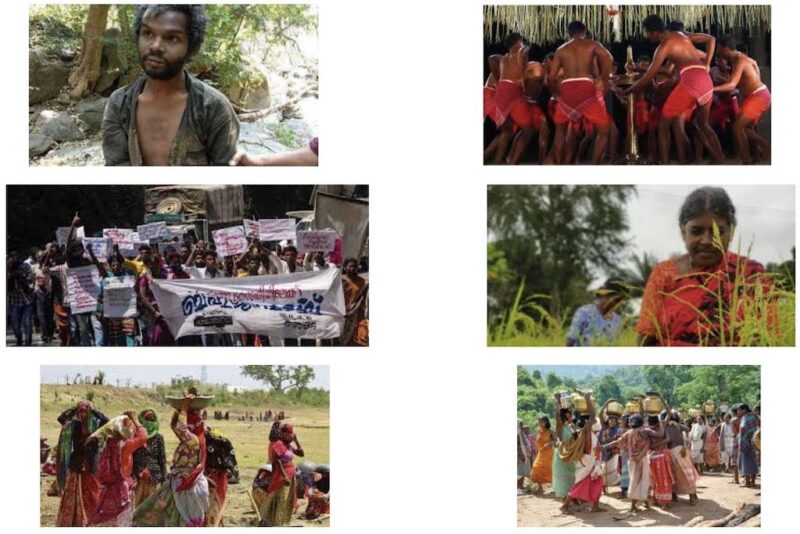
Explore India’s tribal cultural heritage with the help of another interactive map >>