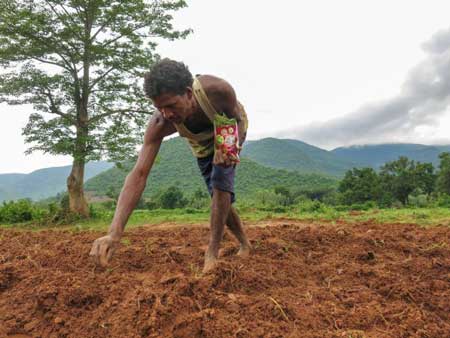
Rayagada: “one of the world’s great biodiversity hotspots, and a historical area of rice diversification”
Pirikaka is a Kondh Adivasi farmer in her 40s. Every year, for over two decades, she would prepare a hill slope for dongar chaas – literally, ‘mountain farming’ (shifting cultivation). Following traditions honed by the region’s farmers over centuries, Pirikaka would sow mixed plots of heirloom seeds which she had saved from family harvests the previous year. These would yield a basket of food crops: millets like mandia and kangu, pulses like pigeon pea and black gram, as well as traditional varieties of long beans, niger seeds and sesame.
This July, for the first time, Pirikaka switched to Bt cotton. That was the time we met her, sowing the dark pink, chemical-doused seeds on a hill slope at her village in Bishamakatak block. The penetration of cotton into the shifting cultivation practices of the Adivasis was striking, making us ask her about this switch. “Other crops like turmeric also give money,” admits Pirikaka. “But nobody is doing that. Everyone is leaving mandia [millet]… and going after cotton.” […]
Rayagada, with close to 1 million people, is a part of the Koraput region, one of the world’s great biodiversity hotspots, and a historical area of rice diversification. A 1959 survey of the Central Rice Research Institute showed the region still had over 1,700 rice varieties at the time. It’s down to around 200 now. Some researchers believe it to be a birthplace of rice cultivation.
The Kondh Adivasis here, largely subsistence farmers, are known for their sophisticated practices of agro-forestry. Even today, many Kondh families across the region’s emerald-green terraced fields and mountainside farms, cultivate a dizzying array of paddy and millet varieties, pulses and vegetables. Surveys by Living Farms, a non-profit in Rayagada, have recently documented 36 millet varieties and 250 forest foods.
Most Adivasi farmers here work on individual or common property farms ranging from 1 to 5 acres in size.
Their seeds are largely nurtured and shared within the community, using almost no synthetic fertilisers or other agri-chemicals (also called agro-chemicals).
Yet, cotton has become the second-most cultivated crop in Rayagada after paddy, overtaking millets – the premier traditional food crops of the region. It covers a fifth of the 428,947 acres under cultivation in this district. Cotton’s swift expansion is reshaping this land and people steeped in agro-ecological knowledge. […]
“The traditional knowledge of farm-related as well as non-farm occupations are rapidly disappearing,” he said. In village after village, there is no potter, no carpenter, no weaver. All household goods are bought from the market, and most of these – from the pitcher to the mat – are made of plastics, imported from faraway towns. Bamboos have disappeared from most villages, and with them bamboo crafts. They are now substituted by wood from the forest and expensive concrete. Even for erecting a pole or making a fence, villagers have to cut trees from the forest. The more people depend on the market due to the lure of profit, the more the environment degrades.” […]
Source: Sowing the Seeds of the Climate Crisis in Odisha
URL: https://www.counterpunch.org/2019/10/08/sowing-the-seeds-of-the-climate-crisis-in-odisha/
Date visited: 27 February 2026
[Bold typeface added above for emphasis]
Up-to-date reports by Indian experts and journalists
Search tips
Combine the name of any particular state, language or region with that of any tribal (Adivasi) community.
Add keywords of special interest (music, poetry, dance just as health, sacred grove and biodiversity); learn about the rights of Scheduled Tribes such as the “Forest Rights Act” (FRA); and the United Nations “Declaration on the Rights of Indigenous Peoples”, “Universal Declaration of Human Rights”, “women’s rights”, or “children’s right to education”.
Ask a question that includes “tribal” or “Adivasi”, for instance: “Adivasi way of life better?” (or “tribal way of life worse?”)
Specify any particular issue or news item (biodiversity, bonded labour and human trafficking, climate change, ecology, economic development, ethnobotany, ethnomedicine, global warming, hunter-gatherers in a particular region or state, prevention of rural poverty, water access).
For official figures include “scheduled tribe ST” along with a union state or region: e.g. “Chhattisgarh ST community”, “Himalayan tribe”, “Scheduled tribe Tamil Nadu census”, “ST Kerala census”, “Particularly Vulnerable Tribal Group Jharkhand”, “PVTG Rajasthan”, “Adivasi ST Kerala”, “Adibasi ST West Bengal” etc.
SafeSearch browser tips
If your (mobile) browser fails to display “embedded” media contents, Google maps and SafeSearch windows
Try another browser like Firefox, Chrome or Safari available on your device
Ensure your favourite browser is up to date
Close your present browser
Check your browser and mobile (gsm) settings:
e.g. permission for video or JavaScript
(seen under Preferences >Security >Enable JavaSript)
Restart your computer (smartphone, tablet)
Reconnect to your wifi network or connect to a different one
On some iPhone models the following helps:
>Settings >Safari >scroll down to:
SETTING FOR WEBSITES
Enable “Request Desktop Website” (All Websites) temporarily
Return to the map-post in Safari and “Reload”
Return to >Settings and disable “Request Desktop Website” again
Return to the post in Safari and “Reload”which should now display “embedded” contents as intended (with the convenience of browsing the mobile version on a small screen)
Note: similar solutions may also work with other mobile operating systems.
List of websites covered by this Google custom search engine
Academia.edu (platform for academics to share research papers) – www.academia.edu
Archive.org – https://archive.org
Centre for Science and Environment – https://www.cseindia.org
Current Conservation – https://www.currentconservation.org
Development and Cooperation (D+C) https://www.dandc.eu
Down To Earth (India) – www.downtoearth.org.in
India Environment Portal – www.indiaenvironmentportal.org.in
Harnessing Nature Magazine – https://harnessingnature.online
Mongabay-India – https://india.mongabay.com
M S Swaminathan Research Foundation – www.mssrf.org
Navdanya (protecting India’s biodiversity based food heritage) – https://navdanya.org
People’s Archive of Rural India – https://ruralindiaonline.org/
Third World Network (Penang, Malaysia) – https://twn.my
The Shola Trust (nature conservation in the Nilgiri region) – www.thesholatrust.org
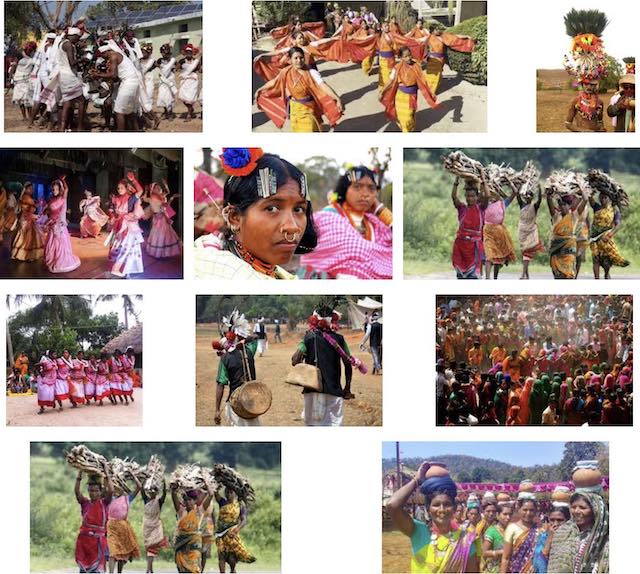
Indian online periodicals and platforms | Images view >>
~ ~ ~
Personalize your CustomSearch by combining other search words >>
(e.g. name of a tribal community and region, a craft, or dance and puppetry)
Research: explore PhD theses from all over India
Shodhganga (Open Access)
“If we take action, the right action – as the report [on Biological Diversity] proposes – we can transition to a sustainable planet.” […] Many good things are happening around the world and these should be celebrated and encouraged […] We have to act now. It is not too late. Otherwise, our children and grandchildren will curse us because we will leave behind a polluted, degraded and unhealthy planet.” – Elizabeth Maruma Mrema, executive secretary, UN Convention on Biological Diversity – “Extinction: Urgent change needed to save species, says UN”, BBC News, 15 September 2020 >>
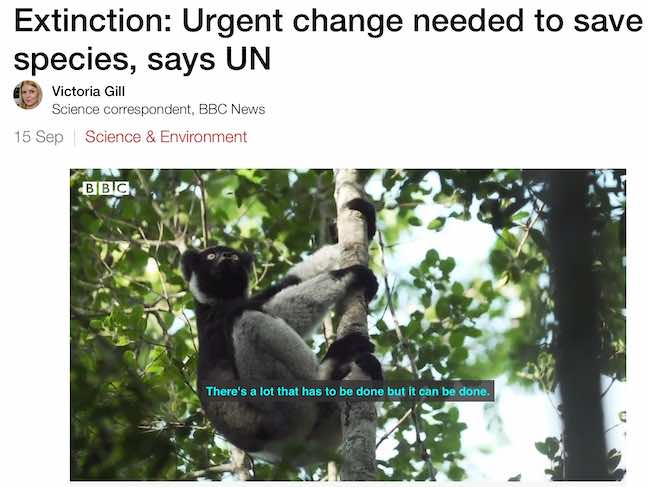
Watch the video on BBC News | More about Biodiversity in India >>
Research: explore PhD theses from all over India
Shodhganga (Open Access)
Learn more
Atree.org | Ashoka Trust for Research in Ecology & the Environment (posts)
Biodiversity | Hyderabad biodiversity pledge | Nilgiri Biosphere
Climate change | United Nations on climate change
eBook | Background guide for education
eLearning: Center for World Indigenous Studies
Health and nutrition | Recommendations by the Expert Committee
Tips for using interactive maps
Toggle to normal view (from reader view) should the interactive map not be displayed by your tablet, smartphone or pc browser
For details and hyperlinks click on the rectangular button (left on the map’s header)
Scroll and click on one of the markers for information of special interest
Explore India’s tribal cultural heritage with the help of another interactive map >>