Tribal heritage needs to be respected on its own terms. It will be disastrous to aim at absorbing tribal communities into the ‘mainstream’. Nehru had forewarned us against following such ‘interventionist’ policies, ‘There is no point to make them a second-rate copy of ourselves’ […]
The tribal culture at its best provides a living example of the Gandhian concept of trusteeship […] In cross-cultural settings, individual and group relations among tribals are valued on trust rather than on dominance.
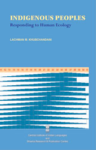
Source: Lachman Khubchandani in Indigenous Peoples: Responding to Human Ecology (pp. 14-15) | Free eBook download | Backup >>
Indigenous Peoples: Responding to Human Ecology Author : Lachman Khubchandani Publisher : Bhasha Centre and CIIL, 2009 Pages : 130
Indigenous Peoples reflects on the current development crises in a framework of human ecology and discusses how Adivasis have responded. Indigenous Peoples explores the rubric of indigenous knowledge systems and discusses the issue of language endangerment in the context of politico-economic and technological patterns of modern societies. The book argues for re-assessment of development plans and strategies in the context of adivasi worldview.
Source: Bhasha Research and Publication Center : www.bhasharesearch.org.in Address : http://bhashaebooks.org/Downloadbook.aspx?name=6 Date Visited: 27 November 2020
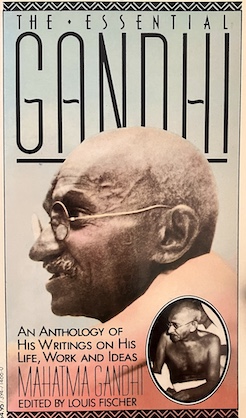
Mahatma Gandhi on the spirit of democracy: individual liberty of opinion and action
The spirit of democracy is not a mechanical thing to be adjusted by abolition of forms. It requires change of the heart. … The spirit of democracy requires the inculcation of the spirit of brotherhood…
Democracy is not a state in which people act like sheep. Under democracy individual liberty of opinion and action is jealousy guarded.
No special legislation without a change of heart can possibly bring about organic unit. And when there is a change of heart, no such legislation can possibly be necessary.
Louis Fischer quoting Gandhi in Young India (1920-1927). Vintage Books 1983 ed. pp. 220-221
Find scholarly books, poetry and fiction relating to tribal culture – Indian publishers
List of sites covered by this Google SafeSearch engine
Combine the name of any particular state, language or region with that of any tribal (Adivasi) community.
Add keywords of special interest (music, poetry, dance just as health, sacred grove and biodiversity); learn about the rights of Scheduled Tribes such as the “Forest Rights Act” (FRA); and the United Nations “Declaration on the Rights of Indigenous Peoples”, “Universal Declaration of Human Rights”, “women’s rights”, or “children’s right to education”.
Ask a question that includes “tribal” or “Adivasi”, for instance: “Adivasi way of life better?” (or “tribal way of life worse?”)
Specify any particular issue or news item (biodiversity, bonded labour and human trafficking, climate change, ecology, economic development, ethnobotany, ethnomedicine, global warming, hunter-gatherers in a particular region or state, prevention of rural poverty, water access).
For official figures include “scheduled tribe ST” along with a union state or region: e.g. “Chhattisgarh ST community”, “Himalayan tribe”, “Scheduled tribe Tamil Nadu census”, “ST Kerala census”, “Particularly Vulnerable Tribal Group Jharkhand”, “PVTG Rajasthan”, “Adivasi ST Kerala”, “Adibasi ST West Bengal” etc.
SafeSearch browser tips
If your (mobile) browser fails to display “embedded” media contents, Google maps and SafeSearch windows
Try another browser like Firefox, Chrome or Safari available on your device
Ensure your favourite browser is up to date
Close your present browser
Check your browser and mobile (gsm) settings: e.g. permission for video or JavaScript (seen under Preferences >Security >Enable JavaSript)
Restart your computer (smartphone, tablet)
Reconnect to your wifi network or connect to a different one
On some iPhone models the following helps:
>Settings >Safari >scroll down to: SETTING FOR WEBSITES
Return to >Settings and disable “Request Desktop Website” again
Return to the post in Safari and “Reload”which should now display “embedded” contents as intended (with the convenience of browsing the mobile version on a small screen)
Note: similar solutions may also work with other mobile operating systems.