India is home to nearly 20 Cr. [200 million] traditional forest-dwelling Adivasis and OTFDs [other forest dwelling communities], who derive their subsistence and livelihoods from forest and forest resources over several generations and thousands of years. The passage of the Scheduled Tribes and other Forest Dwellers (Recognition of Forest Rights) Act (2006), recognizing both the individual and community rights over forest and forest resources is an attempt to redress the “historical injustice” meted out to [200 million] tribals and OTFDs [other forest dwelling communities]. But the state governments have failed to implement the FRA, as indicated by the high rejection rates, majority of them being wrongful and on flimsy ground. […]
The last section provides concluding remarks and range of policy recommendations meant for increasing the effectiveness of the FRA in its present form.
Source: Introduction by Research team (Sayantani Satpathi, Shambhavi Singh & Subhodeep Basu) in “Revisiting the Forest Rights Act: Status of Implementation with respect to Land Tenures and Collection of Minor Forest Produce”)”, Bharat Rural Livelihoods Foundation New Delhi, 12 July 2019, p. 3
URL: https://www.academia.edu/41756309
Date visited: 6 November 2o22
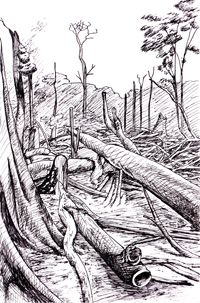
“We can do things differently to reinvent growth without pollution. But only if we have the courage to think differently.” – Sunita Narain in Down To Earth >>
The Community Forest Resource (CFR) rights provisions of the Scheduled Tribes and Other Traditional Forest Dwellers (Recognition of Forest Rights) Act, 2006 (also known as the FRA) is a revolutionary tool in forest governance. It visualizes statutorily backed devolution of forest management authority to Gram Sabhas, and full transfer of rights over non-timber forest products to them. The CFR provision gives local communities the right to protect, regenerate or conserve or manage any community forest resource which the communities have been traditionally protecting and conserving for sustainable use. It further has the potential to bring about a transformative change in the economic and social conditions of the local people, and improve the management of the forests.
Source: Project description titled “Action Research and Policy Support on Community Forest Resource management in Central India” by Ashoka Trust for Research in Ecology and the Environment (ATREE)
URL: https://www.atree.org/projects/action-research-and-policy-support-community-forest-resource-management-central-india
Date Visited: 5 July 2021
[T]here are three major rights on forests to be transferred to the forest-dwelling tribal people [including] Title for Forest Land Under Occupation, right of ownership, access to collect, use, and dispose of minor forest produce, [i.e.] all non-timber produce of plant origin, including bamboo, brush wood, stumps, cane, tussar, cocoons, honey, wax, lac, tendu or kendu leaves, medicinal plants and herbs, roots, tubers.
Implementation of Forest Rights Act: Towards an informed collective action by stakeholders by Azim Premji University Team, Initiative for Effective Implementation of FRA
More about India’s forest legislation: Forest Rights Act (FRA) & Illegal mining >>
“In his play Muktadhara (The Waterfall), Tagore robustly employs this element of freedom. The play relates the story of an exploited people and their eventual release from it. [Today, when] tribal populations across India are being uprooted with impudence Tagore’s message of freedom, in all its shades, is of utmost relevance.” – Bhaswati Ghosh in Freedom in Tagore’s Plays | Learn more >>
The Forest Rights Act, 2006, though is laudable in its intent but it only furthers the same isolationist policy. For, the title of the land given to the STs is only heritable, but not alienable or transferable under section 4 of that Act. By giving forest land which is not transferable or monetisable, the STs are perpetually shackled to the forest for generations. Giving land in non-forest and non-Scheduled Areas would have helped the STs grow much better and join the mainstream.
Source: M Nageswara Rao (Indian Police Service, IPS) in “Scheduled Tribes: Who are they? How to mainstream them?” (Times of India, 16 May 2020)
URL: https://timesofindia.indiatimes.com/blogs/voices/scheduled-tribes-who-are-they-how-to-mainstream-them/
Date Visited: 5 July 2021

Dr. Ivy Hansdak clarifies that during the early twentieth century, “two main streams within Indian anthropology influenced the literary and visual representations of tribes by mainstream writers, artists and film-makers. One group was led by GS Ghurye (the assimilationist position) and the other by Verrier Elwin (the isolationist position). Later, Elwin shifted to the intergrationist position. According to the former, tribes were seen as ‘backward Hindus’ and an attempt was made to assimilate them into the Hindu fold. The identity of tribals as ‘vanavasi‘ comes from this position. Elwin, on the other hand, wanted to preserve their distinctive culture and often glorified them as the Noble Savage. Elwin’s views influenced Pandit Nehru’s tribal policy. Today, most tribals are being clubbed together with the scheduled castes (SC or dalit) with whom they share reservation in college admission and jobs. In the government documents, ‘SC/ST‘ are usually written together. The certificate that is issued to those claiming reserved status is also called ‘caste certificate’.” (email dated 26 April 2023)
A constitution which guarantees: “The State shall not discriminate against any citizen” – The Sovereign Republic of India | Learn more >>
Millions of people live in and near India’s forest lands, but have no legal right to their homes, lands or livelihoods. A few government officials have all power over forests and forest dwellers. The result? Both forests and people die. This Act recognises forest dwellers’ rights and makes conservation more accountable. […]
For the first time, this law also gives the community the right to protect and manage the forest. Section 3(1) (i) provide a right and a power to conserve community forest resources, while section 5 gives the community a general power to protect wildlife, forests, etc. This is vital for the thousands of village communities who are protecting their forests and wildlife against threats from forest mafias, industries and land grabbers, most of whom operate in connivance with the Forest Department.
Source: “What is the Forest Rights Act about?” – Campaign for Survival and Dignity (“a national platform of tribal and forest dwellers’ organisations in ten States”)
Address : https://www.forestrightsact.com/what-is-this-act-about
Date Visited: 31 July 2020
“The forest was never far away from habitation. For instance, excavations of the settlements at Atranjikhera and Hastinapur, which are not too far from Delhi, have yielded evidence of a large variety of forest trees. The Buddhist Canon states that aside from the village and its outskirts, the rest of the land is jungle. Travelling from one town to another meant going through a forest. Therefore, when in exile, the forest was not a physically distant place, although distant in concept.“ – Romila Thapar (Emeritus Professor of History, Jawaharlal Nehru University) in “Forest dwellers in early India – myths and ecology in historical perspective” | Learn more >>
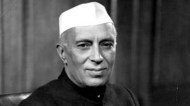
Jawaharlal Nehru on five principles for the policy to be pursued vis-a-vis the tribals >>
Photo © Indian Express
The current predicament of Adivasis
The current predicament of a vast majority of Adivasis is one of sharp erosion in their livelihoods and their life-worlds. Despite assurances of autonomy (the Fifth and Sixth Schedules, the Panchsheel, PESA 1996, Forests Rights Act 2006) and attempts of focused addressal of Adivasi and Tribal issues (including the establishment of an umbrella outfit, the National Council for Tribal Welfare), there are counter structures and programmes that defy the enabling of genuinely decentralised autonomy and the guarantee of democratic participation. For instance, the recently approved ‘Integrated Action Plan’ in Tribal areas overrides the representation of Adivasis in local issues in decision-making processes and arrogates powers of governance to bureaucrats and specialists.
In addition to such contradictory and conflicting measures, the forces of fast-expanding capital, along with the top-down deployment of development models have resulted in large scale displacement in Adivasi regions. Global capital’s access to mineral wealth has also intensified violence of various forms and degrees.
Source: Ch. 2, “Context and Conditions of Adivasi Life Worlds” (p. 5) in THE EDUCATION QUESTION’ FROM THE PERSPECTIVE OF ADIVASIS: CONDITIONS, POLICIES AND STRUCTURES by National Institute of Advanced Studies (Bangalore), March 2012 & UNICEF | Backup (PDF, 4 MB)
On a January night in 1967, Vanthala Ramanna became an encroacher on his own land. The Andhra Pradesh government snatched away his land when it decided to create a new reserve forest almost the size of Mumbai city.
The news reached Panasalpadu village in Vishakhapatnam district almost two days later. By then, Ramanna and all others in the village had become de facto landless who had to prove their land ownership.
The notification was issued under Section 4 of the Indian Forest Act, 1927. It is the first step in the process of declaring any piece of land as a reserve forest. The next steps involve settling the land rights before the transfer is made to the new owners — the forest department. But that never happened. This is not the first time the village residents had to prove their rights over their ancestral land.
Some 150 years ago, the first Indian Forest Act in 1865, promulgated by the British government, had usurped the traditional ownership and management power of forest-dwelling communities. […]
The taskforce, headed by A P Srivastav, the then additional chief secretary of the state forest department, submitted its final report on February 6, 2020. […]
The taskforce found that there are 27,000 villages where private and common land was wrongly taken over by the forest department and never returned to the revenue department. What this means is that the fate of the residents of these 27,000 villages is dependent on an endless bureaucratic exercise. […]
In a country which boasts of one of the top 10 forest covers in the world, it is ironic that the forest departments and the Union government have not followed its own law for over 90 years. Meanwhile, in many villages across India, like in Panasalpadu, the rights recognition process has not taken place till now. While Chinnaya Ramanna was failed by the Indian Forest Act, 1927, it seems for his son, justice is being delayed, and therefore denied, under FRA.
This article is supported by Internews’ Earth Journalism Network
Source: “Inside ad hoc forests: Government failure, both at the Centre and the states, is hurting communities and forests alike” by Ishan Kukreti (Down To Earth, 18 January 2021)
URL: https://www.downtoearth.org.in/news/forests/inside-ad-hoc-forests-75051
Date Visited: 5 July 2021
[Bold typeface added above for emphasis]
Find up-to-date information provided by, for and about Indian authors, researchers, officials, and educators
List of sites covered by this Google SafeSearch engine
Ashoka Trust for Research in Ecology and the Environment (ATREE) – www.atree.org
Freedom United – www.freedomunited.org
Government of India (all websites ending on “.gov.in”)
Kalpavriksh Environmental Action Group – https://kalpavriksh.org
Shodhganga (a reservoir of Indian theses) – https://shodhganga.inflibnet.ac.in
Survival International – www.survivalinternational.org
UCLA Digital Library – https://digital.library.ucla.edu
Unesco – https://en.unesco.org
Unesco digital library – https://unesdoc.unesco.org
Unicef – www.unicef.org
United Nations – www.un.org/en
Video Volunteers – www.videovolunteers.org
WorldCat (“the world’s largest library catalog, helping you find library materials online”) – https://worldcat.org
Search tips
Combine the name of any particular state, language or region with that of any tribal (Adivasi) community.
Add keywords of special interest (music, poetry, dance just as health, sacred grove and biodiversity); learn about the rights of Scheduled Tribes such as the “Forest Rights Act” (FRA); and the United Nations “Declaration on the Rights of Indigenous Peoples”, “Universal Declaration of Human Rights”, “women’s rights”, or “children’s right to education”.
Ask a question that includes “tribal” or “Adivasi”, for instance: “Adivasi way of life better?” (or “tribal way of life worse?”)
Specify any particular issue or news item (biodiversity, bonded labour and human trafficking, climate change, ecology, economic development, ethnobotany, ethnomedicine, global warming, hunter-gatherers in a particular region or state, prevention of rural poverty, water access).
For official figures include “scheduled tribe ST” along with a union state or region: e.g. “Chhattisgarh ST community”, “Himalayan tribe”, “Scheduled tribe Tamil Nadu census”, “ST Kerala census”, “Particularly Vulnerable Tribal Group Jharkhand”, “PVTG Rajasthan”, “Adivasi ST Kerala”, “Adibasi ST West Bengal” etc.
SafeSearch browser tips
If your (mobile) browser fails to display “embedded” media contents, Google maps and SafeSearch windows
Try another browser like Firefox, Chrome or Safari available on your device
Ensure your favourite browser is up to date
Close your present browser
Check your browser and mobile (gsm) settings:
e.g. permission for video or JavaScript
(seen under Preferences >Security >Enable JavaSript)
Restart your computer (smartphone, tablet)
Reconnect to your wifi network or connect to a different one
On some iPhone models the following helps:
>Settings >Safari >scroll down to:
SETTING FOR WEBSITES
Enable “Request Desktop Website” (All Websites) temporarily
Return to the map-post in Safari and “Reload”
Return to >Settings and disable “Request Desktop Website” again
Return to the post in Safari and “Reload”which should now display “embedded” contents as intended (with the convenience of browsing the mobile version on a small screen)
Note: similar solutions may also work with other mobile operating systems.
“The forests were ‘wastelands’ that needed to be tamed, settled and developed [according to the official 1960s plan by the Government of India to ‘colonize’ the Andaman and Nicobar Islands]. It did not matter that these forests were the home of myriads of plants and animals that had evolved over aeons. It did not matter that ancient tribal peoples were living here for centuries, neither that they were physically and spiritually sustained by these forests. The idea that forests could mean more than just the timber the trees provided had not even taken seed in the national consciousness.” – Pankaj Sekhsaria in Islands in Flux: The Andaman and Nicobar Story (Harper Litmus, 2017), pp. 4-5

Find copies of Pankaj Sekhsaria’s books
Indian publishers and distributors | WorldCat library search >>
For additional learning resources visit the website of the Centre for Science and Environment (CSE), “a public interest research and advocacy organisation based in New Delhi”:
Communication for Awareness
CSE’s publications and informational products have been its strength and they have always combined research and readability to get the message across.

CSE’s tools for awareness raising are periodicals, publications, films/short spots, briefing papers, exhibitions, posters and other products. CSE’s informational products reach people in more diverse ways such as features service, website and e-news bulletins. […]
Source: About CSE
URL: https://www.cseindia.org
Date Visited: 10 July 2022
See also
Adverse inclusion | Casteism | Rural poverty
Anganwadi | Community facilities | Ekalavya
Demographic Status of Scheduled Tribe Population of India (Census figures 2011)
Fact checking | Figures, census and other statistics
Human Rights Commission (posts) | www.nhrc.nic.in (Government of India)
Search tips | Names of tribal communities, regions and states of India
“The world sells humans. What kind of world is this?” – Hindi Movie “Kamla” revisited
“What is the Forest Rights Act about?” – Campaign for Survival and Dignity
“Who are Scheduled Tribes?” – Government of India (National Commission for Scheduled Tribes, NCST)