Research the Journal of People’s Studies: A Quarterly Journal for ongoing discussions on tribal/indigenous/Adivasi issues
Journal of People’s Studies (JPS) is an open access online international, interdisciplinary, independent, peer-reviewed journal that is published quarterly. It is devoted to initiate a discourse through critical, scholarly, intellectual and communitarian perspective on varied issues of concern. In a way this is a space to theorise people’s wisdom and knowledge. In addition to being a platform for original thinkers and writers, it is an effort to bring information, knowledge and wisdom of marginalised sections that has been conspicuously absent from the mainstream academic discourses. […]
EDITORIAL COLLECTIVE
EDITORS
[Journal of People’s Studies, November 2015 Volume 1, Issue 2]:
Pragya Mishra, Felix Padel, Diana Van Vugt, Paddy Noble, Nalini Abraham, Lenin Raghuvanshi, Sujatha Surepally, Nitin Kamble, Cynthia Stephen, Irshad Mohammad, Sreedevi Venkat Gannavarapu, Vemula Sridevi, Edvina Ekka, Priyanka Sandilya
Source: JOURNAL OF PEOPLE’S STUDIES
URL: https://peoples-studies.academia.edu/JOURNALOFPEOPLESSTUDIES
Date visited: 22 May 2023
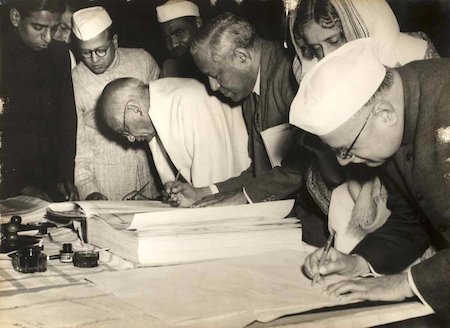
Photo: The Better India >>
Bhimrao Ramji Ambedkar (1891–1956): “Indian jurist, economist, social reformer and political leader who headed the committee drafting the Constitution of India [and] served as Law and Justice minister in the first cabinet of Jawaharlal Nehru” | Wikipedia >>
“The State shall not discriminate against any citizen on grounds only of religion, race, caste, sex, place of birth or any of them.” – Constitution of India & National Human Rights Commission >>
“Religion is a personal matter and should not be politicised.” – Invitation by the Bharat Jodo Abhiyan (BJA) – a civil society platform involving organisations from across 15 states – extended to all like-minded citizens “who take pride in our progressive, inclusive civilization and are committed to our constitutional values of fraternity, liberty, equality and justice” | TheWire (2 January 2024) >>
“The Indian constitution had to empower the state to enter into the realm of Indian society and transform it by eradicating deeply embedded economic, political and social hierarchies.” – “The Foreign and the Indigenous in the Indian Constitution: Constitution Day talk” by Arun Thiruvengadam (Centre for Law and Policy Research, Bangalore, 2 December 2015)
“Tribals are subject to oppression and cruelty even after independence and still picked up by the investigating officers to cover up shoddy investigations. […] The only recourse available to us is to faithfully abide by and give life to the constitutional ideals which Dr Ambedkar helped formulate, and use those to bring transformative change in the minds and perceptions of the society.” – Supreme Court Judge Justice D.Y. Chandrachud (The Wire, 7 December 2021)
Learn more
Find scholarly books, poetry and fiction relating to tribal culture – Indian publishers
List of sites covered by this Google SafeSearch engine
https://www.alephbookcompany.com
More SafeSearch on this website
Search tips
Combine the name of any particular state, language or region with that of any tribal (Adivasi) community.
Add keywords of special interest (music, poetry, dance just as health, sacred grove and biodiversity); learn about the rights of Scheduled Tribes such as the “Forest Rights Act” (FRA); and the United Nations “Declaration on the Rights of Indigenous Peoples”, “Universal Declaration of Human Rights”, “women’s rights”, or “children’s right to education”.
Ask a question that includes “tribal” or “Adivasi”, for instance: “Adivasi way of life better?” (or “tribal way of life worse?”)
Specify any particular issue or news item (biodiversity, bonded labour and human trafficking, climate change, ecology, economic development, ethnobotany, ethnomedicine, global warming, hunter-gatherers in a particular region or state, prevention of rural poverty, water access).
For official figures include “scheduled tribe ST” along with a union state or region: e.g. “Chhattisgarh ST community”, “Himalayan tribe”, “Scheduled tribe Tamil Nadu census”, “ST Kerala census”, “Particularly Vulnerable Tribal Group Jharkhand”, “PVTG Rajasthan”, “Adivasi ST Kerala”, “Adibasi ST West Bengal” etc.
SafeSearch browser tips
If your (mobile) browser fails to display “embedded” media contents, Google maps and SafeSearch windows
Try another browser like Firefox, Chrome or Safari available on your device
Ensure your favourite browser is up to date
Close your present browser
Check your browser and mobile (gsm) settings:
e.g. permission for video or JavaScript
(seen under Preferences >Security >Enable JavaSript)
Restart your computer (smartphone, tablet)
Reconnect to your wifi network or connect to a different one
On some iPhone models the following helps:
>Settings >Safari >scroll down to:
SETTING FOR WEBSITES
Enable “Request Desktop Website” (All Websites) temporarily
Return to the map-post in Safari and “Reload”
Return to >Settings and disable “Request Desktop Website” again
Return to the post in Safari and “Reload”which should now display “embedded” contents as intended (with the convenience of browsing the mobile version on a small screen)
Note: similar solutions may also work with other mobile operating systems.
Search Worldcat.org for publications by reputed authors (select “Open Content/Open Access” for freely downloadable content)
Search tips
Combine the name of any particular state, language or region with that of any tribal (Adivasi) community.
Ask a question that includes “tribal” or “Adivasi”, for instance: “Adivasi way of life better?” (or “tribal way of life worse?”)
Add keywords of special interest (music, poetry, dance just as health, sacred grove and biodiversity); learn about the rights of Scheduled Tribes such as the “Forest Rights Act” (FRA); and the United Nations “Declaration on the Rights of Indigenous Peoples”, “Universal Declaration of Human Rights”, “women’s rights”, or “children’s right to education”.
Specify any particular issue or news item (biodiversity, bonded labour and human trafficking, climate change, ecology, economic development, ethnobotany, ethnomedicine, global warming, hunter-gatherers in a particular region or state, prevention of rural poverty, water access).
Learn more
Anthropology | Irish Journal of Anthropology | Folio Special issue
Colonial policies | History | Indus Valley | Mohenjo Daro
eBooks, eJournals & reports | eLearning
eBook | Background guide for education
Ekalavya (Eklavya)
Forest Rights Act (FRA) | Hunter-gatherers | Nishad (Nishada, Sanskrit Niṣāda, “tribal, hunter, mountaineer, degraded person outcast”) | Vanavasi (Vanvasi, Vanyajati)
India’s Constitutional obligation to respect their cultural traditions
Jawaharlal Nehru’s “five principles” for the policy to be pursued vis-a-vis the tribals
Particularly vulnerable tribal group (PVTG)
Rabindranath Tagore: a universal voice – Unesco
Remembering Birsa Munda: The charismatic tribal leader who shook the British Empire – Jharkhand
Scheduled Tribes | Classifications in different states
Video | Adivasi Academy & Museum of Adivasi Voice at Tejgadh – Gujarat
Video | Tribes in Transition-III: “Indigenous Cultures in the Digital Era”
What is the Forest Rights Act about?
Who is a forest dweller under this law, and who gets rights?