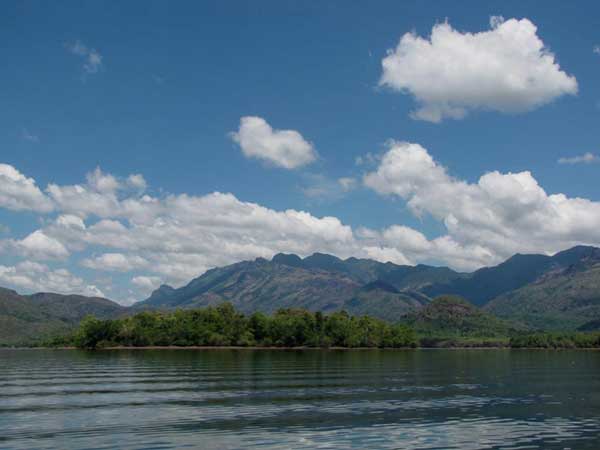
West Ghats near Kanyakumari in the Tamil Nadu – Kerala border region Photo courtesy Davidson Sargunam >>
Facts and figures: India’s biological, cultural and geographic diversity
Spread over 3,287,240 km2 and despite a total human population of over 1,210,000,000, India represents a wide spectrum of biological, cultural and geographic diversity. It has been identified as one of the top 12 global biodiversity hotspots and has 91 eco-cultural zones inhabited by 4,635 ethnic communities. India also has amongst the largest indigenous/tribal population, constituting 8.08% of the country’s population, representing 461 tribes. The term ‘Indigenous Peoples’ is not officially recognized in the country, instead the Constitution of India uses the term ‘Scheduled Tribes’. The total forest cover is estimated to be approximately 20% of the total area of the country. About 1,70,379 villages with a population of 10,674,334 inhabit areas in close proximity of forests.
The art of storytelling has been in vogue among the Kaani tribals as this is the only way they have been able to preserve their culture for their language has no written script. It was this very art of oral narrative that was celebrated at the International Day of the World Indigenous People on Thursday at Vellambi Kaani tribal settlement near Pechipparai.
The programme that was sponsored by the Tribal Foundation focused on this year’s theme of indigenous media, empowering indigenous voices. Preservation of the language and transmission of knowledge through the media were stressed. The theme stressed the role of indigenous networks as forums for discussion and sharing of ideas and experience.
According to environmental educator[the late Davidson Sargunam], storytelling enabled the tribal children to develop their communication skills, which helped them preserve their dialectical language and helped to link the related language skills to other language skills, besides creating leadership qualities of the story teller. In this context, a narration by a tribal girl was a positive indicator of feminine liberation in the tribal community. The story thread revolves round the forest ecology and the dependence of the tribal people on this for their livelihood sustenance.
The wooden mortar and pestle, white coral bead with its ethnobotanical usage, mud pot for cooking, traditional strain of wild paddy, utility of fish tail palm and washing clothes in a pond signify the rich tapestry of forest biodiversity of the Western Ghats. The culture of tenaciously clinging to mystical aspects, resorting to clan magician for social advice and direction, the highlight of a taboo of refusing to marry a brother denoted the traditional culture of the tribal community were highlighted in the story.
The language of the Kaani tribe is an amalgamation of Tamil and Malayalam called Malampasha, a dialectical language. […]
The current communication revolution, concept of globalization, free trade and westernization had their inevitable impact in the youth and made them lose interest in their native dialects, songs, dance, ethnobotany and folk culture. Revival of folk culture would preserve their rich cultural forms to posterity, said Mr. Davidson.
Moreover the Kaani tribal people, who strived to conserve forest ecology, were honoured with shawls.
Source: “Empowering indigenous voices through oral narrative” by P. S. Suresh Kumar, The Hindu, 10 August 2012 Address : http://www.thehindu.com/todays-paper/tp-national/tp-tamilnadu/article3749059.ece Date Visited: Fri Aug 10 2012 20:43:41 GMT+0200 (CEST)
Tribal languages are a treasure trove of knowledge about a region’s flora, fauna and medicinal plants
“Tribal languages are a treasure trove of knowledge about a region’s flora, fauna and medicinal plants. Usually, this information is passed from generation to generation. However, when a language declines, that knowledge system is completely gone.” – Ayesha Kidwai (Centre for Linguistics, School of Language, Literature and Culture Studies, Jawaharlal Nehru University, New Delhi) quoted by Abhijit Mohanty in “Seven decades after independence, many tribal languages in India face extinction threat” | Learn more about the work done by the People’s Linguistic Survey of India and endangered languages worldwide >>
“India’s geographic location at the confluence of three major biogeographic zones – i.e. the Indo-Malayan, the Eurasian and the Afro-Tropical – makes it extremely biodiverse in its genes, species and ecosystems. It is one of the world’s 17 megadiverse countries (Mittermeier et al. 1997). India can boast of over 8.1% of the world’s biodiversity supported on 2.4% of the earth’s surface. An estimated 47,000 identified plant species represent 11% of the world’s flora.” | Learn more: eBook | Disseminating environment related information to improve peoples’ livelihoods >>
“The notion of ‘mainstreaming’ needs to be challenged not just because Adivasi culture is being crushed, but also because Adivasi values and ways of life offer insights that the ‘mainstream’ needs. If we are to halt the destruction of ecosystems, we need to understand how closely biodiversity and cultural diversity are intertwined. Perhaps it is time to reverse the gaze and begin to learn afresh from Adivasis.” – Felix Padel & Malvika Gupta (The Hindu) | Learn more about the role of tribal communities in fostering biodiversity, ethnobotany and cultural diversity | Success stories | Tribal identity >>
“I think that by retaining one’s childhood love of such things as trees, fishes, butterflies and … toads, one makes a peaceful and decent future a little more probable, and that by preaching the doctrine that nothing is to be admired except steel and concrete, one merely makes it a little surer that human beings will have no outlet for their surplus energy except in hatred and leader worship.” – George Orwell | Learn more: Childhood | Customs | Games and leisure time | Literature – fiction | Storytelling >>
Adivasi communities: stewards of India’s cultural heritage and biodiversity
[…] India’s tribal communities — over 104.5 million people, or 8.6 per cent of the population — remain among the most marginalised despite decades of welfare schemes and development promises. In states such as Chhattisgarh, Jharkhand, Bihar, Rajasthan and Odisha, tribal districts consistently record higher poverty levels than non-tribal areas, even as these regions supply land, forests and minerals for the country’s growth. These communities have often been compelled to relinquish their lands for large-scale infrastructure projects, resulting in the erosion of their identity, livelihoods, and future prospects.
It is crucial to recognise the value these communities bring, particularly their eco-friendly lifestyles, which offer important insights into addressing climate-related challenges. For instance, during the 2018 drought in Sundergarh, Odisha, a visit to a remote tribal village revealed thriving vegetation and effective water-harvesting systems. Kiri village in Lahunipara block of Sundergarh district, inhabited by the Paudi Bhuyan community — a Particularly Vulnerable Tribal Group (PVTG) — has demonstrated remarkable resilience.
This observation underscores the importance of learning from traditional ecological knowledge, especially sustainable farming practices that rely on drought-resistant and indigenous seeds.
Adivasi communities, as stewards of India’s cultural heritage and biodiversity, must be central to the nation’s development narrative. Their lives are intricately linked to land, forests and water, yet they face growing threats from climate change, livelihood insecurity and displacement. Addressing these challenges requires more than welfare initiatives; it demands robust enforcement of constitutional rights, substantial public investment and the strengthening of Gram Sabha–based governance. […]