What justice actually means for women and girls Without justice, rights are just words. With justice, rights become power.
Laws that protect women and girls from violence, discrimination, and exploitation. Courts that believe ALL women and girls and end impunity. Legal aid that women and girls can access and afford. Support to recover when rights are violated. What you can do for Rights. Justice. Action. Justice doesn’t just happen. It is built and must be funded. Join and support UN Women as we continue to stand with women’s movements worldwide and work with governments that choose equality.
UN Women has launched a campaign with engaging materials and key information to spread the word and call for equal rights for all women and girls. | Join the UN Women’s campaign >>
UN Secretary-General’s message for the International Women’s Day
Women’s rights are human rights. But in these troubled times, as our world becomes more unpredictable and chaotic, the rights of women and girls are being reduced, restricted and reversed. Empowering women and girls is the only way to protect their rights and make sure they can realize their full potential. Read more>
A bit of history: International Women’s Day, back to 1975
Since its inception, International Women’s Day has grown into a global celebration of past and present accomplishments of women, and as an opportunity to look ahead to the untapped potential and opportunities for future generations of women.
In 1945, the Charter of the United Nations became the first international agreement to affirm the principal of equality between women and men. With that belief in mind, the UN celebrated its first official International Women’s Day in 1975, 42 years ago.
This year, the UN theme for International Women’s Day is “Planet 50-50 by 2030: Step It Up for Gender Equality”. Despite the enormous progress since 1975, women are still underrepresented in too many sectors of society, undermining progress and sustainable development. It constrains creativity and talent and suffocates inclusion and pluralism. This does not just harm women – it weakens the very fabric of societies.
For the celebration of International Women’s Day 2017, UNESCO will focus on Women and Art, showcasing the work of young women artists and discussing the way forward.
Source: International Women’s Day 2017 | United Nations Educational, Scientific and Cultural Organization Address: http://www.unesco.org/new/en/womens-day Date Visited: Thu Mar 09 2017 11:04:10 GMT+0100 (CET)
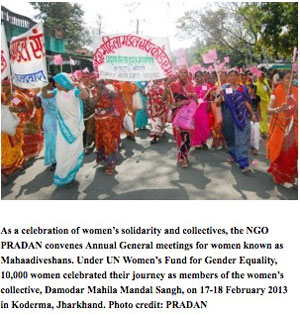
Women’s collectives foster access to justice in India
Through special women’s courts and justice committees, women’s collectives in eastern India have forged an increasingly respected system to access justice, which also addresses cases of violence against women. They resolve disputes through both formal and informal channels, while providing emotional support and counselling. | Learn more >>
“National development and the development of tribal communities are linked to each other” – Droupadi Murmu | Learn more >>
“Tribal communities are a standing example of how women play a major role in preservation of eco historic cultural heritage in India.” – Mari Marcel Thekaekara (writer and Co-Founder of ACCORD-Nilgiris) | Learn more >>
“Women and girls are disproportionately affected by modern slavery. As they transition through childhood, adolescence and adult life, the impacts of discrimination multiply and gender inequality grows.” – Walk Free Foundation | Learn more >>
“There is no social bias against women in tribal communities such as there exists among the middle castes, especially landed ones. Women can ask for a divorce, and in many communities, money is paid to the girl’s family at the time of marriage.” – Abhay Bang, the award-winning doctor and social activist from Gadchiroli in Maharashtra | Learn more >>
Home, shelter and security as well as music, education, nature, and books for every child
In 1911, the American poet and novelist James Oppenheim wrote the now infamous poem “Bread and Roses“, inspired by the women’s suffrage activist Helen Todd. Working as a factory inspector for the state of Illinois, Todd spent her days listening to women’s accounts of low pay, inequality, and the drudgery of their work. Along with four other women from the Chicago Women’s Club, an association of wealthy middle-class women that had recently established some of the first kindergartens in Chicago, Todd began organising Illinois automobile workers for women’s right to vote in the summer of 1910. Inspired by a discussion she had with a young woman the night before giving a speech, Todd pronounced that the women’s “vote will go toward helping forward the time when life’s Bread, which is home, shelter and security, and the Roses of life, music, education, nature, and books, shall be the heritage of every child that is born in the country“. More than 70 years after the Seneca Falls convention declared women’s universal suffrage as its goal, the seemingly impossible became inevitable, and in 1920 Congress past the Nineteenth amendment to the US Constitution.
“If a man cannot enjoy the return of spring, why should he be happy in a labour-saving Utopia? … I think that by retaining one’s childhood love of such things as trees, fishes, butterflies and … toads, one makes a peaceful and decent future a little more probable, and that by preaching the doctrine that nothing is to be admired except steel and concrete, one merely makes it a little surer that human beings will have no outlet for their surplus energy except in hatred and leader worship.”
Combine the name of any particular state, language or region with that of any tribal (Adivasi) community.
Add keywords of special interest (music, poetry, dance just as health, sacred grove and biodiversity); learn about the rights of Scheduled Tribes such as the “Forest Rights Act” (FRA); and the United Nations “Declaration on the Rights of Indigenous Peoples”, “Universal Declaration of Human Rights”, “women’s rights”, or “children’s right to education”.
Ask a question that includes “tribal” or “Adivasi”, for instance: “Adivasi way of life better?” (or “tribal way of life worse?”)
Specify any particular issue or news item (biodiversity, bonded labour and human trafficking, climate change, ecology, economic development, ethnobotany, ethnomedicine, global warming, hunter-gatherers in a particular region or state, prevention of rural poverty, water access).
For official figures include “scheduled tribe ST” along with a union state or region: e.g. “Chhattisgarh ST community”, “Himalayan tribe”, “Scheduled tribe Tamil Nadu census”, “ST Kerala census”, “Particularly Vulnerable Tribal Group Jharkhand”, “PVTG Rajasthan”, “Adivasi ST Kerala”, “Adibasi ST West Bengal” etc.
SafeSearch browser tips
If your (mobile) browser fails to display “embedded” media contents, Google maps and SafeSearch windows
Try another browser like Firefox, Chrome or Safari available on your device
Ensure your favourite browser is up to date
Close your present browser
Check your browser and mobile (gsm) settings: e.g. permission for video or JavaScript (seen under Preferences >Security >Enable JavaSript)
Restart your computer (smartphone, tablet)
Reconnect to your wifi network or connect to a different one
On some iPhone models the following helps:
>Settings >Safari >scroll down to: SETTING FOR WEBSITES
Return to >Settings and disable “Request Desktop Website” again
Return to the post in Safari and “Reload”which should now display “embedded” contents as intended (with the convenience of browsing the mobile version on a small screen)
Note: similar solutions may also work with other mobile operating systems.