Adivasi music and the public stage by Jayasri Banerjee
These days, no festival or utsav is considered complete without some sort of folk music or dance. The idea of presenting the music and dance traditions of the Adivasis in a public forum is generally well-meaning—to create general awareness among the urban/rural public about Adivasi lives and to generate a sustainable development of Adivasi art forms. Unfortunately, these good intentions are far removed from reality, as I found in the course of a two-year study I conducted in the Burdwan and Birbhum districts of West Bengal.
This article examines the impact of public presentations of Adivasi (in this case Santal) music and dance upon the distinctive traits of such traditions. Public presentation here refers to the presentation of the music and dance traditions of the Adivasi communities outside their everyday lives and natural performance contexts; that is, outside the context of their parav (festivals), rites and rituals. […]
It is by now common knowledge that Adivasi artistic-creative traditions have been organically interwoven into a total way of life, which has, over generations, been developed on the basis of an eco-centric world view that considers the human world and nature as parts of the same continuum. Such traditions, whether wall/floor decorations, iconography, fine and/or performing arts, are deeply related to one another, and all of them are related to the everyday Adivasi way of life. […]
In the course of my study, I found a large corpus of songs on literacy and family planning, which were first written in Bengali and then grafted on to Adivasi, mainly Santal, melodic and metrical moulds of different musical genres. This distorts the formal structure of different genres of Santal songs, since melody and language are integrally related in Santal music. Multiple song texts are seen to be set in limited, genre-specific melodic moulds. Since, in Santali tradition, tune/melody “provides structural values to its text”, the imposition of Bengali linguistic tendencies is deeply disturbing. This not only changes the formal structure of Santal music, singing and dance, it affects the instrumental accompaniment, which closely follows the melodic and metric moulds of the Santal songs. […]
Jayasri Banerjee is an independent researcher and is working on folk and tribal performance genres of the Jungle Mahal.
Source: Indian Folklife, January 2002, Vol. 1 Issue 3 January 2002
URL: https://indianfolklore.org/journals/index.php/IFL/article/viewArticle/646Date Visited: Sun Jun 03 2012 16:31:59 GMT+0200 (CEST)
[Bold typeface added above for emphasis]
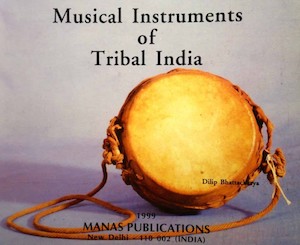
Musical Instruments of Tribal India
by Dilip Bhattacharya >>
See also
Audio | Santali Traditional and Fusion Songs: Ghosaldanga Bishnubati Adibasi Trust – West Bengal
Childhood | Child marriage | Children’s right to Education
Crafts and visual arts | Masks
India’s tribal, folk and devotional music: Secular and ceremonial songs
Memory of the World Programme – Unesco
Music and dance | Musicology | Adivasi music and the public stage by Jayasri Banerjee
Video | Banam lutes and fiddles of the Santal people – Jharkhand & West Bengal
Video | Celestial Dancers of Manipur
Video | Cultural traditions of the Halakki people – Karnataka
Video | Khasi musical heritage of Meghalaya
Video | Kota women’s dance: Shivaratri celebrations – Nilgiris – Tamil Nadu
Video | Santali video album “Ale Ato” (Our Village, Part 1 of 2) – West Bengal
Video | South Gujarat tribal music documentation by Bhasha – Gujarat
Video | Tribes in Transition-III: “Indigenous Cultures in the Digital Era”
Video | Safe contents for educational use on many topics (music, visual arts and more)
Research: explore PhD theses from all over India
Shodhganga (Open Access)