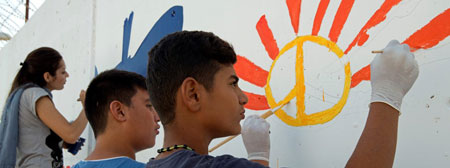
International Day of the World’s Indigenous People (9 August) >>
The International Mother Language Day highlights the role of young people in shaping the future of multilingual education. Youth voices on multilingual education emphasizes that language is more than a means of communication: it is central to identity, learning, well-being and participation in society. The celebration underscores the importance of education systems that recognise and value every learner’s language to support inclusion and learning outcomes. | Learn more: https://www.unesco.org/en/days/mother-language >>
Schoolteachers
- Encourage children to use their mother languages to introduce themselves and talk about their families and culture
- Celebrate culture by having them read poetry, tell a story or sing a song in their mother tongues. Paintings and drawings with captions in mother languages can also be displayed.
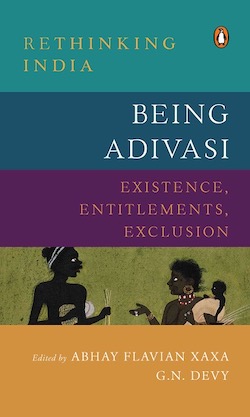
Search publications via Indian publishers & libraries:
Virginius Xaxa & Ganesh Devy or G.N. Devy >>
Publications
- See how many mother languages your fellow students speak. Make a survey of the languages by interviewing them and publish the results on internet.
- Help organize cultural activities such as films, plays and music that celebrate different languages.
- Mother tongue-based multilingual education: the key to unlocking SDG 4: quality Education for All, UNESCO Bangkok, 2017
- MTB MLE resource kit: Including the excluded: promoting multilingual education, UNESCO Bangkok, 2016
- Literacy in multilingual and multicultural contexts: effective approaches to adult learning and education, UNESCO-UIL, 2016
- If you don’t understand, how can you learn?, Global Education Monitoring Report Policy Paper 24, UNESCO, 2016
- 2016 Global Monitoring Report section on Languages, UNESCO, 2016
- UNESCO Atlas of the World’s Languages in Danger
UN and UNESCO resolutions
- UNESCO resolution proclaiming “International Mother Language Day” to be observed on 21 February, 1999, following a proposition made by People’s Republic of Bangladesh
- Resolution adopted by UN General Assembly on multilingualism(link is external), 2002
- Report by UNESCO Director-General on a strategy concerning the role of languages in achieving Education for All (EFA) in the context of sustainable development, 2009
- UN Declaration on the Rights of Indigenous Peoples(link is external), 2008
- Universal Declaration on Cultural Diversity, 2001
- Declaration on the Rights of Persons Belonging to National or Ethnic Religious and Linguistic Minorities(link is external), 1992
“One’s mother tongue is closest to any person as is one’s mother” – Ganesh Devy
One’s mother tongue is closest to any person as is one’s mother. It is from the mother that a child learns language skills. No mother ever teaches a newborn the rules of grammar; yet all those extremely complicated rules are internalised by the child by merely watching the lip movements and gestures of its mother and by imbibing the tones and textures of her speech. There is a somewhat wrong and widespread impression that children learn languages in school. That may be true of the languages other than the language of one’s home. One has to “learn” through grammar and translation the second or the third language, or more. But, the making of the human brain allows a child to learn most of the complexities of the mother tongue by the time the child is three years old. Writing is another matter. In any case, in the several million years history of Homo sapiens, writing emerged as an apparatus of expression, communication, and memory-storing just about seven thousand years ago. Language is essentially speech; writing is an additional feature that enables long-distance and inter-generational language transactions.
Ganesh Devy in “Languages not liked by Hindutva ideology suffer existential crisis”, Frontline Magazine, 15 June 2023 >>
[Bold typeface added above for emphasis]
Search Worldcat.org for publications by reputed authors (select “Open Content/Open Access” for freely downloadable content)
Search tips
Combine the name of any particular state, language or region with that of any tribal (Adivasi) community.
Ask a question that includes “tribal” or “Adivasi”, for instance: “Adivasi way of life better?” (or “tribal way of life worse?”)
Add keywords of special interest (music, poetry, dance just as health, sacred grove and biodiversity); learn about the rights of Scheduled Tribes such as the “Forest Rights Act” (FRA); and the United Nations “Declaration on the Rights of Indigenous Peoples”, “Universal Declaration of Human Rights”, “women’s rights”, or “children’s right to education”.
Specify any particular issue or news item (biodiversity, bonded labour and human trafficking, climate change, ecology, economic development, ethnobotany, ethnomedicine, global warming, hunter-gatherers in a particular region or state, prevention of rural poverty, water access).
“[T]he Constitution gives equal respect to all communities, sects, lingual and ethnic groups, etc. The Constitution guarantees to all citizens freedom of speech (Article 19), freedom of religion (Article 25), equality (Articles 14 to 17), liberty (Article 21), etc.” – Supreme Court judgment quoted by The Hindu in “India, largely a country of immigrants” >>
In Marginalised but not Defeated, Tarun Kanti Bose (a seasoned public interest journalist) “documents the hard and difficult struggle to implement the Forest Rights Act, how the oppressed adivasis have united into forest unions, how they are now entering into new thresholds of protracted struggles and victories in a non-violent manner. […] A must for all young journalists, social science students, editors, civil society groups and the academia.” | Read the full book review here:
https://countercurrents.org/2023/05/book-review-marginalised-but-not-defeated >>
Learn more about “The world’s largest democracy“, its Constitution and Supreme Court and linguistic heritage; and also why a well functioning democracy has to rely on Accountability in the face of Modernity and rapid Globalization.
Find up-to-date information provided by, for and about Indian authors, researchers, officials, and educators
List of sites covered by this Google SafeSearch engine
Ashoka Trust for Research in Ecology and the Environment (ATREE) – www.atree.org
Freedom United – www.freedomunited.org
Government of India (all websites ending on “.gov.in”)
Kalpavriksh Environmental Action Group – https://kalpavriksh.org
Shodhganga (a reservoir of Indian theses) – https://shodhganga.inflibnet.ac.in
Survival International – www.survivalinternational.org
UCLA Digital Library – https://digital.library.ucla.edu
Unesco – https://en.unesco.org
Unesco digital library – https://unesdoc.unesco.org
Unicef – www.unicef.org
United Nations – www.un.org/en
Video Volunteers – www.videovolunteers.org
WorldCat (“the world’s largest library catalog, helping you find library materials online”) – https://worldcat.org
Search tips
Combine the name of any particular state, language or region with that of any tribal (Adivasi) community.
Add keywords of special interest (music, poetry, dance just as health, sacred grove and biodiversity); learn about the rights of Scheduled Tribes such as the “Forest Rights Act” (FRA); and the United Nations “Declaration on the Rights of Indigenous Peoples”, “Universal Declaration of Human Rights”, “women’s rights”, or “children’s right to education”.
Ask a question that includes “tribal” or “Adivasi”, for instance: “Adivasi way of life better?” (or “tribal way of life worse?”)
Specify any particular issue or news item (biodiversity, bonded labour and human trafficking, climate change, ecology, economic development, ethnobotany, ethnomedicine, global warming, hunter-gatherers in a particular region or state, prevention of rural poverty, water access).
For official figures include “scheduled tribe ST” along with a union state or region: e.g. “Chhattisgarh ST community”, “Himalayan tribe”, “Scheduled tribe Tamil Nadu census”, “ST Kerala census”, “Particularly Vulnerable Tribal Group Jharkhand”, “PVTG Rajasthan”, “Adivasi ST Kerala”, “Adibasi ST West Bengal” etc.
SafeSearch browser tips
If your (mobile) browser fails to display “embedded” media contents, Google maps and SafeSearch windows
Try another browser like Firefox, Chrome or Safari available on your device
Ensure your favourite browser is up to date
Close your present browser
Check your browser and mobile (gsm) settings:
e.g. permission for video or JavaScript
(seen under Preferences >Security >Enable JavaSript)
Restart your computer (smartphone, tablet)
Reconnect to your wifi network or connect to a different one
On some iPhone models the following helps:
>Settings >Safari >scroll down to:
SETTING FOR WEBSITES
Enable “Request Desktop Website” (All Websites) temporarily
Return to the map-post in Safari and “Reload”
Return to >Settings and disable “Request Desktop Website” again
Return to the post in Safari and “Reload”which should now display “embedded” contents as intended (with the convenience of browsing the mobile version on a small screen)
Note: similar solutions may also work with other mobile operating systems.