Tawang is one of the most beautiful hill stations you can ever visit during your travel to India. It is also an important center for Buddhist learning, something that attracts people from all across the world. […]
The Losar Festival is among the most important festivals celebrated in Tawang. Losar is celebrated by the Monpas who are a majority in Tawang, Arunachal Pradesh. Belonging to the Mongoloid stock, the Monpas are mainly into agriculture and animal husbandry. […]
Commemorating the advent of the new year, Losar is the occasion when the Monpas feast, drink and make merry. Relatives and friends get together and celebrate this festival in a very pompous manner. The festival of Losar falls in the end of February or early March and is celebrated for 5 days. […]
Before the advent of the Losar festival in Tawang people can be seen cleaning their homes and discarding all unused and old items. It is believed that by doing so one can usher in good health, peace and prosperity to the house. You can also be a part of the Losar Festival during your visit to Tawang. […]
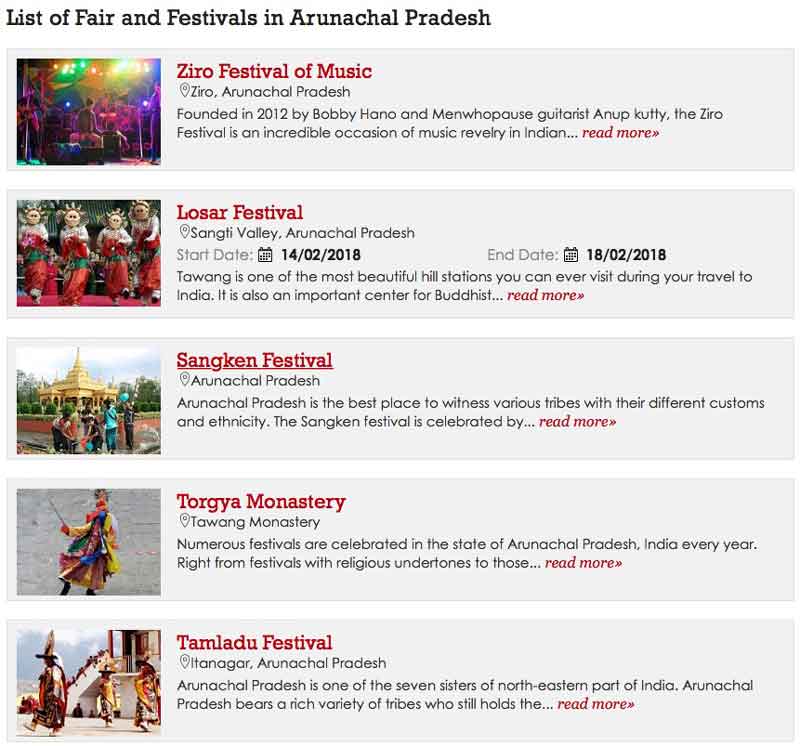
Fairs and Festivals in Arunachal Pradesh
[…] Many of the festivals celebrated in Arunachal Pradesh are closely linked to agriculture, the main occupation of the state. Celebrated on a grand scale, these festivals are characterized by prayers that are later followed by merry making. Among the most popular festivals of Arunachal Pradesh are Ziro Festival of Music , Losar Festival, Tamladu Festival, Sangken Festival. […]
Arunachal Pradesh is home to a good number of tribes. So you can find some festival or the other happening in Arunachal Pradesh at any time of the year. Be a part of the celebrations when you travel to Arunachal Pradesh. For this, just get in touch with us today and we will help you plan a most memorable holiday.
Source: Fairs and Festivals in Arunachal Pradesh
URL: https://www.indianholiday.com/fairs-and-festivals/arunachal-pradesh/losar-festival.html
Date accessed: 5 September 2018
Reports in the Indian press | List of periodicals included in this search >>
Search tips
Combine the name of any particular state, language or region with that of any tribal (Adivasi) community.
Add keywords of special interest (music, poetry, dance just as health, sacred grove and biodiversity); learn about the rights of Scheduled Tribes such as the “Forest Rights Act” (FRA); and the United Nations “Declaration on the Rights of Indigenous Peoples”, “Universal Declaration of Human Rights”, “women’s rights”, or “children’s right to education”.
Ask a question that includes “tribal” or “Adivasi”, for instance: “Adivasi way of life better?” (or “tribal way of life worse?”)
Specify any particular issue or news item (biodiversity, bonded labour and human trafficking, climate change, ecology, economic development, ethnobotany, ethnomedicine, global warming, hunter-gatherers in a particular region or state, prevention of rural poverty, water access).
For official figures include “scheduled tribe ST” along with a union state or region: e.g. “Chhattisgarh ST community”, “Himalayan tribe”, “Scheduled tribe Tamil Nadu census”, “ST Kerala census”, “Particularly Vulnerable Tribal Group Jharkhand”, “PVTG Rajasthan”, “Adivasi ST Kerala”, “Adibasi ST West Bengal” etc.
SafeSearch browser tips
If your (mobile) browser fails to display “embedded” media contents, Google maps and SafeSearch windows
Try another browser like Firefox, Chrome or Safari available on your device
Ensure your favourite browser is up to date
Close your present browser
Check your browser and mobile (gsm) settings:
e.g. permission for video or JavaScript
(seen under Preferences >Security >Enable JavaSript)
Restart your computer (smartphone, tablet)
Reconnect to your wifi network or connect to a different one
On some iPhone models the following helps:
>Settings >Safari >scroll down to:
SETTING FOR WEBSITES
Enable “Request Desktop Website” (All Websites) temporarily
Return to the map-post in Safari and “Reload”
Return to >Settings and disable “Request Desktop Website” again
Return to the post in Safari and “Reload”which should now display “embedded” contents as intended (with the convenience of browsing the mobile version on a small screen)
Note: similar solutions may also work with other mobile operating systems.
“It was assumed that tribal people have same health problems, similar needs and hence the uniform national pattern of rural health care would be applicable to them as well, albeit with some alteration in population: provider ratio. The different terrain and environment in which they live, different social systems, different culture and hence different health care needs were not addressed.” – Abhay Bang in Report of the Expert Committee on Tribal Health >>
Learn more
Biodiversity | Hyderabad biodiversity pledge | Nilgiri Biosphere
Climate change | Audio | The Climate Question (BBC Podcast)
Forest dwellers | Hunter-gatherers | Illegal mining
Particularly vulnerable tribal groups
What is the Forest Rights Act about?
Who is a forest dweller under this law, and who gets rights?
Tips for using interactive maps
Toggle to normal view (from reader view) should the interactive map not be displayed by your tablet, smartphone or pc browser
For details and hyperlinks click on the rectangular button (left on the map’s header)
Scroll and click on one of the markers for information of special interest
Explore India’s tribal cultural heritage with the help of another interactive map >>
“The uniqueness of northeast states of India lies in their cultures” | Learn more >>
In Marginalised but not Defeated, Tarun Kanti Bose (a seasoned public interest journalist) “talks about the Khasis, Nagas, Karbis, Garos, Rabhas, Misings, Daflas, Bodos, Akas and others in the North-east. […] The mainstream development paradigm is being questioned and new rainbows of collective, community reassertions are happening across the tribal belt in India. More so, in most cases, led by brave, empowered and resilient women.” | Read the full review: https://countercurrents.org/2023/05/book-review-marginalised-but-not-defeated >>
Up-to-date reports by Indian journalists and commentators
To search Indian periodicals, magazines, web portals and other sources safely, click here. To find an Indian PhD thesis on a particular tribal community, region and related issues, click here >>