Leaving no one behind: Indigenous peoples and the call for a new social contract
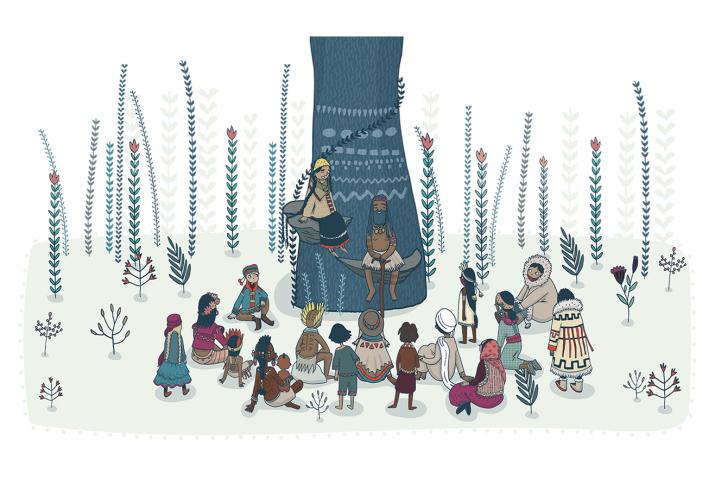
There are over 476 million indigenous peoples living in 90 countries across the world, accounting for 6.2 per cent of the global population. Indigenous peoples are the holders of a vast diversity of unique cultures, traditions, languages and knowledge systems. They have a special relationship with their lands and hold diverse concepts of development based on their own worldviews and priorities.
Although numerous indigenous peoples worldwide are self-governing and some have been successful in establishing autonomy in varying forms, many indigenous peoples still come under the ultimate authority of central governments who exercise control over their lands, territories and resources. Despite that reality, indigenous peoples have demonstrated extraordinary examples of good governance, ranging from the Haudenosaunee to the National Congress of Australia’s First Peoples.
The COVID-19 pandemic has exposed and exacerbated many existing inequalities, disproportionately affecting populations all over the world that were already suffering from poverty, illness, discrimination, institutional instability or financial insecurity. From the perspective of indigenous peoples, the contrast is even starker. In many of our societies, the social contract, at the very least, needs some revision.
Source: International Day of the World’s Indigenous Peoples 9 August
URL: https://www.un.org/en/observances/indigenous-day
Date Visited: 7 July 2021
[Bold typeface added above for emphasis]
E-learning tool on the rights of Indigenous Peoples >>
Learn more >>
Read or download titles for free (eBooks & Magazine) >>
Find up-to-date information provided by, for and about Indian authors, researchers, officials, and educators
List of sites covered by this Google SafeSearch engine
Ashoka Trust for Research in Ecology and the Environment (ATREE) – www.atree.org
Freedom United – www.freedomunited.org
Government of India (all websites ending on “.gov.in”)
Kalpavriksh Environmental Action Group – https://kalpavriksh.org
Shodhganga (a reservoir of Indian theses) – https://shodhganga.inflibnet.ac.in
Survival International – www.survivalinternational.org
UCLA Digital Library – https://digital.library.ucla.edu
Unesco – https://en.unesco.org
Unesco digital library – https://unesdoc.unesco.org
Unicef – www.unicef.org
United Nations – www.un.org/en
Video Volunteers – www.videovolunteers.org
WorldCat (“the world’s largest library catalog, helping you find library materials online”) – https://worldcat.org
Search tips
Combine the name of any particular state, language or region with that of any tribal (Adivasi) community.
Add keywords of special interest (music, poetry, dance just as health, sacred grove and biodiversity); learn about the rights of Scheduled Tribes such as the “Forest Rights Act” (FRA); and the United Nations “Declaration on the Rights of Indigenous Peoples”, “Universal Declaration of Human Rights”, “women’s rights”, or “children’s right to education”.
Ask a question that includes “tribal” or “Adivasi”, for instance: “Adivasi way of life better?” (or “tribal way of life worse?”)
Specify any particular issue or news item (biodiversity, bonded labour and human trafficking, climate change, ecology, economic development, ethnobotany, ethnomedicine, global warming, hunter-gatherers in a particular region or state, prevention of rural poverty, water access).
For official figures include “scheduled tribe ST” along with a union state or region: e.g. “Chhattisgarh ST community”, “Himalayan tribe”, “Scheduled tribe Tamil Nadu census”, “ST Kerala census”, “Particularly Vulnerable Tribal Group Jharkhand”, “PVTG Rajasthan”, “Adivasi ST Kerala”, “Adibasi ST West Bengal” etc.
SafeSearch browser tips
If your (mobile) browser fails to display “embedded” media contents, Google maps and SafeSearch windows
Try another browser like Firefox, Chrome or Safari available on your device
Ensure your favourite browser is up to date
Close your present browser
Check your browser and mobile (gsm) settings:
e.g. permission for video or JavaScript
(seen under Preferences >Security >Enable JavaSript)
Restart your computer (smartphone, tablet)
Reconnect to your wifi network or connect to a different one
On some iPhone models the following helps:
>Settings >Safari >scroll down to:
SETTING FOR WEBSITES
Enable “Request Desktop Website” (All Websites) temporarily
Return to the map-post in Safari and “Reload”
Return to >Settings and disable “Request Desktop Website” again
Return to the post in Safari and “Reload”which should now display “embedded” contents as intended (with the convenience of browsing the mobile version on a small screen)
Note: similar solutions may also work with other mobile operating systems.
Learn more
Articles on Adivasi culture in Folio Special issue
Contents on this website by and about Prof. Ganesh Devy
eBook | Background guide for education
eBooks, eJournals & reports | eLearning
Education and literacy | Right to education
Figures, census and other statistics
Forest Rights Act (FRA) | Nishad (Nishada, Sanskrit Niṣāda, “tribal, hunter, mountaineer, degraded person outcast”) | Vanavasi (Vanvasi, Vanyajati)
Human Rights Commission (posts) | www.nhrc.nic.in (Government of India)
International Day of the World’s Indigenous People
Irish Journal of Anthropology: Special issue on Adivasi identity
Misconceptions | “Casteism” and its effect on tribal communities
Remembering Birsa Munda: The charismatic tribal leader who shook the British Empire – Jharkhand
Scheduled Tribes | Classifications in different states
Tribal groups (Indian tribal communities)
Tribal Politics – adivasi culture, language, and religion in Encyclopedia of India
United Nations Declaration for the Rights of Indigenous Peoples