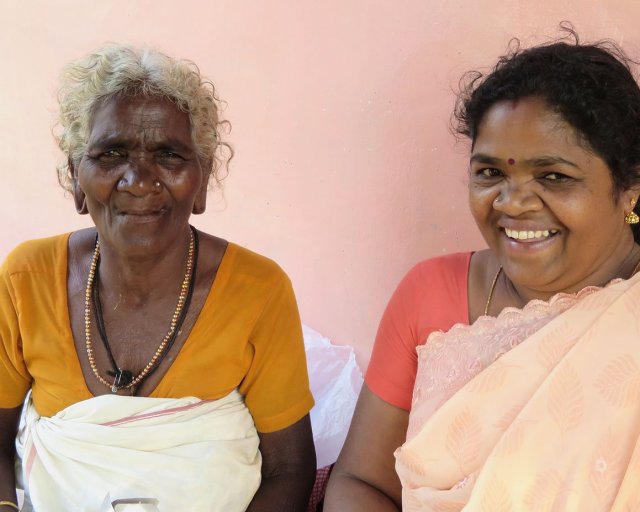
“We are so much more than that. We follow a tradition rich in music, dance and love.” – Author Swarnalatha whose NGO works for the upliftment of her Irula community | SafeSearch (Irular) >>
In our quest for tourism that is more equitable, sustainable and just we have had on our radar the impact that current forms of tourism development have on women’s lives. […]
On the social and cultural front, tourism also reflects social, economic and political power relations existing in society, therefore, initiatives taken in relation to tourism should take into consideration these realities. Women from Dalit communities constitute large part of cleaning jobs, especially manual scavenging (95%). They face discrimination on both caste and gender grounds and are subjected to multitude of atrocities including rape.
The marketing of tourism is one area which features women prominently. The language of patriarchy, heterosexuality and tourism promotion are inter-linked and primarily addressed to the need of male tourists. Stereotypical and sexist images of women are often part of tourism promotion in brochures and advertisements.
We call upon governments, policy makers, industry, civil society to engage in more systemic ways with the challenge of women’s empowerment in tourism. It is time for the government to recognise tourism as a site for blatant and inhuman exploitation of women in tourism. We urge the committee to incorporate provisions to protect women at tourism destinations and declare that tourism will not be promoted at expense of women’s dignity, respect and rights. […]
Surabhi Singh
Programme Coordinator EQUATIONS
Source: Equitable Tourism Options (EQUATIONS) | Submission To Justice Verma Committee On Tourism’s Role In Tourism
Address : http://www.equitabletourism.org/campaign.php?AID=2687
Date Visited: 12 May 2014
[Bold typeface added above for emphasis]
Making tourism “non-exploitative”: economic development that benefits local communities
We envision forms of tourism which are non-exploitative, where decision making is democratised, and access to and benefits of tourism are equitably distributed. EQUATIONS believes in the capacity of individuals and communities to actualise their potential for the well-being of society. We work toward justice, equity, people centred and movement centred activism, democratisation and dialogue.
Everyday we hear that tourism brings economic development, it creates jobs and revenues. But who really benefits from it? The local community, the village elite, or the owner?
There’s been an exponential increase in tourism in India over the last several decades, fueled by the growing economy and disposable incomes. The tourism industry in India has expanded wildly in an unregulated fashion with no regard for environmental, social and cultural impacts.
Source: Equitable Tourism (EQUATIONS)
URL: https://beta.equitabletourism.org/about
Date Visited: 28 November 2021 | Backup (PDF, 100 KB)
“The forest in Shanthi Teacher’s classroom” on Ruralindiaonline.org >>
More about Tribal elders & Women >>
Success stories >>
“National development and the development of tribal communities are linked to each other” – Droupadi Murmu | Learn more >>
“Tribal communities are a standing example of how women play a major role in preservation of eco historic cultural heritage in India.” – Mari Marcel Thekaekara (writer and Co-Founder of ACCORD-Nilgiris) | Learn more >>
“When you are leaving 60 percent of the people behind, you cannot have the ambition to be an economic power.” – Poonam Muttreja (Executive Director of the Population Foundation of India) >>
“Women and girls are disproportionately affected by modern slavery. As they transition through childhood, adolescence and adult life, the impacts of discrimination multiply and gender inequality grows.” – Walk Free Foundation | Learn more >>
“There is no social bias against women in tribal communities such as there exists among the middle castes, especially landed ones. Women can ask for a divorce, and in many communities, money is paid to the girl’s family at the time of marriage.” – Abhay Bang, the award-winning doctor and social activist from Gadchiroli in Maharashtra | Learn more >>
Up-to-date reports by Indian journalists and commentators
To search Indian periodicals, magazines, web portals and other sources safely, click here. To find an Indian PhD thesis on a particular tribal community, region and related issues, click here >>
See also
Adverse inclusion | Casteism | Rural poverty
Anganwadi | Community facilities | Ekalavya
Demographic Status of Scheduled Tribe Population of India (Census figures 2011)
Fact checking | Figures, census and other statistics
Human Rights Commission (posts) | www.nhrc.nic.in (Government of India)
Search tips | Names of tribal communities, regions and states of India
“The world sells humans. What kind of world is this?” – Hindi Movie “Kamla” revisited
“What is the Forest Rights Act about?” – Campaign for Survival and Dignity
“Who are Scheduled Tribes?” – Government of India (National Commission for Scheduled Tribes, NCST)