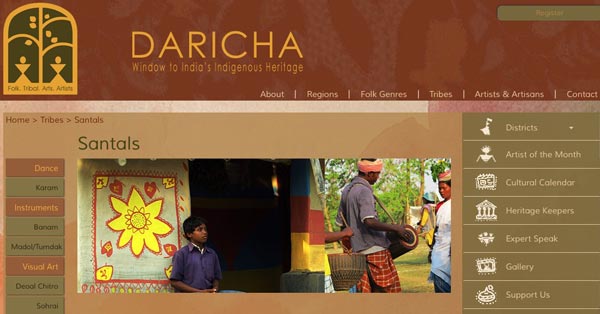
The Santals, a proto-Austroloid racial group, are the largest tribe in West Bengal accounting for more than 50% of the state`s tribal population.
Other than West Bengal, their major concentration is in the states of Bihar, Jharkhand, Odisha and Tripura. In Assam, they are not classified separately as a tribe and their lot is clubbed with the generic “Tea Tribes of Assam.” There is also a sizeable Santal community in neighboring Bangladesh, and a smaller group in Nepal.
Although they reside in several districts of West Bengal, the majority of Santals are found in Paschim Medinipur District. Their primary occupation today is daily agricultural and manual labour, though there is an increasing move among the youth towards better education and self sustenance. […]
Santals have a rich cultural heritage and Santal dance and music traditionally revolved around Santal religious celebrations. They have been able to preserve this, in the most part, over the centuries, despite waves of migrations, invasions by the Mughals and the British, influence of Hinduism and Christian missionaries on traditional animist beliefs and later, urbanization. […]
Source: Daricha Foundation
Address: http://www.daricha.org/tribes.aspx?ID=TR140630204053&Name=Santals
Date Visited: 29 June 2020

“[A] common perception of conversion, prevalent in India, is that all conversions take place only among deprived lower caste or tribal groups, which are considered more susceptible to allurement or coercion. The reality of upper caste conversions is ignored in this climate of cynicism.”– Dr. Ivy Imogene Hansdak in Pandita Ramabai Saraswati: the convert as ‘heretic’ | More about the effects of “casteism” >>
Tips: find more resources by typing “Daricha Foundation”, “Santhal festival” [spelling with “t” or “th”],village festival”, “Santal worship” or any combination of keywords on related projects across India here:
Reports in the Indian press | List of periodicals included in this search >>
Search tips
Combine the name of any particular state, language or region with that of any tribal (Adivasi) community.
Add keywords of special interest (music, poetry, dance just as health, sacred grove and biodiversity); learn about the rights of Scheduled Tribes such as the “Forest Rights Act” (FRA); and the United Nations “Declaration on the Rights of Indigenous Peoples”, “Universal Declaration of Human Rights”, “women’s rights”, or “children’s right to education”.
Ask a question that includes “tribal” or “Adivasi”, for instance: “Adivasi way of life better?” (or “tribal way of life worse?”)
Specify any particular issue or news item (biodiversity, bonded labour and human trafficking, climate change, ecology, economic development, ethnobotany, ethnomedicine, global warming, hunter-gatherers in a particular region or state, prevention of rural poverty, water access).
For official figures include “scheduled tribe ST” along with a union state or region: e.g. “Chhattisgarh ST community”, “Himalayan tribe”, “Scheduled tribe Tamil Nadu census”, “ST Kerala census”, “Particularly Vulnerable Tribal Group Jharkhand”, “PVTG Rajasthan”, “Adivasi ST Kerala”, “Adibasi ST West Bengal” etc.
SafeSearch browser tips
If your (mobile) browser fails to display “embedded” media contents, Google maps and SafeSearch windows
Try another browser like Firefox, Chrome or Safari available on your device
Ensure your favourite browser is up to date
Close your present browser
Check your browser and mobile (gsm) settings:
e.g. permission for video or JavaScript
(seen under Preferences >Security >Enable JavaSript)
Restart your computer (smartphone, tablet)
Reconnect to your wifi network or connect to a different one
On some iPhone models the following helps:
>Settings >Safari >scroll down to:
SETTING FOR WEBSITES
Enable “Request Desktop Website” (All Websites) temporarily
Return to the map-post in Safari and “Reload”
Return to >Settings and disable “Request Desktop Website” again
Return to the post in Safari and “Reload”which should now display “embedded” contents as intended (with the convenience of browsing the mobile version on a small screen)
Note: similar solutions may also work with other mobile operating systems.
Search tips: to find Indian publications, type the name of author in combination with “tribal” or “Adivasi”; include an Indian State, Union Territory or region (e.g. “Bastar”, “Northeast India”, “Nilgiri”, “West Bengal”).
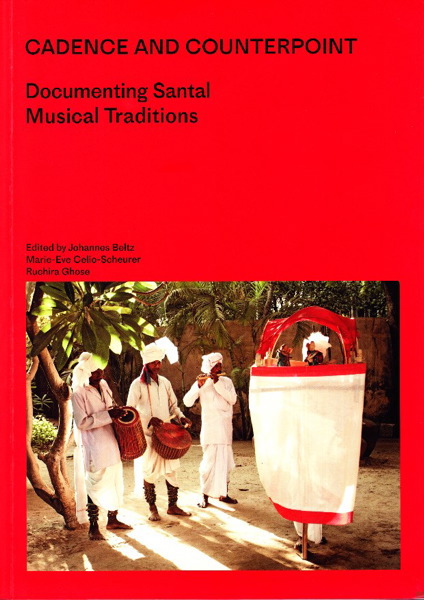
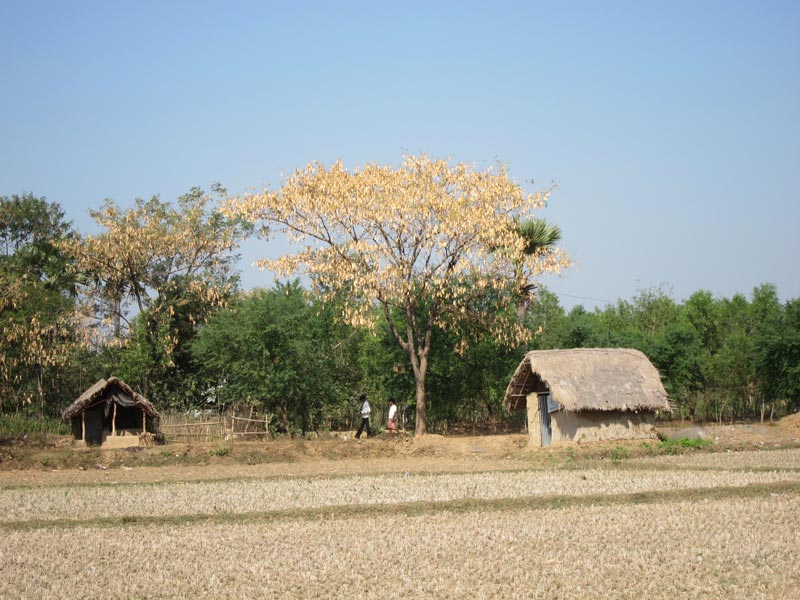
Photo © Ludwig Pesch
Learn more about a wide range of issues
including Education and literacy, Health and nutrition & Ethnobotany >>
UNESCO World Heritage Centre | Backup: PDF-Repository >>
Learn more about the status and spread of Santali in different regions of India: