Sohrai – The First Day
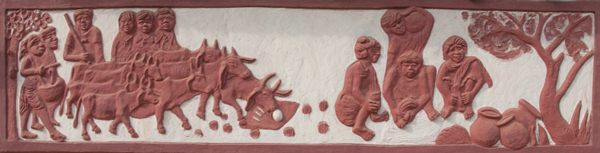
The most important festival of the Santals is called Sohrai. It is the Harvest Festival celebrated after the rice harvest in early January. The celebrations stretch over several days. The first day is Um hiloah.
Every family contributes half a kilo of rice, a young chicken, salt, turmeric powder, potatoes, firewood to prepare khichuri, a mixture of rice with dal and potatoes. They also contribute ranu, a fermenting agent like yeast to prepare rice beer. On this first day the men perform a ritual on a field outside the village to initiate the festival.
After the ritual performed by the Naike (the priest of the village) the men folk eat khichuri and drink rice beer together. Goget, the messenger later distributes the rest of the khichuri to every family on leaves of the Banyan tree. In the afternoon when the cows return home, an egg is laid on the path to the village. The owner of the cow or buffalo which stamps on the egg will gift a pot of rice beer in the forthcoming Magh Festival of the village.
Source: Santals Celebrate the Seasons published by Ashadullapur Gramin Silpa & Sastha Bidhan Kendra and Ghosaldanga Bishnubati Adibasi Trust © 2014
Learn more about this unique project, view the entire series of photographs or download the eBook here: Six Murals by Sanyasi Lohar and his team >>

All contents are being published with an understanding that the respective copyright owners have agreed to the license terms explained in the Creative Commons Attribution-NonCommercial-NoDerivs 3.0 Unported License. This means that no commercial use or modification of such content is permissible without written consent by their respective copyright holders.
“The tribal households traditionally had a backyard garden that had multiple, multilayered and multipurpose indigenous trees, plants, herbs, and shrubs. […] The produce from this small garden was sufficient to meet the dietary and nutrition needs of a family for an entire year.” – Learn more about food crops that are resistant to pests, grow on poor soils, flourish under changed climatic conditions and offer high nutritive value | Food distribution >>
Adivasi communities: stewards of India’s cultural heritage and biodiversity
[…] India’s tribal communities — over 104.5 million people, or 8.6 per cent of the population — remain among the most marginalised despite decades of welfare schemes and development promises. In states such as Chhattisgarh, Jharkhand, Bihar, Rajasthan and Odisha, tribal districts consistently record higher poverty levels than non-tribal areas, even as these regions supply land, forests and minerals for the country’s growth. These communities have often been compelled to relinquish their lands for large-scale infrastructure projects, resulting in the erosion of their identity, livelihoods, and future prospects.
It is crucial to recognise the value these communities bring, particularly their eco-friendly lifestyles, which offer important insights into addressing climate-related challenges. For instance, during the 2018 drought in Sundergarh, Odisha, a visit to a remote tribal village revealed thriving vegetation and effective water-harvesting systems. Kiri village in Lahunipara block of Sundergarh district, inhabited by the Paudi Bhuyan community — a Particularly Vulnerable Tribal Group (PVTG) — has demonstrated remarkable resilience.
This observation underscores the importance of learning from traditional ecological knowledge, especially sustainable farming practices that rely on drought-resistant and indigenous seeds.
Adivasi communities, as stewards of India’s cultural heritage and biodiversity, must be central to the nation’s development narrative. Their lives are intricately linked to land, forests and water, yet they face growing threats from climate change, livelihood insecurity and displacement. Addressing these challenges requires more than welfare initiatives; it demands robust enforcement of constitutional rights, substantial public investment and the strengthening of Gram Sabha–based governance. […]
Source: “Union Budget must shift from welfare to rights-based public investment for Adivasi communities” by Debabrat Patra, Sion Kongari & Saurabh Kumar, Down to Earth, 9 February 2026
URL: https://www.downtoearth.org.in/governance/union-budget-must-shift-from-welfare-to-rights-based-public-investment-for-adivasi-communities
Date Visited: 30 June 2026
Learn more
Ashadullapur Gramin Silpa & Sastha Bidhan Kendra | Sanyasi Lohar
Crafts and visual arts | Masks
Daricha Foundation | Deoal Chitro (wall paintings) | Homepage | YouTube channel
eBook | Background guide for education
Ghosaldanga Bishnubati Adibasi Trust
Santal music CD and DVD by Ghosaldanga Bishnubati Adibasi Trust
Santali language | eBook | A Santali-English dictionary – Archive.org
Video | Roots and Branches: The Lifeworld of an Enlightened Villager in West Bengal
Video | Santali video album “Ale Ato” (Our Village, Part 1 of 2) – West Bengal
To locate the Museum of Santal Culture in Bishnubati village (near Santiniketan) on the map seen below, open by clicking on the left button:
Tips for using interactive maps
Toggle to normal view (from reader view) should the interactive map not be displayed by your tablet, smartphone or pc browser
For details and hyperlinks click on the rectangular button (left on the map’s header)
Scroll and click on one of the markers for information of special interest
Explore India’s tribal cultural heritage with the help of another interactive map >>