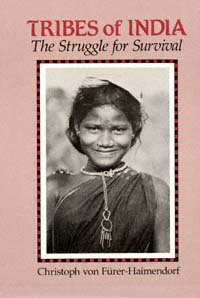
University of California >>
Free eBook (PDF) >>
Summary & Contents >>
By Arup Maharatna, Mainstream
[…] Thus, the relatively low infant and child mortality (vis-à-vis adults) in the tribal population, if true, could provide a clue simultaneously to their relatively high CWR on the one hand and a stability of their relative population size vis-à-vis a secular decline for the Hindus over the first half of the twentieth century on the other. In fact our own demographic estimates (based on an ‘indirect demographic technique’) show lower levels of both mortality and fertility among aggregate tribal people than those of the Hindus in the early last century India, reinforcing further doubts on Davis’ hypothesis of highest tribal fertility.3 A brief overall portrayal of an admirable demographic regime (that is, relatively low fertility and mortality) among India’s tribes sounds pretty vivid in the following remarks made as late as 1985 by C. von Fürer-Haimendorf, a celebrated authority on Indian tribes over the large part of the last century:
….only one or two generations ago many tribal communities enjoyed the advantages of a well-balanced ecology fully in tune with the natural resources of their environment and boast an overall quality of life superior in many ways to that of large sections of the Indian rural population. Adequate food-supplies, non-exploitative social structure, freedom from indebtedness and other forms of dependence on non-tribal outsiders, equality of the sexes and a remarkable tolerance in all interpersonal relations were outstanding characteristics of such tribal societies. Moreover there seems to be no reason to assume that their way of life could not have continued for the foreseeable future without requiring any aid from outside sources, particularly as in most tribal areas there was no excessive population growth threatening the ecological balance.4 […]
REFERENCES
4. Fürer-Haimendorf, C. (1985), Tribal Population and Cultures of the Indian Subcontinent (Leiden-Koln: E.J. Brill).
The author is a Professor, Gokhale Institute of Politics and Economics, Pune.
Source: ‘Who Is Civilised?’: In Praise of Tribal Traditions, Society, and Culture in India – Mainstream Weekly , Vol XLVIII, No 40, September 25, 2010
Address : http://www.mainstreamweekly.net/article2337.html
Date Visited: 18 January 2022
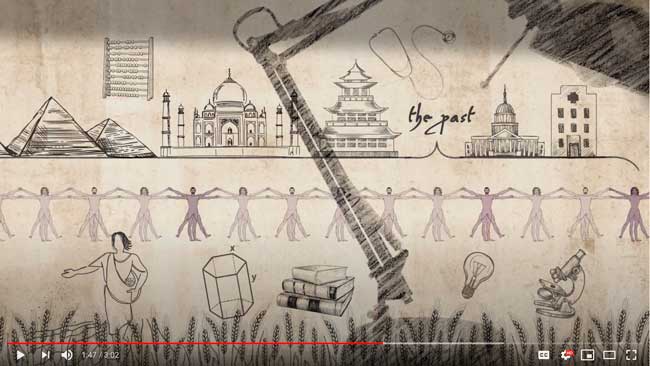
Watch “The Good Ancestor – The Legacies We Leave” (3 min.): An animation that explores the legacies we might leave for future generations >>
Links to some of the most important organisations, thinkers and doers that are leading the way and that have inspired the book The Good Ancestor by Roman Krznaric >>
Facts and figures: India’s biological, cultural and geographic diversity
Spread over 3,287,240 km2 and despite a total human population of over 1,210,000,000, India represents a wide spectrum of biological, cultural and geographic diversity. It has been identified as one of the top 12 global biodiversity hotspots and has 91 eco-cultural zones inhabited by 4,635 ethnic communities. India also has amongst the largest indigenous/tribal population, constituting 8.08% of the country’s population, representing 461 tribes. The term ‘Indigenous Peoples’ is not officially recognized in the country, instead the Constitution of India uses the term ‘Scheduled Tribes’. The total forest cover is estimated to be approximately 20% of the total area of the country. About 1,70,379 villages with a population of 10,674,334 inhabit areas in close proximity of forests.
Source: RECOGNITION AND SUPPORT OF ICCAs IN INDIA by Neema Pathak Broome and Tushar Dash, p. 4 | PDF-Repository
URL: https://kalpavriksh.org/wp-content/uploads/2021/01/IndiaICCARecognition_Final_SEPT2012-as-published.pdf
Date Visited: 10 March 2025
Tips for using interactive maps
Toggle to normal view (from reader view) should the interactive map not be displayed by your tablet, smartphone or pc browser
For details and hyperlinks click on the rectangular button (left on the map’s header)
Scroll and click on one of the markers for information of special interest
Explore India’s tribal cultural heritage with the help of another interactive map >>
See also
Adverse inclusion | Casteism | Rural poverty
Anganwadi | Community facilities | Ekalavya
Demographic Status of Scheduled Tribe Population of India (Census figures 2011)
Fact checking | Figures, census and other statistics
Human Rights Commission (posts) | www.nhrc.nic.in (Government of India)
Search tips | Names of tribal communities, regions and states of India
“The world sells humans. What kind of world is this?” – Hindi Movie “Kamla” revisited
“What is the Forest Rights Act about?” – Campaign for Survival and Dignity
“Who are Scheduled Tribes?” – Government of India (National Commission for Scheduled Tribes, NCST)
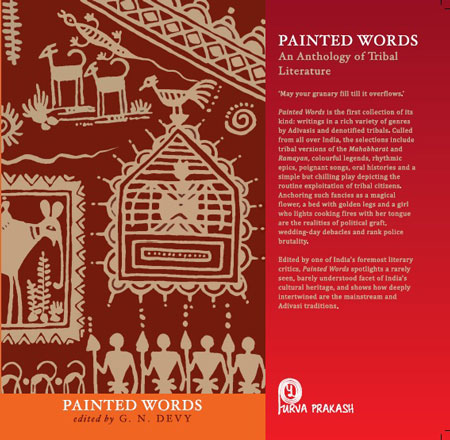
Tribal Literature by G.N. Devy >>
Free eBooks & Magazine: Adivasi literature and languages >>
“India, a union of states, is a Sovereign, Secular, Democratic Republic with a Parliamentary system of Government. The President is the constitutional head of Executive of the Union. In the states, the Governor, as the representative of the President, is the head of Executive. The system of government in states closely resembles that of the Union. There are 28 states and 8 Union territories in the country. Union Territories are administered by the President through an Administrator appointed by him/her. From the largest to the smallest, each State/UT of India has a unique demography, history and culture, dress, festivals, language etc. This section introduces you to the various States/UTs in the Country and urges you to explore their magnificent uniqueness…” – KnowIndia (Government), States and Union Territories (Visited: 2 September 2023)
Learn more about India’s 28 States and 8 Union Territories – From Andhra Pradesh to West Bengal | Nutrition >>
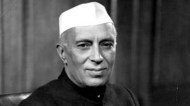
Jawaharlal Nehru on five principles for the policy to be pursued vis-a-vis the tribals >>
Photo © Indian Express
The current predicament of Adivasis
The current predicament of a vast majority of Adivasis is one of sharp erosion in their livelihoods and their life-worlds. Despite assurances of autonomy (the Fifth and Sixth Schedules, the Panchsheel, PESA 1996, Forests Rights Act 2006) and attempts of focused addressal of Adivasi and Tribal issues (including the establishment of an umbrella outfit, the National Council for Tribal Welfare), there are counter structures and programmes that defy the enabling of genuinely decentralised autonomy and the guarantee of democratic participation. For instance, the recently approved ‘Integrated Action Plan’ in Tribal areas overrides the representation of Adivasis in local issues in decision-making processes and arrogates powers of governance to bureaucrats and specialists.
In addition to such contradictory and conflicting measures, the forces of fast-expanding capital, along with the top-down deployment of development models have resulted in large scale displacement in Adivasi regions. Global capital’s access to mineral wealth has also intensified violence of various forms and degrees.
Source: Ch. 2, “Context and Conditions of Adivasi Life Worlds” (p. 5) in THE EDUCATION QUESTION’ FROM THE PERSPECTIVE OF ADIVASIS: CONDITIONS, POLICIES AND STRUCTURES by National Institute of Advanced Studies (Bangalore), March 2012 & UNICEF | Backup (PDF, 4 MB)