UNESCO World Heritage Centre >>
“The highest education is that which does not merely give us information but makes our life in harmony with all existence.” – Rabindranath Tagore | Rabindranath Tagore: a universal voice – Unesco >>
Tagore and His India
by Amartya Sen, nobelprize.org (with permission from The New York Review, first published 28 August 2001)Voice of Bengal
Rabindranath Tagore, who died in 1941 at the age of eighty, is a towering figure in the millennium-old literature of Bengal. Anyone who becomes familiar with this large and flourishing tradition will be impressed by the power of Tagore’s presence in Bangladesh and in India. His poetry as well as his novels, short stories, and essays are very widely read, and the songs he composed reverberate around the eastern part of India and throughout. […]
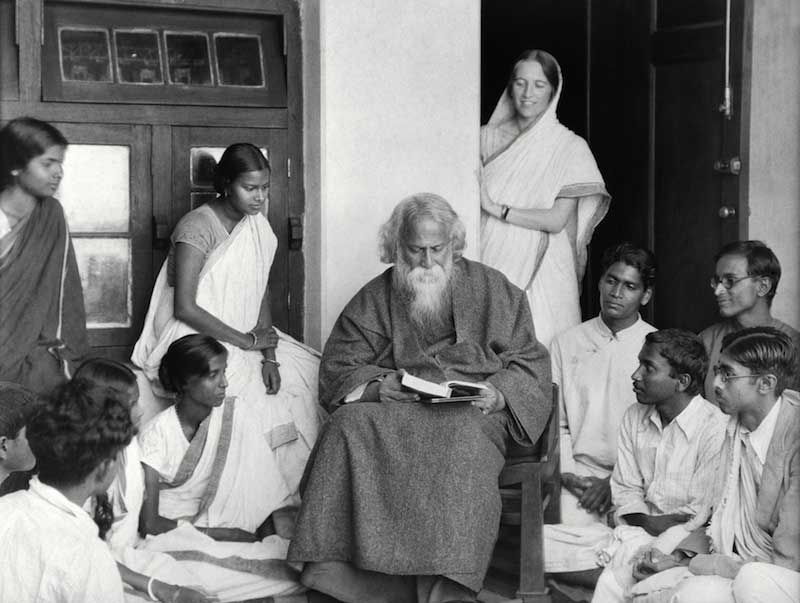
I am partial to seeing Tagore as an educator, having myself been educated at Santiniketan. The school was unusual in many different ways, such as the oddity that classes, excepting those requiring a laboratory, were held outdoors (whenever the weather permitted). No matter what we thought of Rabindranath’s belief that one gains from being in a natural setting while learning (some of us argued about this theory), we typically found the experience of outdoor schooling extremely attractive and pleasant. Academically, our school was not particularly exacting (often we did not have any examinations at all), and it could not, by the usual academic standards, compete with some of the better schools in Calcutta. But there was something remarkable about the ease with which class discussions could move from Indian traditional literature to contemporary as well as classical Western thought, and then to the culture of China or Japan or elsewhere. The school’s celebration of variety was also in sharp contrast with the cultural conservatism and separatism that has tended to grip India from time to time.
The cultural give and take of Tagore’s vision of the contemporary world has close parallels with the vision of Satyajit Ray, also an alumnus of Santiniketan who made several films based on Tagore’s stories. Ray’s words about Santiniketan in 1991 would have greatly pleased Rabindranath: “I consider the three years I spent in Santiniketan as the most fruitful of my life…. Santiniketan opened my eyes for the first time to the splendours of Indian and Far Eastern art. Until then I was completely under the sway of Western art, music and literature. Santiniketan made me the combined product of East and West that I am.”
Source: Tagore and His India
Address : https://www.nobelprize.org/nobel_prizes/literature/laureates/1913/tagore-article.html
Date Visited: 4 October 2020
Rabindranath Tagore’s legacy
Haroon Habib, The Hindu, May 17, 2011“Let the mind be universal. The individual should not be sacrificed.”
He was a member of the elite, but Tagore did not have elitist views on education. He wrote: “I believe that all human problems find their fundamental solution in education … Poverty, pestilence, communal fights and industrial backwardness make our path narrow and perilous owing to the meagreness of education…”
Reflecting on the plight of his country under foreign rule, Tagore understood, just as Gandhi did, that violence cannot serve the ultimate purpose of humanity. He was deeply aware that India needed more than a change of political regime. Therefore, he opted for a self-reliant village economy. In the region that is now Bangladesh, he initiated projects of local initiative, local leadership and local self-government, developing cooperative systems.
Source: Celebrating Rabindranath Tagore’s legacy – The Hindu
Address : http://www.thehindu.com/opinion/lead/celebrating-rabindranath-tagores-legacy/article2026880.ece
Date Visited: Thu Jul 31 2014 15:24:48 GMT+0200 (CEST)
* Rabindranath Tagore 1926 quoted in Rabindranath Tagore: A Biography by Uma Das Gupta (Oxford University Press, New Delhi 2004), p. 25
[Bold typeface added above for emphasis]
Find scholarly books, poetry and fiction relating to tribal culture – Indian publishers
List of sites covered by this Google SafeSearch engine
https://www.alephbookcompany.com
More SafeSearch on this website
Search tips
Combine the name of any particular state, language or region with that of any tribal (Adivasi) community.
Add keywords of special interest (music, poetry, dance just as health, sacred grove and biodiversity); learn about the rights of Scheduled Tribes such as the “Forest Rights Act” (FRA); and the United Nations “Declaration on the Rights of Indigenous Peoples”, “Universal Declaration of Human Rights”, “women’s rights”, or “children’s right to education”.
Ask a question that includes “tribal” or “Adivasi”, for instance: “Adivasi way of life better?” (or “tribal way of life worse?”)
Specify any particular issue or news item (biodiversity, bonded labour and human trafficking, climate change, ecology, economic development, ethnobotany, ethnomedicine, global warming, hunter-gatherers in a particular region or state, prevention of rural poverty, water access).
For official figures include “scheduled tribe ST” along with a union state or region: e.g. “Chhattisgarh ST community”, “Himalayan tribe”, “Scheduled tribe Tamil Nadu census”, “ST Kerala census”, “Particularly Vulnerable Tribal Group Jharkhand”, “PVTG Rajasthan”, “Adivasi ST Kerala”, “Adibasi ST West Bengal” etc.
SafeSearch browser tips
If your (mobile) browser fails to display “embedded” media contents, Google maps and SafeSearch windows
Try another browser like Firefox, Chrome or Safari available on your device
Ensure your favourite browser is up to date
Close your present browser
Check your browser and mobile (gsm) settings:
e.g. permission for video or JavaScript
(seen under Preferences >Security >Enable JavaSript)
Restart your computer (smartphone, tablet)
Reconnect to your wifi network or connect to a different one
On some iPhone models the following helps:
>Settings >Safari >scroll down to:
SETTING FOR WEBSITES
Enable “Request Desktop Website” (All Websites) temporarily
Return to the map-post in Safari and “Reload”
Return to >Settings and disable “Request Desktop Website” again
Return to the post in Safari and “Reload”which should now display “embedded” contents as intended (with the convenience of browsing the mobile version on a small screen)
Note: similar solutions may also work with other mobile operating systems.
Search Worldcat.org for publications by reputed authors (select “Open Content/Open Access” for freely downloadable content)
Search tips
Combine the name of any particular state, language or region with that of any tribal (Adivasi) community.
Ask a question that includes “tribal” or “Adivasi”, for instance: “Adivasi way of life better?” (or “tribal way of life worse?”)
Add keywords of special interest (music, poetry, dance just as health, sacred grove and biodiversity); learn about the rights of Scheduled Tribes such as the “Forest Rights Act” (FRA); and the United Nations “Declaration on the Rights of Indigenous Peoples”, “Universal Declaration of Human Rights”, “women’s rights”, or “children’s right to education”.
Specify any particular issue or news item (biodiversity, bonded labour and human trafficking, climate change, ecology, economic development, ethnobotany, ethnomedicine, global warming, hunter-gatherers in a particular region or state, prevention of rural poverty, water access).
See also
eBook | Free catalogue: Museum of Santal Culture (Bishnubati)
eBook | Free catalogue: Banam: One of the ancient musical instruments of the Santals
Santal | Santali language | Santali script – Ol Chiki
The Santhal family and the invention of a subaltern counterpublic