Mahasweta Devi was born in 1926 in the city of Dacca in East Bengal (modern day Bangladesh). As an adolescent, she and her family moved to West Bengal in India. Born into a literary family, Mahasweta Devi was also influenced by her early association with Gananatya, a group who attempted to bring social and political theater to rural villages in Bengal in the 1930s and 1940s. After finishing a master’s degree in English literature from Calcutta University, Devi began working as a teacher and journalist. Her first book, Jhansir Rani (The Queen of Jhansi), was published in 1956. This work also marked the beginning of a prolific literary career. In the last half century, Devi has published twenty collections of short stories and close to a hundred novels, primarily in her native language of Bengali. She has also been a regular contributor to several literary magazines such as Bortika, a journal dedicated to the cause of oppressed communities within India. In 1984, she retired from her job as an English lecturer at a Calcutta university to concentrate on her writing. Devi has been the recipient of several literary prizes. She was awarded the Jnanpath, India’s highest literary award in 1995. In the following year, she was one of the recipients of the Magsaysay award, considered to be the Asian equivalent of the Nobel Prize. She currently resides and works in Calcutta, India. […]
Another important theme in the works of Mahasweta Devi involves the position of tribal communities within India. She is a long-time champion for the political, social and economic advancement of these communities, whom she characterizes as “suffering spectators of the India that is traveling towards the twenty first century” (Imaginary Maps, xi). These concerns can be seen in works such as Aranyer Adhikar (Rights of the Forest) and anthologies such as her 1979 Nairhite Megh (Clouds in the Southwestern Sky). Aranyer Adhikar, which was published in 1977, is based on the life of Birsa Munda, a tribal freedom fighter. She has also donated the prize money from both the Jnanpath and Magsaysay awards to tribal communities and continues to use her work to further the position of these groups in India.
This activism is central to Devi’s understanding of the role of a writer in society: “I think a creative writer should have a social conscience. I have a duty towards society. Yet I don’t really know why I do these things. The sense of duty is an obsession. I must remain accountable to myself.”
Gayatri Chakravorty Spivak, who has translated two collections of Devi’s stories including those in Imaginary Maps into English, suggests that this interplay of activism and literary writing in Devi’s fiction can be of substantial interest to current academic discourse and practices. Spivak insists that Devi’s work suggests a model in which activism and writing can reflect upon each other, providing a necessary vision of inter-nationality, and the possibility of constructing a new kind of responsibility for the cultural worker (Imaginary Maps, xxvi). […]
Source: » Devi, Mahasweta Postcolonial Studies @ Emory
Address : http://postcolonialstudies.emory.edu/mahsweta-devi/
Date Visited: Wed May 22 2013 15:41:17 GMT+0200 (CEST)
Aranyer Adhikar (Rights of the Forest) & Pterodactyl by Mahasweta Devi
Aranyer Adhikar (Rights of the Forest) is a text that focuses on the tribal leader Birsa Munda and his fight against the British. Aranyer Adhikar chronicles how the tribals fought against the British atrocities and asserted their rights. The novel is a scathing criticism of the injustices that were present in the contemporary society. Mahasweta Devi considered the British as the outsiders who wanted to usurp the traditional rights of the tribal communities over the forested areas of India. Critic Ilina Sen believes, “Mahasweta Devi’s writings on tribal life are intimate and clearly identify the state and its agents as violent oppressors of the people.” (Sen 1) Mahasweta Devi’s promotion of the tribal culture is found in other works as well. In her novella, Pterodactyl, she examines the social factors that contribute towards the misunderstanding of the tribal communities by the mainstream society. She probes closely how this misunderstanding ultimately prompts social injustices and prejudices that affect social cohesion. Jogamaya Bayer comments “The outsiders misapprehension of the adivasis’desperation indicates their indifference to the adivasi culture.” (Bayer 96) Mahasweta Devi felt that the tribal communities were wronged by the mainstream society that was characterised by hypocrisy and falsity.
Source: “Mahasweta Devi and Postmodern Cultural Hegemony” by 2021 Rajdeep Guha, The Achievers Journal, Journal of English Language, Literature and Culture, Volume 7, Issue 1, January to March 2021
URL: http://theachieversjournal.org/index.php/taj/article/view/427/114
Date Visited: 20 July 2025
“The tribal world and the tribal way is complete in itself.” – Mahasweta Devi quoted by Gopalkrishna Gandhi in “Swearing by Mahasweta” (The Hindu, 6 August 2016) | Backup (PDF, 450 KB) >>
[Bold typeface added above for emphasis]

“We have to write our own stories, about our issues, from our own perspectives.” – Abhay Xaxa, a “Fiercely Unapologetic Adivasi Scholar-Activist” | Read more >>
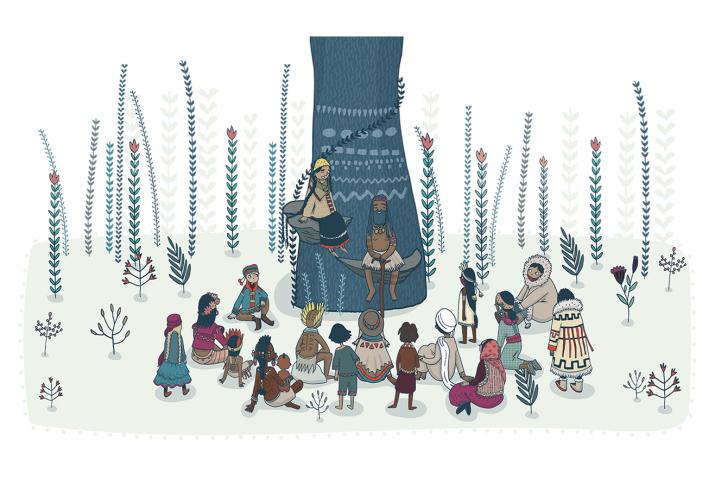
E-learning tool on the rights of Indigenous Peoples >>
Search Worldcat.org for publications by reputed authors (select “Open Content/Open Access” for freely downloadable content)
Search tips
Combine the name of any particular state, language or region with that of any tribal (Adivasi) community.
Ask a question that includes “tribal” or “Adivasi”, for instance: “Adivasi way of life better?” (or “tribal way of life worse?”)
Add keywords of special interest (music, poetry, dance just as health, sacred grove and biodiversity); learn about the rights of Scheduled Tribes such as the “Forest Rights Act” (FRA); and the United Nations “Declaration on the Rights of Indigenous Peoples”, “Universal Declaration of Human Rights”, “women’s rights”, or “children’s right to education”.
Specify any particular issue or news item (biodiversity, bonded labour and human trafficking, climate change, ecology, economic development, ethnobotany, ethnomedicine, global warming, hunter-gatherers in a particular region or state, prevention of rural poverty, water access).
Learn more
eBook | Adivasi Stories from Gujarat
Forest dwellers | Hunter-gatherers | Illegal mining
Forest dwellers in early India – myths and ecology in historical perspective
Literature and bibliographies | Literature – fiction | Poetry
The President of India Smt. Droupadi Murmu – Press Releases
Women | Safe search | President Droupadi Murmu on women’s empowerment