Dreams of mega development herald disaster for a highly vulnerable island. Great Nicobar Island is the southernmost and largest landmass in the chain that makes up the Nicobar Islands in the Bay of Bengal. A Rs.72,000 crore project that is planned for the development of this island will result in ultimately destroying both the island’s delicate rainforest ecosystem and its indigenous people. […] In The Great Nicobar Betrayal, Pankaj Sekhsaria, one of the best known chroniclers of contemporary issues in the Andaman and Nicobar Islands, has compiled articles written by various experts across publications that examine the proposed project from every angle—environmental, geological, impact on local communities, law, due process, and ecology. These pieces together shed light on the magnitude of the disaster that will be unleashed on this pristine place if the project comes through.

Edited by Pankaj Sekhsaria
Frontline Publication (Rs. 499)
Book Synopsis & Endorsement by Amitav Ghosh
Dreams of mega development herald disaster for a highly vulnerable island. Great Nicobar Island is the southernmost and largest landmass in the chain that makes up the Nicobar Islands in the Bay of Bengal. A Rs.72,000 crore project that is planned for the development of this island will result in ultimately destroying both the island’s delicate rainforest ecosystem and its indigenous people.
In The Great Nicobar Betrayal, Pankaj Sekhsaria, one of the best known chroniclers of contemporary issues in the Andaman and Nicobar Islands, has compiled articles written by various experts across publications that examine the proposed project from every angle—environmental, geological, impact on local communities, law, due process, and ecology.
These pieces together shed light on the magnitude of the disaster that will be unleashed on this pristine place if the project comes through.
The book is a warning and a catalogue of the manmade catastrophe that lurks on the horizon, one that will destroy more than the tsunami of December 2004 ever did.
An edited collection of short pieces by different writers, annexures and 12 colour plates pictures on the mega infrastructure project being pushed in Great Nicobar Island
Articles by Pankaj Sekhsaria, Aathira Perinchery, Janki Andharia, V Ramesh & Ravinder Dhiman, B Chaudhari, Ishika Ramakrishna, Uday Mondal, Mahi Mankeshwar, Shrishtee Bajpai, S Harikrishnan, Manish Chandi, Ajay Saini, Norma Alvares.
Foreword by: Madhav Gadgil
“Even at a time of accelerating environmental vandalism around the world, what the Indian government is planning in the Andaman and Nicobar Islands stands out for its sheer folly and short-sightedness. As this excellent collection of essays shows in painful detail, these plans are a perfect example of ‘disaster capitalism, in which the government is taking advantage of the displacement of the native Nicobarese by the tsunami of 2004 to make a massive land grab for a completely senseless plan of development.” – Amitav Ghosh
Learn more from Pankaj Sekhsaria on this website and on kalpavriksh.org >>
Kalpavriksh believes that a country can develop meaningfully only when ecological sustainability and social equity are guaranteed, and a sense of respect for, and oneness with nature, and fellow humans is achieved. It is a non-hierarchical organisation and the group takes all decisions after appropriate debate and discussion. – Learn more >>
Tip | Search for “Andaman and Nicobar Islands” and “Pankaj Sekhsaria” in the search field seen below
Up-to-date reports by Indian experts and journalists
List of sites covered by this Google SafeSearch engine
Academia.edu (platform for academics to share research papers) – www.academia.edu
Archive.org – https://archive.org
Centre for Science and Environment – https://www.cseindia.org
Current Conservation – https://www.currentconservation.org
Development and Cooperation (D+C) https://www.dandc.eu
Down To Earth (India) – www.downtoearth.org.in
India Environment Portal – www.indiaenvironmentportal.org.in
Harnessing Nature Magazine – https://harnessingnature.online
Kalpavriksh Environmental Action Group – https://kalpavriksh.org
Mongabay-India – https://india.mongabay.com
M S Swaminathan Research Foundation – www.mssrf.org
Navdanya (protecting India’s biodiversity based food heritage) – https://navdanya.org
People’s Archive of Rural India – https://ruralindiaonline.org/
Third World Network (Penang, Malaysia) – https://twn.my
The Shola Trust (nature conservation in the Nilgiri region) – www.thesholatrust.org
TribalConnect (“uplift and benefit the community without adversely affecting or changing their vernacular”) – https://tribalconnect.org.in
WorldCat (“the world’s largest library catalog, helping you find library materials online”) – https://worldcat.org
More SafeSearch on this website
Search tips
Combine the name of any particular state, language or region with that of any tribal (Adivasi) community.
Add keywords of special interest (music, poetry, dance just as health, sacred grove and biodiversity); learn about the rights of Scheduled Tribes such as the “Forest Rights Act” (FRA); and the United Nations “Declaration on the Rights of Indigenous Peoples”, “Universal Declaration of Human Rights”, “women’s rights”, or “children’s right to education”.
Ask a question that includes “tribal” or “Adivasi”, for instance: “Adivasi way of life better?” (or “tribal way of life worse?”)
Specify any particular issue or news item (biodiversity, bonded labour and human trafficking, climate change, ecology, economic development, ethnobotany, ethnomedicine, global warming, hunter-gatherers in a particular region or state, prevention of rural poverty, water access).
For official figures include “scheduled tribe ST” along with a union state or region: e.g. “Chhattisgarh ST community”, “Himalayan tribe”, “Scheduled tribe Tamil Nadu census”, “ST Kerala census”, “Particularly Vulnerable Tribal Group Jharkhand”, “PVTG Rajasthan”, “Adivasi ST Kerala”, “Adibasi ST West Bengal” etc.
SafeSearch browser tips
If your (mobile) browser fails to display “embedded” media contents, Google maps and SafeSearch windows
Try another browser like Firefox, Chrome or Safari available on your device
Ensure your favourite browser is up to date
Close your present browser
Check your browser and mobile (gsm) settings:
e.g. permission for video or JavaScript
(seen under Preferences >Security >Enable JavaSript)
Restart your computer (smartphone, tablet)
Reconnect to your wifi network or connect to a different one
On some iPhone models the following helps:
>Settings >Safari >scroll down to:
SETTING FOR WEBSITES
Enable “Request Desktop Website” (All Websites) temporarily
Return to the map-post in Safari and “Reload”
Return to >Settings and disable “Request Desktop Website” again
Return to the post in Safari and “Reload”which should now display “embedded” contents as intended (with the convenience of browsing the mobile version on a small screen)
Note: similar solutions may also work with other mobile operating systems.
What does it mean to be Indigenous?
Indigenous Peoples can be identified according to certain characteristics:
They are politically and socially marginalized.
Most importantly, they self-identify as Indigenous Peoples.
They share an ancestral link with those who inhabited a country or region before they were colonized or before other peoples became dominant.
They have a strong link to particular territories and the surrounding natural resources.
They have distinct social, economic or political systems, which they are resolved to maintain and reproduce.
They have a distinct language, culture and beliefs.
There are more than 5,000 different Indigenous Peoples around the world comprising 476 million people – around 6.2% of the global population. They are spread across more than 90 countries in every region and speak more than 4,000 languages. | Learn more (Amnesty International) >>
Source: “INDIGENOUS PEOPLES’ RIGHTS” by Amnesty International
URL: https://www.amnesty.org/en/what-we-do/indigenous-peoples/
Date Visited: 10 May 2025
Learn more on the Rights of Indigenous Peoples, their Languages & linguistic heritage & Tribal culture worldwide >>
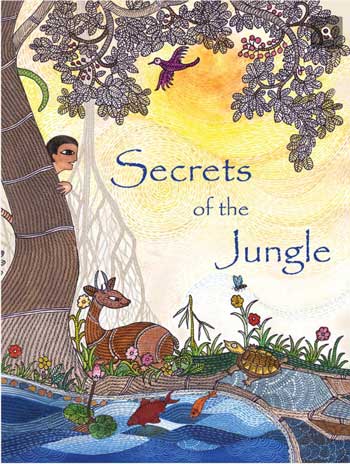
An activity book about the Central Indian forests, its wildlife and its people
https://kalpavriksh.org/our-store/secrets-of-the-jungle/
More about Kalpavriksh >>
Resources for educators >>
See also
Adverse inclusion | Casteism | Rural poverty
Anganwadi | Community facilities | Ekalavya
Demographic Status of Scheduled Tribe Population of India (Census figures 2011)
Fact checking | Figures, census and other statistics
Human Rights Commission (posts) | www.nhrc.nic.in (Government of India)
Search tips | Names of tribal communities, regions and states of India
“The world sells humans. What kind of world is this?” – Hindi Movie “Kamla” revisited
“What is the Forest Rights Act about?” – Campaign for Survival and Dignity
“Who are Scheduled Tribes?” – Government of India (National Commission for Scheduled Tribes, NCST)