Within the world of food collection
[…] Hunts such as these, all of them taking place in the months preceding the monsoon and involving only men, made me first realize that ‘hunting’ is not synonymous with ‘meat’ or ‘food’, and that there were other connotations attached to the activity. They inevitably involved rituals and, often, first fruit ceremonies that commenced the harvest or use of certain plants, and they sometimes heralded specific social and economic actions such as horn-blowing, sowing, or the consumption of mahua distilled from fresh flowers. […]
Compared to hunting, fishing is more pointedly about food. […]
Also, a fishing expedition always involved women – sometimes only women – and often children, the latter learning about the use of plants and plant parts used in stupefying fish. And because of the children involved the mood was one of a family outing or picnic, with noise and splashing and pranks.
The gathering of plant foods is an entirely different domain, in the sense of it being an ‘all year round’ activity and almost entirely a women’s affair.
Every village has its own ‘super-woman’, a plant collector par excellence, in whose house one inevitably finds unusual foods. […]What makes plant collection important is the fact that it contributes to a large proportion of the adivasi diet. […]
A quick survey of edible plant foods in some villages in Bastar yielded a list of more than 300 species. However, those that were regularly eaten were far fewer, many species having slipped out of traditional diets as ‘there was not enough time’ (a common answer to the question, ‘Why don’t you eat this tuber or that fruit anymore?’ […]
I was accompanied by a young Durwa boy who had been to school and who surprised me with his ability to discern several species of the said genus Dioscorea. […] When I asked him how he had learned all this – this being an especially difficult genus even for botanists – he said that he had watched his mother as a young child, as she would carry him along on yam trips. […]
Much of what he knew about yams, and indeed about the forest itself, he learned by watching, and not because he had been consciously taught.
Hunting is almost totally banned in India, strictly enforced by policing in protected areas. The Forest Rights Act (2006) explicitly states, while conferring other rights to the Scheduled Tribes and other Traditional Forest Dwellers, that it excludes ‘the traditional right of hunting or trapping or extracting a part of the body of any species of wild animal’ (ch 2, 3(l)). […]
Yet, plant food gathering hardly faces any legal restriction and is carried out in most forests all over the country. […]
Though some of the animals whose meats are consumed may be threatened or endangered, the bulk of fish and plant foods are harvested in most places in central India according to customary rules that assure their long-term survival. […]
Source: “Within the world of food collection” by Madhu Ramnath
URL: https://www.india-seminar.com/2018/702/702_madhu_ramnath.htm
Date Visited: 15 April 2024
[Bold typeface added above for emphasis]
Publication by M. Ramnath, ‘The Role of Wild Food in Tribal Culture in India: as Taste, Identity, Metaphor’, in A. Baviskar (ed.), Nature Today: New Studies in Ecology and Environment. Oxford University Press, New Delhi.
Search Worldcat.org for publications by reputed authors (select “Open Content/Open Access” for freely downloadable content)
Search tips
Combine the name of any particular state, language or region with that of any tribal (Adivasi) community.
Ask a question that includes “tribal” or “Adivasi”, for instance: “Adivasi way of life better?” (or “tribal way of life worse?”)
Add keywords of special interest (music, poetry, dance just as health, sacred grove and biodiversity); learn about the rights of Scheduled Tribes such as the “Forest Rights Act” (FRA); and the United Nations “Declaration on the Rights of Indigenous Peoples”, “Universal Declaration of Human Rights”, “women’s rights”, or “children’s right to education”.
Specify any particular issue or news item (biodiversity, bonded labour and human trafficking, climate change, ecology, economic development, ethnobotany, ethnomedicine, global warming, hunter-gatherers in a particular region or state, prevention of rural poverty, water access).
Tribal communities in the central Indian region of Bastar:
Baiga | Bhatra | Dhruva | Gond | Halba | Madia | Maria | Muria
Up-to-date reports by Indian experts and journalists
Search tips
Combine the name of any particular state, language or region with that of any tribal (Adivasi) community.
Add keywords of special interest (music, poetry, dance just as health, sacred grove and biodiversity); learn about the rights of Scheduled Tribes such as the “Forest Rights Act” (FRA); and the United Nations “Declaration on the Rights of Indigenous Peoples”, “Universal Declaration of Human Rights”, “women’s rights”, or “children’s right to education”.
Ask a question that includes “tribal” or “Adivasi”, for instance: “Adivasi way of life better?” (or “tribal way of life worse?”)
Specify any particular issue or news item (biodiversity, bonded labour and human trafficking, climate change, ecology, economic development, ethnobotany, ethnomedicine, global warming, hunter-gatherers in a particular region or state, prevention of rural poverty, water access).
For official figures include “scheduled tribe ST” along with a union state or region: e.g. “Chhattisgarh ST community”, “Himalayan tribe”, “Scheduled tribe Tamil Nadu census”, “ST Kerala census”, “Particularly Vulnerable Tribal Group Jharkhand”, “PVTG Rajasthan”, “Adivasi ST Kerala”, “Adibasi ST West Bengal” etc.
SafeSearch browser tips
If your (mobile) browser fails to display “embedded” media contents, Google maps and SafeSearch windows
Try another browser like Firefox, Chrome or Safari available on your device
Ensure your favourite browser is up to date
Close your present browser
Check your browser and mobile (gsm) settings:
e.g. permission for video or JavaScript
(seen under Preferences >Security >Enable JavaSript)
Restart your computer (smartphone, tablet)
Reconnect to your wifi network or connect to a different one
On some iPhone models the following helps:
>Settings >Safari >scroll down to:
SETTING FOR WEBSITES
Enable “Request Desktop Website” (All Websites) temporarily
Return to the map-post in Safari and “Reload”
Return to >Settings and disable “Request Desktop Website” again
Return to the post in Safari and “Reload”which should now display “embedded” contents as intended (with the convenience of browsing the mobile version on a small screen)
Note: similar solutions may also work with other mobile operating systems.
List of websites covered by this Google custom search engine
Academia.edu (platform for academics to share research papers) – www.academia.edu
Archive.org – https://archive.org
Centre for Science and Environment – https://www.cseindia.org
Current Conservation – https://www.currentconservation.org
Development and Cooperation (D+C) https://www.dandc.eu
Down To Earth (India) – www.downtoearth.org.in
India Environment Portal – www.indiaenvironmentportal.org.in
Harnessing Nature Magazine – https://harnessingnature.online
Mongabay-India – https://india.mongabay.com
M S Swaminathan Research Foundation – www.mssrf.org
Navdanya (protecting India’s biodiversity based food heritage) – https://navdanya.org
People’s Archive of Rural India – https://ruralindiaonline.org/
Third World Network (Penang, Malaysia) – https://twn.my
The Shola Trust (nature conservation in the Nilgiri region) – www.thesholatrust.org
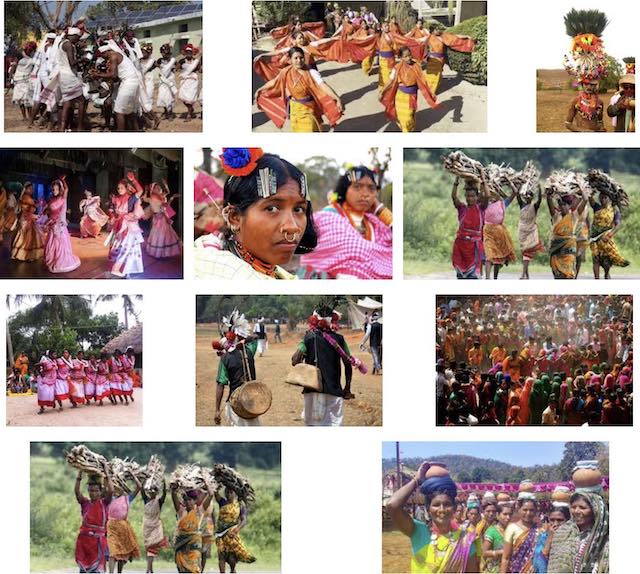
Indian online periodicals and platforms | Images view >>
~ ~ ~
Personalize your CustomSearch by combining other search words >>
(e.g. name of a tribal community and region, a craft, or dance and puppetry)
Research: explore PhD theses from all over India
Shodhganga (Open Access)
“The practice of religious rituals, ceremonies and sanctions by specific cultural groups allow such sacred landscapes to be maintained, emphasizing that humans are intrinsically part of the ecosystem. Taboos, codes and customs specific to activities and community members restrict access to most sacred groves. […] The inclusion of local people’s needs and interests in conservation planning is increasingly accepted as essential, both to promote the well-being of human populations, and to ensure that biodiversity and conservation needs are met in the long-term.” – Nazir A. Pala, Ajeet K. Neg and N.P. Todaria in “The Religious, Social and Cultural Significance of Forest Landscapes in Uttarakhand Himalaya, India” (International Journal of Conservation Science, Vol. 5, Issue 2, April-June 2014) | Sacred groves | Biodiversity and development – Himalaya >>
Facts and figures: India’s biological, cultural and geographic diversity
Spread over 3,287,240 km2 and despite a total human population of over 1,210,000,000, India represents a wide spectrum of biological, cultural and geographic diversity. It has been identified as one of the top 12 global biodiversity hotspots and has 91 eco-cultural zones inhabited by 4,635 ethnic communities. India also has amongst the largest indigenous/tribal population, constituting 8.08% of the country’s population, representing 461 tribes. The term ‘Indigenous Peoples’ is not officially recognized in the country, instead the Constitution of India uses the term ‘Scheduled Tribes’. The total forest cover is estimated to be approximately 20% of the total area of the country. About 1,70,379 villages with a population of 10,674,334 inhabit areas in close proximity of forests.
Source: RECOGNITION AND SUPPORT OF ICCAs IN INDIA by Neema Pathak Broome and Tushar Dash, p. 4 | PDF-Repository
URL: https://kalpavriksh.org/wp-content/uploads/2021/01/IndiaICCARecognition_Final_SEPT2012-as-published.pdf
Date Visited: 10 March 2025
Explore India’s tribal cultural heritage with the help of several interactive maps, specially created for visitors to this website:
- An alphabetical journey across India: from Andaman to West Bengal
- Northeastern India: the “Seven Sister States” & Sikkim
- Visit a museum in India: Indigenous art, anthropological & ethnographical collections
- A virtual journey across time and space: from Gondi-Harappan to present & future
- Locations for video documentaries & external media contents
- Particularly Vulnerable Tribal Groups & Endangered languages
- Places associated with press reports and blogs about India’s tribal cultural heritage
- A virtual journey across India: from Ladakh to Gujarat