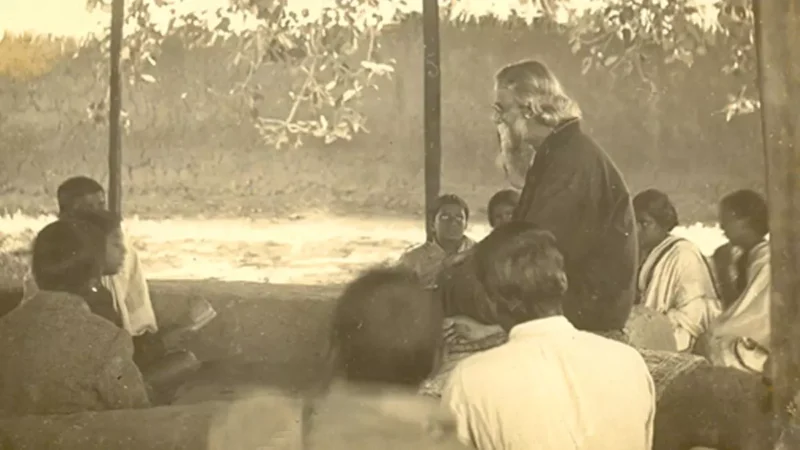
Rabindranath Tagore teaches at Santiniketan in the early 1900s. His educational philosophy was based on the conviction that children learn better when they receive their education in the midst of nature. | Photo Credit: The Hindu Archives
Guha’s book shows what they will look like if they are united, and how that unity can be meaningful for India. Guha calls it “livelihood environmentalism”, as opposed to full-stomach environmentalism. It is an ecosophy practised by and relevant for all groups of people, from Adivasis to Dalits to peasants and the general public. And, as Guha explains, it is, in many ways, uniquely Indian. […]
Developing countries cannot dilute environmental standards giving growth as an excuse [given that] densely populated countries with fragile ecologies need to be even more responsible in how they use nature. […]
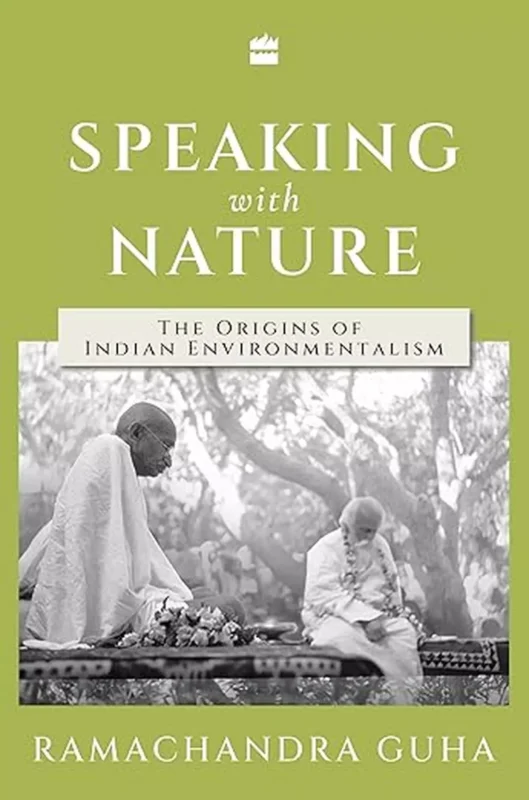
Ramachandra Guha “Speaking with Nature”, a group portrait of 10 nation-shapers who were also the founding figures of environmentalism in India, Fourth Estate India, Rs. 799
“The British established mode of forest governance imposed restrictions on local forest-dwelling communities. In 1860, the Company withdrew all access rights for using the forests (food, fuel, medicine and selling forest products) since the forests and forest-dwelling communities provided refuge to the rebels during the Sepoy Mutiny.” – Bharat Rural Livelihoods Foundation >>
“Tribal population was spread all over India and most of them occupied wild tracts, hilly and forested areas, away from more civilized centers. In 1880 their population was estimated at about seventy million. They had existed for centuries with their own social traditions and beliefs and subsisted on natural resources. They had preserved their near isolation and way of life until the British administration and policies made inroads into their territories.” – Subha Johari in Tribal Dissatisfaction Under Colonial Economy of 19th Century >>
In Marginalised but not Defeated, Tarun Kanti Bose (a seasoned public interest journalist) “documents the hard and difficult struggle to implement the Forest Rights Act, how the oppressed adivasis have united into forest unions, how they are now entering into new thresholds of protracted struggles and victories in a non-violent manner.” | Learn more: https://countercurrents.org/2023/05/book-review-marginalised-but-not-defeated >>
“Tribal men and women mix freely, but with respect for each other [but] caste Hindu society in India is so convinced of its own superiority that it never stops to consider the nature of social organisation among tribal people. In fact it is one of the signs of the ‘educated’ barbarian of today that he cannot appreciate the qualities of people in any way different from himself – in looks or clothes, customs or rituals.” – Guest Column in India Today >>