“My (mobile) browser fails to display embedded media content” | Tips >>
5 Rasi Nato (Big Village)
[Starting from 16:25, continues/ends in Part 2]
Theme
A group of women recall their bygone days:
In our big village we girls and boys were together in pairs. But the pairs of our friendships are no more. Some of us have shut ourselves up indoors. Some of us have chained ourselves and have multiplied like the roots of a banana plant.
Literary translation
Boys and girls in our big village
We used to be in pairs,
Pairs of our friendship is broken.
Some of us have closed ourselves indoor,
Some of us have chained ourselves,
Some of us have multiplied like root of banana plants.
Continue and view Part 2 here >>
View the full video album from the beginning >>
Learn more
- RSV School & Museum of Santal Culture >>
- Print-friendly version (PDF 200 KB) for the above translations and Part 1 >>
Courtesy: Dr. Boro Baski © Ghosaldanga Bishnubati Adibasi Trust –
Dr. Boro Baski works for the community-based organisation Ghosaldanga Adibasi Seva Sangha in West Bengal. The NGO is supported by the German NGO Freundeskreis Ghosaldanga und Bishnubati. He was the first person from his village to go to college as well as the first to earn a PhD (in social work) at Viswa-Bharati. This university was founded by Rabindranath Tagore to foster integrated rural development with respect for cultural diversity. The cooperation he inspired helps local communities to improve agriculture, economical and environmental conditions locally, besides facilitating education and health care based on modern science.
He authored Santali translations of two major works by Rabindranath Tagore, the essay “Vidyasagar-Charit” and the drama Raktakarabi (English “Red Oleanders”), jointly published by the Asiatic Society & Sahitya Akademi (India’s National Academy of Letters) in 2020.
Other posts contributed by Dr. Boro Baski >>
Ghosaldanga Bishnubati Adibasi Trust
Registration under Trust Registration Act 1982
P.O. Sattore, Dist. Birbhum
West Bengal-731 236
India
For inquiries on Santal cultural and educational programs, please contact:
Mob. 094323 57160
Copyright

All contents are being published with an understanding that the respective copyright owners have agreed to the license terms explained in the Creative Commons Attribution-NonCommercial-NoDerivs 3.0 Unported License. This means that no commercial use or modification of such content is permissible without written consent by their respective copyright holders.
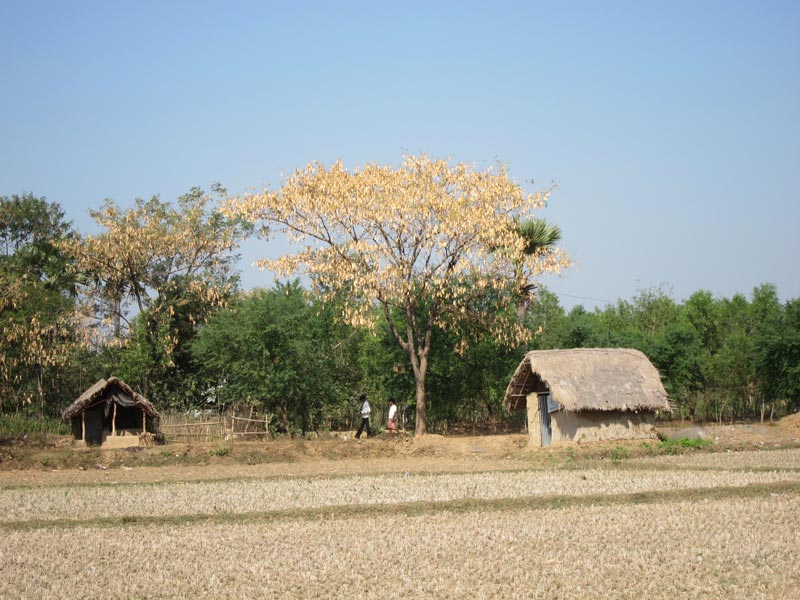
Photo © Ludwig Pesch
Learn more about a wide range of issues
including Education and literacy, Health and nutrition & Ethnobotany >>
UNESCO World Heritage Centre | Backup: PDF-Repository >>
Learn more about the status and spread of Santali in different regions of India: