Abstract 10: The Tribe against Itself: Narratives of Ethnicity and Othering of the Bodos and the Adivasis in Bodoland
Paper presented for “Tribes In Transition-II: Reaffirming Indigenous Identity Through Narrative” (National Conference) – New Delhi
EVY MEHZABEEN
Centre for the Study of Regional Development, School of Social Sciences, Jawaharlal Nehru University, New Delhi
KEYWORDS: IDENTITY, BODOLAND, CULTURE, TERRITORY, VIOLENCE
Tribal narratives of alienation of forest, land and water form one of the core subaltern chapters of Tribal Studies in India. The Bodo movement for grant of autonomy is woven around such demands of safeguard from the exploitation of land and forest resources; it has been an entourage of ideals like autochthony, cultural superiority, ethnic distinction, alienated identity and the contested right to self-determination. However, identity assertion, resource conflict and the demand for grant of autonomy is seldom so modestly unidirectional, as it incorporates questions of power, hegemony and control in a society having multiple tribal communities.
This paper explores indigenous identity in Bodoland, Assam by studying two tribal groups- Bodos and Adivasis; one considered the autochthon for which a Sixth Schedule safeguarding autonomy is granted and the other, considered an ‘outsider’ is continuously subjected to justify their access to the forests and lands of Bodoland and is not even recognised as a ‘Scheduled Tribe’. Such politics of hegemony is centered around the belongingness to a piece of territory where tribal identity is constructed and defined to negotiate the access to forest and land of every tribal community.
The paper focuses on these issues:
- a) How have the Adivasis been selectively excluded from the mainstream tribal politics historically to construct them as the ‘other’ in Bodoland?
- b) The internalisation of violence with respect to identity- ethnicity- territory to create hegemony within the otherwise exploited tribal communities of Assam.
- c) The meaning of territory for tribal communities and the role of territory in ethnic identity assertions assigning the tribes their identity.
The paper is based on an ethnographic survey, with primary data collecting narratives from more than 150 households and 10 focus group discussions from all the four districts of Bodoland- Kokrajhar, Chirang, Baksa and Udalguri.
BIONOTE: Evy Mehzabeen is currently pursuing her PhD at the Centre for the Study of Regional Development, SSS, Jawaharlal Nehru University, New Delhi. She may be contacted at the email ID: evymehzabeen@gmail.com
Source: Book of Abstracts for the ICSSR-sponsored Two-Day National Conference Tribes In Transition-II: Reaffirming Indigenous Identity Through Narrative organised by The Department of English & Outreach Programme Jamia Millia Islamia (New Delhi, 27-28 February 2017)
Courtesy Dr. Ivy Hansdak, Assistant Professor, Department of English, Jamia Millia Islamia University New Delhi (email 4 October 2017)
Bodoland, (also Boroland), officially the Bodoland Territorial Region, is an autonomous region in India. It made up of four districts on the north bank of the Brahmaputra river, by the foothills of Bhutan and Arunachal Pradesh. It is administered by an elected body known as the Bodoland Territorial Council which came into existence under the terms of a peace agreement signed in February 2003 and its autonomy was further extended by an agreement signed in January 2020. The region covers an area of over eight thousand square kilometres and is predominantly inhabited by the Bodo people and other indigenous communities of Assam.
Source: Bodoland Territorial Region – Wikipedia
URL: https://en.wikipedia.org/wiki/Bodoland_Territorial_Region
Date visited: 2 June 2020
Search Worldcat.org for publications by reputed authors (select “Open Content/Open Access” for freely downloadable content)
Search tips
Combine the name of any particular state, language or region with that of any tribal (Adivasi) community.
Ask a question that includes “tribal” or “Adivasi”, for instance: “Adivasi way of life better?” (or “tribal way of life worse?”)
Add keywords of special interest (music, poetry, dance just as health, sacred grove and biodiversity); learn about the rights of Scheduled Tribes such as the “Forest Rights Act” (FRA); and the United Nations “Declaration on the Rights of Indigenous Peoples”, “Universal Declaration of Human Rights”, “women’s rights”, or “children’s right to education”.
Specify any particular issue or news item (biodiversity, bonded labour and human trafficking, climate change, ecology, economic development, ethnobotany, ethnomedicine, global warming, hunter-gatherers in a particular region or state, prevention of rural poverty, water access).
Related posts: Bodoland >>
“The forest was never far away from habitation. For instance, excavations of the settlements at Atranjikhera and Hastinapur, which are not too far from Delhi, have yielded evidence of a large variety of forest trees. The Buddhist Canon states that aside from the village and its outskirts, the rest of the land is jungle. Travelling from one town to another meant going through a forest. Therefore, when in exile, the forest was not a physically distant place, although distant in concept.“ – Romila Thapar (Emeritus Professor of History, Jawaharlal Nehru University) in “Forest dwellers in early India – myths and ecology in historical perspective” | Learn more >>
National Commission for Scheduled Tribes NCST 31 May 2020
The framers of the Constitution took note of the fact that certain communities in the country were suffering from extreme social, educational and economic backwardness arising out of age-old practice of untouchability and certain others on account of this primitive agricultural practices, lack of infrastructure facilities and geographical isolation, and who need special consideration for safeguarding their interests and for their accelerated socio-economic development. These communities were notified as Scheduled Castes and Scheduled Tribes as per provisions contained in Clause 1 of Articles 341 and 342 of the Constitution respectively. […] The National Commission for Scheduled Tribes is vested with the duty to participate and advise in the planning process of socio-economic development of STs, and to evaluate the progress of their development under the Union and any State. | Learn more >>
“Nehru was fascinated by the spontaneity of tribal culture and their capacity of joy and heroism in spite of their appalling poverty, destitution, and ignorance. […] In Nehru’s view, the process of modernization must not be taken as forcing a sudden break with the tribals past but help them build upon it and grow by a natural process of evolution.” – Dr. Chittaranjan Mishra in “Tribal Philosophy and Pandit Nehru” (Odisha Review, November 2017) | Learn more >>
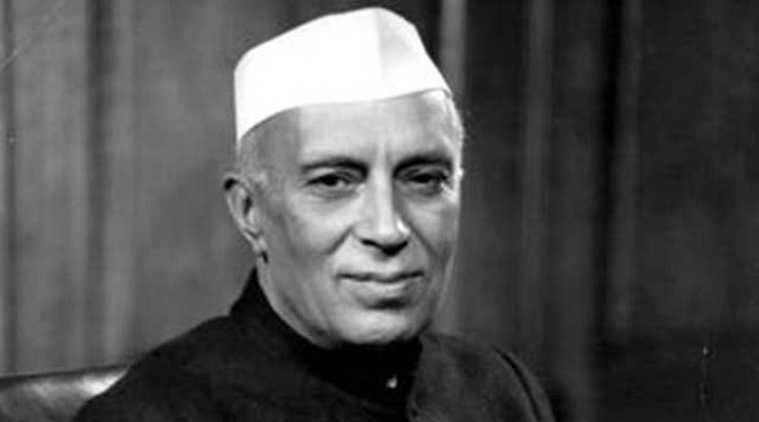
Photo © Indian Express
The current predicament of Adivasis
The current predicament of a vast majority of Adivasis is one of sharp erosion in their livelihoods and their life-worlds. Despite assurances of autonomy (the Fifth and Sixth Schedules, the Panchsheel, PESA 1996, Forests Rights Act 2006) and attempts of focused addressal of Adivasi and Tribal issues (including the establishment of an umbrella outfit, the National Council for Tribal Welfare), there are counter structures and programmes that defy the enabling of genuinely decentralised autonomy and the guarantee of democratic participation. For instance, the recently approved ‘Integrated Action Plan’ in Tribal areas overrides the representation of Adivasis in local issues in decision-making processes and arrogates powers of governance to bureaucrats and specialists.
In addition to such contradictory and conflicting measures, the forces of fast-expanding capital, along with the top-down deployment of development models have resulted in large scale displacement in Adivasi regions. Global capital’s access to mineral wealth has also intensified violence of various forms and degrees.
Source: Ch. 2, “Context and Conditions of Adivasi Life Worlds” (p. 5) in THE EDUCATION QUESTION’ FROM THE PERSPECTIVE OF ADIVASIS: CONDITIONS, POLICIES AND STRUCTURES by National Institute of Advanced Studies (Bangalore), March 2012 & UNICEF | Backup (PDF, 4 MB)
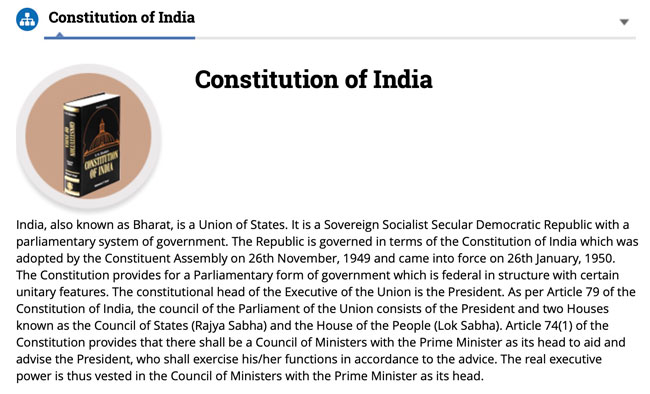
“India, also known as Bharat, is a Union of States. It is a Sovereign Socialist Secular Democratic Republic with a parliamentary system of government.” – Constitution of India
Source: National Portal of India
Learn more about the Indian Constitution and decisions by India’s Supreme Court >>
Reports in the Indian press | List of periodicals included in this search >>
Search tips
Combine the name of any particular state, language or region with that of any tribal (Adivasi) community.
Add keywords of special interest (music, poetry, dance just as health, sacred grove and biodiversity); learn about the rights of Scheduled Tribes such as the “Forest Rights Act” (FRA); and the United Nations “Declaration on the Rights of Indigenous Peoples”, “Universal Declaration of Human Rights”, “women’s rights”, or “children’s right to education”.
Ask a question that includes “tribal” or “Adivasi”, for instance: “Adivasi way of life better?” (or “tribal way of life worse?”)
Specify any particular issue or news item (biodiversity, bonded labour and human trafficking, climate change, ecology, economic development, ethnobotany, ethnomedicine, global warming, hunter-gatherers in a particular region or state, prevention of rural poverty, water access).
For official figures include “scheduled tribe ST” along with a union state or region: e.g. “Chhattisgarh ST community”, “Himalayan tribe”, “Scheduled tribe Tamil Nadu census”, “ST Kerala census”, “Particularly Vulnerable Tribal Group Jharkhand”, “PVTG Rajasthan”, “Adivasi ST Kerala”, “Adibasi ST West Bengal” etc.
SafeSearch browser tips
If your (mobile) browser fails to display “embedded” media contents, Google maps and SafeSearch windows
Try another browser like Firefox, Chrome or Safari available on your device
Ensure your favourite browser is up to date
Close your present browser
Check your browser and mobile (gsm) settings:
e.g. permission for video or JavaScript
(seen under Preferences >Security >Enable JavaSript)
Restart your computer (smartphone, tablet)
Reconnect to your wifi network or connect to a different one
On some iPhone models the following helps:
>Settings >Safari >scroll down to:
SETTING FOR WEBSITES
Enable “Request Desktop Website” (All Websites) temporarily
Return to the map-post in Safari and “Reload”
Return to >Settings and disable “Request Desktop Website” again
Return to the post in Safari and “Reload”which should now display “embedded” contents as intended (with the convenience of browsing the mobile version on a small screen)
Note: similar solutions may also work with other mobile operating systems.
See also
Accordweb.in | Accord | Articles by co-founder Mari Marcel Thekaekara | Shola Trust
Atree.org | Ashoka Trust for Research in Ecology & the Environment (posts)
Climate change | Audio | The Climate Question (BBC Podcast)
Environmental history and what makes for a civilization – Romila Thapar
Equations blog (Equitable Tourism Options)
Information provided by Indian government agencies and other organizations (FAQ)
Nature and wildlife | Crocodile | Elephant | Tiger | Mangrove forest | Trees
PARI’s tales from tiger territory | People’s Archive of Rural India (PARI)
United Nations on climate change
What is the Forest Rights Act about?
Who is a forest dweller under this law, and who gets rights?
Research: explore PhD theses from all over India
Shodhganga (Open Access)
Tips for using interactive maps
Toggle to normal view (from reader view) should the interactive map not be displayed by your tablet, smartphone or pc browser
For details and hyperlinks click on the rectangular button (left on the map’s header)
Scroll and click on one of the markers for information of special interest
Explore India’s tribal cultural heritage with the help of another interactive map >>